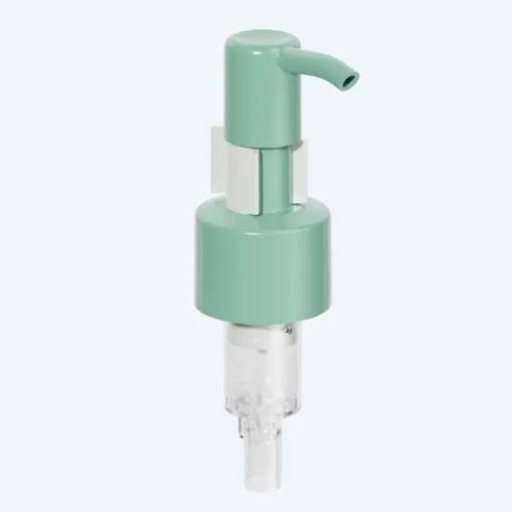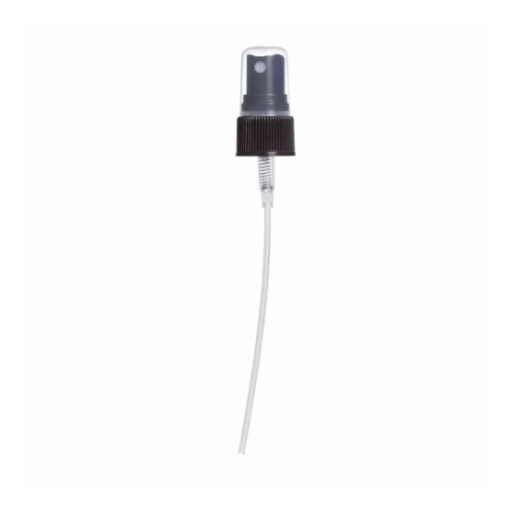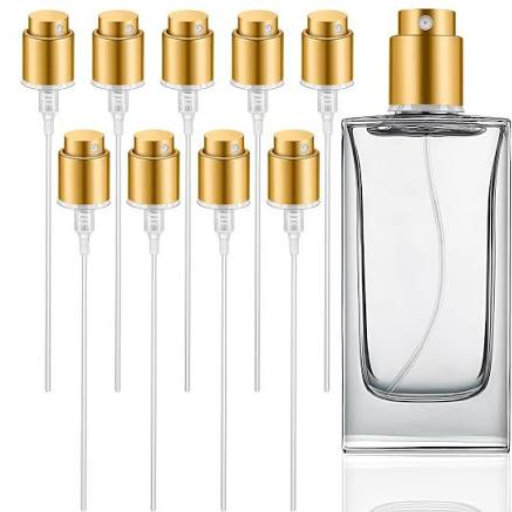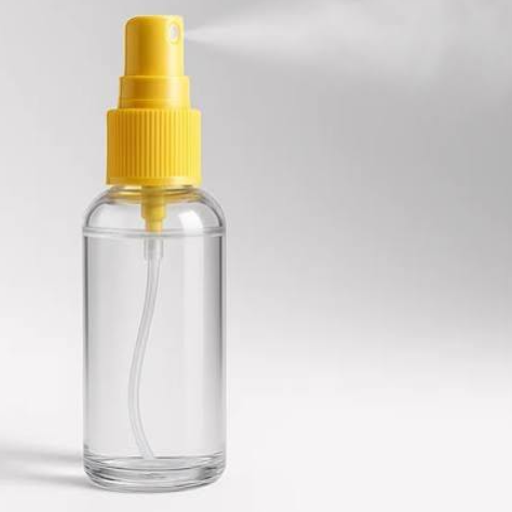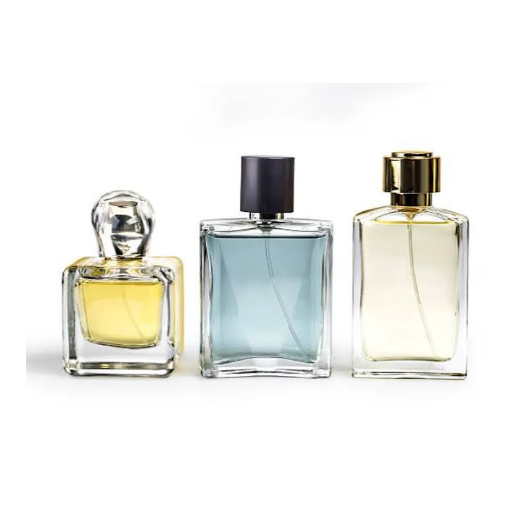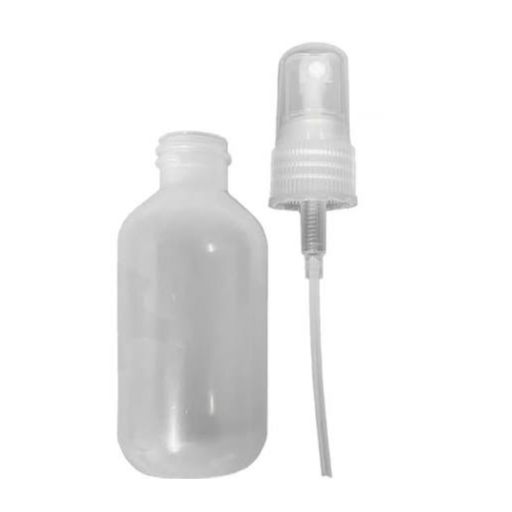
A fine mist sprayer is a finger pump that turns a thin liquid into a soft, even cloud of droplets. The right one comes down to four numbers: neck finish, dose per press, gasket material and dip tube length. Get those right and the bottle feels effortless in the hand. Get one wrong and it leaks, sputters, or strands the last few millilitres at the bottom.
Most buyers start with a bottle they already love and work backward, which is the correct instinct. It also hides the common trap. Two bottles can look identical on a shelf and still take different sprayers, because the thread on the neck is measured to a fraction of a millimetre.
This guide covers the specification layer: how a fine mist sprayer works, which neck finishes exist, and how much each press delivers. It also covers what your formula can push through an orifice, and what belongs in an RFQ. If you’re still deciding whether this is the right component at all, start with and return here for the numbers. It’s written for fragrance and personal care brands, contract fillers and buyers who need to specify a part rather than browse a catalogue.
Key Takeaways
- A fine mist sprayer is specified neck first, then dose, then gasket, because colour and decoration can’t fix a bad fit.
- 18/410, 20/410, 24/410 and 28/410 are the common thread sizes, and a 410 sprayer will not seal a 415 bottle sold as the same 24 mm.
- One press delivers about 0.10 ml for a fine fragrance and 0.30 ml or more for a body mist; HCC Packaging lists 0.12, 0.18 and 0.20 ml options.
- Published supplier MOQ bands start at 5,000 to 20,000 pieces for standard specs and reach 100,000 for custom moulds, while our own MOQ is quoted per project.
The Six Specs That Decide Everything
Six choices account for almost every failed sprayer order. Make them in this order and a sample run becomes a formality.
| Spec | What you decide | Typical options | What goes wrong if it’s wrong |
|---|---|---|---|
| Neck finish | The thread or ferrule that attaches to the bottle | 18/410, 20/410, 24/410, 28/410; crimp ferrules at 13, 15, 18 and 20 mm | The sprayer won’t seat, or it seats and leaks under pressure |
| Output per stroke | The dose delivered by one full press | 0.10 to 0.30 ml for cosmetic use | The bottle runs out early, or each press leaves the skin wet |
| Gasket material | The seal between closure and glass | EPDM, silicone, NBR, PE foam | The rubber swells, hardens or leaves residue in the formula |
| Dip tube length | The reach from pump to bottle base | Cut to bottle height minus 1 to 2 mm | Product is stranded, or the tube curls and blocks the inlet |
| Actuator and insert | Spray pattern and finger feel | Fine, medium or wide mist; 0.15 to 0.28 mm orifice | The mist is a soaking blast, or the pump feels stiff |
| Closure style | How the pump attaches | Screw, crimp, continuous spray, trigger | The bottle can’t be refilled, or it can be opened by anyone |
The neck finish is the gate. Until it’s confirmed, no other spec matters, because a beautiful 0.12 ml pump that won’t thread onto your bottle is scrap. CosmeticPump lists orifice diameters of 0.15 to 0.28 mm on face and toner sprayers, and that small range separates a facial mist from a surface soak.
Send us your bottle drawing, your target dose and a specification sheet for the formula, and we’ll return a matched set with samples to test. before you commit to a production run.
How a Fine Mist Sprayer Works
A fine mist sprayer is mechanical. There’s no propellant, no gas cartridge and no battery. One press of the actuator compresses a spring and drives a piston down a small chamber. That stroke pulls liquid up the dip tube and forces it through a narrow orifice, where the pressure drop breaks the stream into droplets.
The droplet size does most of the work. CosmeticPump quotes a DV50 of 25 to 90 µm for cosmetic fine mist sprayers, depending on the orifice, meaning about half the droplets fall below that diameter. The finer the cloud, the lighter the application and the more even the coverage on skin.
The Seven Components
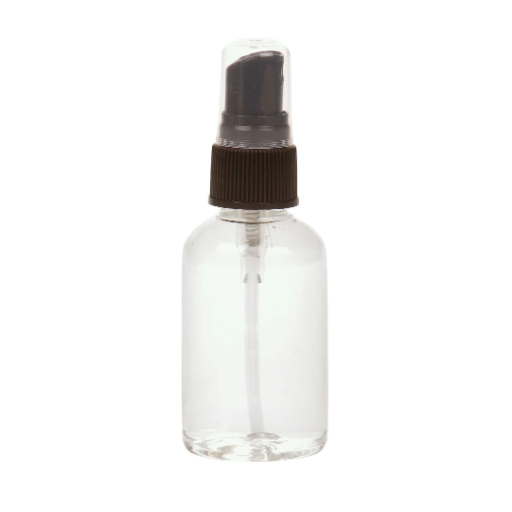
Every fine mist sprayer, from a 5 ml sample to a 500 ml body mist, contains the same seven parts.
- Actuator: the button you press. It holds the insert and sets where the spray lands.
- Insert or nozzle: the precision part with swirl channels that break the liquid into droplets.
- Pump mechanism: the piston, spring, housing and seal that create suction and pressure.
- Closure: the threaded ring or crimp ferrule that joins the pump to the bottle.
- Gasket: the compressible seal that stops liquid escaping at the join.
- Dip tube: the tube that reaches the bottom of the bottle and draws product up.
- Overcap or dust cap: the cover that protects the nozzle and prevents accidental presses.
The pump is the only part that works the formula under pressure, so it’s also the part that decides cycle life. Supplier specifications commonly quote 10,000 actuations or more, a useful benchmark when two quotes look identical on paper.
One Press, One Dose
Output varies more than most buyers expect. Berlin Packaging quotes 0.16 to 1.5 ml across its sprayer family, with high-output models reaching 4 ml. HCC Packaging lists 0.12, 0.18 and 0.20 ml as its cosmetic fine mist options. Our own fragrance sprays sit at the low end, around 0.05 to 0.12 ml per press, because a perfume dose is measured in fractions of a millilitre.
The dose you need follows the product, not the pump’s maximum. A face toner wants a light, repeatable press. A sun care spray wants volume. Choosing a 0.30 ml pump for a luxury fragrance wastes concentrate on every application.
Fit: Neck Finishes and Dip Tubes
Reading a Neck Finish
A fine mist sprayer neck finish such as 24/410 has two parts. The first number is the neck diameter in millimetres. The three digits after the slash describe the thread profile. The 410 profile is the most common continuous thread in cosmetics and personal care, which is why it appears on so many stock bottles.
Four finishes cover most of the market:
- 18/410 suits travel sizes, sample vials and pocket perfumes. It’s small, so there’s limited room for a wide actuator.
- 20/410 fits compact toners, essential oil blends and small skincare bottles. It’s the common choice for a 20/410 fine mist sprayer on a travel-friendly pack.
- 24/410 is the workhorse. Facial toners, setting sprays, body mists and hair mists mostly use it, and it leaves room for a comfortable finger pad.
- 28/410 carries larger packs and high-output products such as home fragrance and full-body mists.
The full dimension table, including the less common sizes, lives on the . Keep it open while you read a bottle drawing.
The 410 vs 415 Trap
A 24/410 sprayer will not seal a 24/415 bottle. The diameter matches, so the sprayer starts to thread on, and that’s what makes the error expensive. The thread pitch differs, so the closure doesn’t reach a proper seal. On a fill line that failure shows up as a spinning cap or a slow leak, and in the field it shows up as a complaint.
Confirm the fine mist sprayer neck size from the drawing or the mould, not from the “24 mm” in the product title. If you can’t confirm it, send the bottle for a fit check before ordering. Our walks through the measurements.
When Fragrance Uses a Crimp Neck
Perfume bottles often skip threads altogether. A crimp sprayer is sealed onto a glass neck with an aluminium ferrule, and our fragrance pumps are built for FEA 13, 15, 18 and 20 mm necks. Crimping gives a tighter seal and clear tamper evidence, and it stops the consumer from opening the bottle. The trade-off is that the pump can’t be replaced or refilled at home.
The mechanics of both closure families, and the reason perfume chose crimp in the first place, are covered on the .
Dip Tube Length
The dip tube is the fine mist sprayer spec buyers forget, and it causes the quietest failures. Measure from the neck opening to the inside base of the bottle, then cut the tube to finish 1 to 2 mm above the bottom. A tube that touches the base can curl and block its own inlet. A tube that stops 5 mm short strands product the customer paid for.
Tube bore matters too. A wider bore draws a thicker liquid more easily, while a narrow bore suits thin formulas and small bottles. If your formula is near the viscosity ceiling, ask for both bore options on the sample request.
Output Per Stroke and Formula Compatibility
Matching the Dose to the Product
| Product type | Typical dose per press | Why |
|---|---|---|
| Fine fragrance | 0.05 to 0.12 ml | Concentrated formula, precise placement on skin |
| Face toner or setting mist | 0.12 to 0.15 ml | Light, repeatable coverage across the face |
| Hair mist or leave-in spray | 0.18 to 0.25 ml | Needs to reach through hair without soaking it |
| Body mist or sun care | 0.25 to 0.30 ml and up | Larger surface area, faster application |
These are application bands, not a single manufacturer’s catalogue. Published figures vary: HCC Packaging lists 0.12, 0.18 and 0.20 ml; Berlin Packaging goes from 0.16 to 1.5 ml across its range, with high-output sprayers above that.
The Spray Count Maths
Dose decides how long a bottle lasts, and buyers notice. A 100 ml body mist at 0.20 ml per press gives about 500 applications, while the same bottle at 0.30 ml gives about 333. A 50 ml toner at 0.12 ml gives roughly 417 presses. If your label promises a number of uses, check it against the fine mist sprayer, not the fill volume alone.
Gaskets and Formula Chemistry
The gasket is a small ring that decides whether a formula stays inside the bottle for a year. Three materials cover most applications, and each suits a different chemistry.
| Gasket | Works well with | Check before specifying |
|---|---|---|
| EPDM | Water-based and many alcohol-based formulas; the usual default for cosmetic mists | Hydrocarbon oils can swell it |
| NBR | Oils and many non-polar ingredients | Strong polar solvents can degrade it |
| Silicone | Wide temperature range; formulas that harden other rubbers | Some solvent blends can swell it |
Those are starting points, not guarantees. Heavy essential oil loads, low pH or solvent blends can attack a gasket that looks fine on a datasheet. Test the final formula, not water, and ask for the gasket material declaration before the pilot run.
What a Fine Mist Sprayer Won’t Dispense
A fine mist spray bottle is only as good as the formula inside it, and sprayers are built for low-viscosity liquids. If the formula pours like water or slightly thicker, the pump will atomise it. If it doesn’t pour, because it’s a gel, a cream or a serum with suspended particles, the orifice blocks or the spray turns into a sputter.
Three formula types cause most of the trouble:
- Gels and thick serums can’t pass the orifice at a useful rate. A lotion pump is the correct component, and the explains where the boundary sits.
- Suspensions and pigments settle and bridge across the inlet. Shake-before-use formulas need a wider bore and a tested insert, not a stock nozzle.
- High-alcohol or solvent-heavy blends may attack the wrong gasket. The spray itself works; the seal fails later.
Test the actual formula at the intended dilution. A sample that sprays water perfectly says nothing about a toner with 20% alcohol and a fragrance oil load.
Fine Mist Sprayer Formats: Crimp, Screw, Continuous and Trigger
Neck finishes describe screw-on sprayers. A fine mist sprayer can also be crimped, continuous or trigger-operated, and the format you need depends on how the product is filled and used.
Crimp and Screw Sprayers
Crimp sprayers are sealed onto the glass and can’t be refilled. They suit fine fragrance, where the seal and the tamper evidence matter more than refillability.
Screw sprayers thread onto a standard neck and can be removed, which suits travel sizes, refill programmes and any product the customer might top up. Our covers both, with crimp-on and screw-on lines. The older word for these devices is atomizer, and the sorts out which one a bottle actually takes.
Continuous Spray Bottles
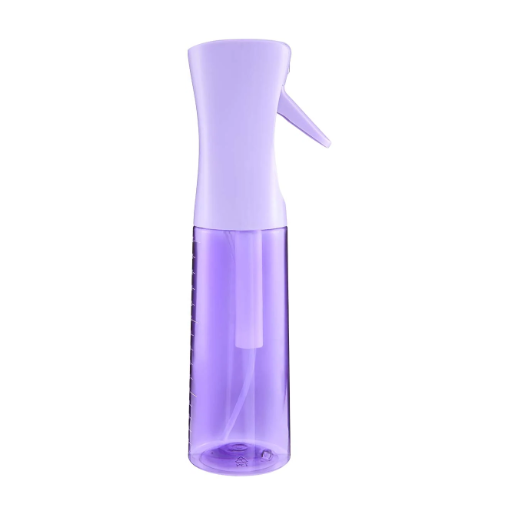
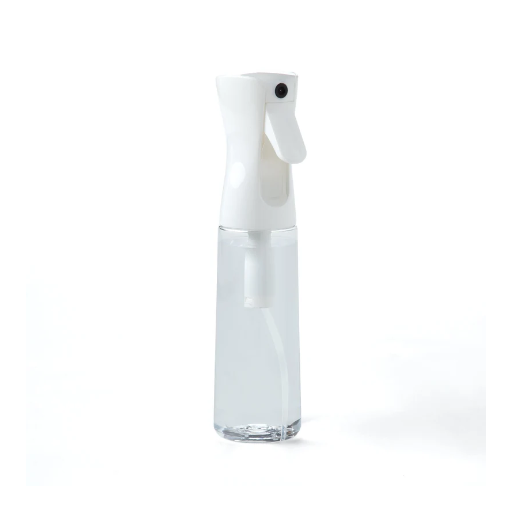
A continuous sprayer stores pressure in the bottle so one hold delivers a steady stream instead of one burst per press. It’s the format behind many salon-style hair mists and some household products. The mechanics and the filling requirements are on the .
Trigger Sprayers
Trigger sprayers move far more liquid per stroke, often 0.8 to 1.5 ml, in much larger droplets. They suit cleaning products, garden care and viscous liquids that a fine mist nozzle would clog. If your product needs coverage rather than a soft cloud, compare the two on the .
Customization, Decoration and Fine Mist Sprayer MOQ
What Can Be Customized
Once fit and dose are settled, customization is where a stock fine mist sprayer becomes a brand asset. The usual options are colour matching on the actuator and closure, matte or gloss finishes, metal overshells and collars, and printing or hot stamping on the actuator. For fragrance, a metal collar in gold, silver or gunmetal adds weight and perceived value to the whole pack.
Tooling is the dividing line. Standard actuators come from existing moulds, so customization stays in colour and decoration. A bespoke actuator shape needs a new mould, which changes cost and minimum order.
MOQ Bands and What They Mean
Published supplier figures map the market. HCC Packaging quotes 10,000 pieces per SKU for a standard specification, 20,000 for a custom Pantone colour and 100,000 for a custom mould. CosmeticPump quotes a 5,000 to 20,000 piece range for Chinese suppliers. Those numbers are industry bands, not our terms.
Our fine mist sprayer MOQ is quoted per project, because it depends on the component, the decoration and whether a new mould is involved. Tell us the bottle, the dose and the finish you want, and we’ll confirm the minimum with the quote.
Price and Lead Time
Price for a fine mist sprayer is driven by four things:
- Pump and closure grade: a metal collar or premium actuator lifts the unit cost.
- Decoration steps: each print or hot-stamp run adds a process.
- Tooling: a new mould is amortized across the order, so volume matters.
- Freight: bottles and pumps ship as separate cartons until they’re kitted.
A two-colour print on one actuator costs more than a stock colour, and a custom mould costs more than both. The breaks down how each factor moves the unit price.
On lead time, HCC Packaging quotes 20 to 25 days for stock specifications. Our production runs take 4 to 6 weeks once an order is confirmed.
Testing, Quality Control and Buying the Bottle as a Set
The Four Tests That Matter
A fine mist sprayer that passes a visual check can still fail in the customer’s hand. Four tests catch most of it.
- Dose uniformity: weigh ten presses across several samples and confirm the output sits inside the agreed tolerance.
- Spray pattern: check for a hollow cone, a heavy centre or spitting, all of which signal a blocked or worn insert.
- Leak and pressure: invert the filled bottle and apply vacuum or pressure to simulate transport and handling.
- Transport simulation: run packed cartons through a distribution test.
ASTM D4169 is the usual reference for shipping container and system performance testing.
AQL and What the Report Should Contain
CosmeticPump cites AQL 1.5 at inspection Level II under ANSI/ASQ Z1.4, which is a common sampling standard for cosmetic components. AQL, or acceptable quality limit, sets the defect rate a batch is allowed before it’s rejected. Ask for the inspection report with the shipment and check that it names the lot size, the sample size, the defects found and the standard applied. A report that says only “passed” tells you nothing.
Buying the Bottle and Sprayer Together
The most expensive mistake in this category isn’t a bad pump. It’s a good pump that was never matched to the bottle. A buyer can confirm a 24/410 finish on the drawing, order 20,000 pumps, then discover the replacement glass lands with a 24/415 neck.
Ordering bottle and sprayer as a set removes that gap, because the fit is checked before either goes into production. We produce both, so a matched set passes one quality gate and ships together. If you’re sourcing them separately, order a pre-production sample of both and test the fit before the bulk order.
Our facility covers 6,000 m² with CNC equipment and automated assembly lines, and sample requests go through the same contact channel as quotes. and we’ll confirm the neck, the dose and the closure in one step.
If a sprayer has already failed in the field, the covers the usual causes before you consider a replacement run.
FAQ
What is a fine mist sprayer? A fine mist sprayer is a mechanical finger pump that turns a low-viscosity liquid into a soft cloud of droplets, usually 25 to 90 µm in diameter. It has seven parts, including an actuator, an insert, a pump and a dip tube, and it needs no propellant gas.
What size fine mist sprayer do I need? Match the fine mist sprayer to the neck finish first. 18/410 and 20/410 suit travel and small bottles, 24/410 suits toners and body mists, and 28/410 suits larger or high-output packs. Then choose the dose: roughly 0.12 ml for a face mist and 0.20 ml or more for a body mist.
How much does a fine mist sprayer dispense per spray? Cosmetic fine mist sprayers usually deliver 0.10 to 0.30 ml per press. HCC Packaging lists 0.12, 0.18 and 0.20 ml options, while Berlin Packaging quotes 0.16 to 1.5 ml across its broader sprayer range. Fine fragrance pumps sit at the low end.
What is the difference between 24/410 and 24/415? The diameter is the same at 24 mm, but the thread profile differs. A 24/410 sprayer will start to thread onto a 24/415 bottle and then fail to seal, which shows up as a spinning cap or a leak. Check the finish on the bottle drawing or mould.
What is the minimum order quantity for a fine mist sprayer? Published industry bands run from 5,000 to 20,000 pieces for standard specifications and up to 100,000 for a custom mould. Our MOQ depends on the component, the decoration and whether new tooling is needed, so it’s quoted per project.
Why is my fine mist sprayer not working? The usual causes are a blocked orifice, a dip tube that doesn’t reach the liquid, a worn pump or a formula too thick for the nozzle. Prime the pump, check the tube length and clean the insert. If the pump has lost pressure, replace the assembly rather than the insert.
Conclusion
A fine mist sprayer is a small component with four decisions behind it. The neck finish decides whether it fits, and the dose decides how the product feels in use. The gasket decides whether it survives the formula, and the dip tube decides whether the customer gets everything they paid for.
Everything else, from colour to metal collars to printing, sits on top of those four. Specify in that order and the pack works; start with a pretty actuator and you inherit a returns problem.
Use the six-spec table to specify your fine mist sprayer. Confirm the neck, set the dose, name the gasket and measure the dip tube. Then ask for samples and test them with the real formula.
Ready to move from specifications to a quote? . We’ll confirm the closure, output and actuator options, and include samples so the decision rests on a tested component.