Perfume bottles use one of two neck systems. The FEA crimp family, usually FEA 15 for anything between 15 ml and 50 ml, where a metal collar is crimped permanently over a bead on the glass. Or a screw finish such as Screw 15, where the pump twists on and can be replaced. Get the number wrong and you scrap a production run.
Fragrance is the only packaging category where the pump is chosen before the bottle. A spray pump arrives from the dispensing factory as a complete assembly, with its collar, dip tube and overcap, and the glass has to present exactly the neck that assembly clamps onto. Most buyers do the reverse: shortlist a bottle for its shape, then hunt for a pump. In fragrance, the fit decides the shape.
Key Takeaways
- FEA15 is the fragrance default for flacons from about 15 ml to 50 ml. FEA13 covers miniatures; FEA18 or FEA20 take over above roughly 75 ml.
- The FEA number is a collar diameter in millimetres, not a bottle diameter. A 15 mm collar fits a bottle whose bead is machined to the 15 mm drawing.
- Crimp necks are permanent and need a press. Screw finishes such as Screw 15 and 18/415 are tool-free and refillable.
- 24/410 and 28/400 are lotion, soap and household finishes. They are not fragrance necks, whatever a listing says.
- A crimp has one attempt. Bead diameter, bead height and bore must all be on the drawing before you approve tooling.
Need a quote before you read further? Send us your capacity and neck finish and we will come back with a matched bottle, pump, collar and cap set.
What Does FEA 15 Mean on a Perfume Bottle?
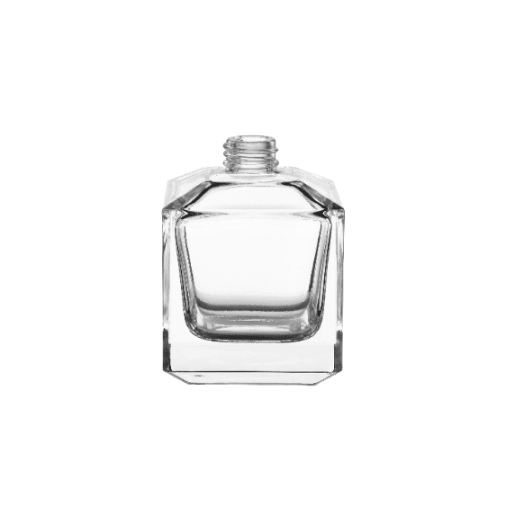
FEA 15 is a 15 mm crimp neck. The glass carries a plain neck with a bead just below the sealing surface, and the pump’s metal or plastic collar slides over that bead. A crimping tool then closes the collar permanently. FEA names the collar family, and 13, 15, 17, 18 and 20 mm are the sizes in common supply.
The number isn’t the opening diameter, the capacity or a thread count. It describes the collar your pump assembly ships with, machined to clamp a specific bead profile.
Most confusion starts here. A buyer measures inside the neck, expects 15 mm, and finds a bore several millimetres narrower. The bore is separate, and it’s what your filling nozzle passes through. Both matter, and neither is the number in the name.
The bead is what the collar grips
Look at the top of a fragrance bottle and you’ll see a raised ring below the lip. That’s the bead: the collar wraps around it and the crimp folds the metal underneath.
The seal is made at the flat land on top of the neck, where an elastomer gasket in the pump is compressed. The bead doesn’t seal anything. It only anchors the collar so the pump can’t be pulled off.
That distinction explains most crimp failures. An oversize bead splits the collar as it closes. An undersize one leaves the pump loose, turning in the customer’s hand while the gasket still looks fine.
Perfume Bottle Neck Size Chart
Two bottles with the same body diameter can take different collars, because format drives the collar: a larger bottle carries a heavier pump. So when a supplier asks your perfume bottle neck size, they want the collar and the drawing, not the capacity. For capacity, see choosing a perfume bottle size.
Here is the whole family. Use the diameter to identify what you have, then confirm the bead or thread profile against the drawing.
| Finish | Diameter | Type | Typical format | Closure it takes |
|---|---|---|---|---|
| FEA 13 | 13 mm | Crimp | Miniature and travel spray, roughly 5 to 15 ml | Crimp-on pump, 13 mm collar |
| FEA 15 | 15 mm | Crimp | 15 to 50 ml, the mainstream flacon | Crimp-on pump, 15 mm collar |
| FEA 17 | 17 mm | Crimp | Less common mid-size; confirm pump supply first | Crimp-on pump, 17 mm collar |
| FEA 18 | 18 mm | Crimp | From about 75 ml upward | Crimp-on pump, 18 mm collar |
| FEA 20 | 20 mm | Crimp | Large-format and prestige bottles | Crimp-on pump, 20 mm collar |
| Screw 15 | 15 mm | Screw, two turns | 30 to 100 ml, refillable ranges | Screw-on perfume pump |
| 18/415 | 18 mm | Screw, two turns | Larger screw formats and oil-adjacent lines | Screw pump or dropper collar |
Two naming notes before you take this to a supplier.
First, the 15 mm screw neck has two names in circulation. Pump makers usually list it as Screw 15, while some bottle suppliers write 15/415, because 415 is a two-turn thread series and 15 is the diameter. They describe the same neck. Ask your pump supplier which name their tooling uses, because the drawing settles it, not the label.
Second, stock pump availability narrows quickly outside FEA 13 and FEA 15, so confirm the pump before you commit to a 17 mm bottle. If you build a range, standardising on FEA 15 cuts the number of pump SKUs you hold.
The screw finishes that are not fragrance
Most neck-finish articles describe 18/410, 20/410 and 24/410, because those are the everyday cosmetic finishes. They are worth knowing, so you can spot them on a quotation and rule them out. They are not perfume bottle neck sizes.
| Finish | T (mm) | E (mm) | H (mm) | Turns | What it belongs to |
|---|---|---|---|---|---|
| 18/410 | 17.68 ±0.20 | 15.54 | 13.28 | 1.5 | Droppers, serums |
| 20/410 | 19.69 ±0.20 | 17.55 | 14.07 | 1.5 | Toners, face mists |
| 24/410 | 23.67 ±0.20 | 21.54 | 16.41 | 1.5 | Lotion pumps, soap |
| 28/410 | 27.38 ±0.25 | 24.99 | 17.73 | 1.5 | Large lotion, household |
| 20/415 | 19.69 ±0.20 | 17.55 | 18.85 | 2 | Tall dropper assemblies |
| 24/415 | 23.67 ±0.20 | 21.54 | 24.31 | 2 | Tall, high-engagement necks |
| 28/415 | 27.38 ±0.25 | 24.99 | 27.48 | 2 | Tall household and bulk |
T is the diameter across the threads, E at the thread root, H the neck height. Those are the published SPI neck finish specifications for plastic closures.
None of these rows is a fragrance neck. A 24/410 bottle can’t accept a standard fragrance pump, and adapting it creates leak and fit problems that surface after filling. If a supplier quotes you 24/410 for fine fragrance, they’re selling you a bottle from a different category. The 410 and 415 series are covered further in our guide to 410 and 415 thread series.
Crimp vs Screw: The Decision That Locks Everything Else
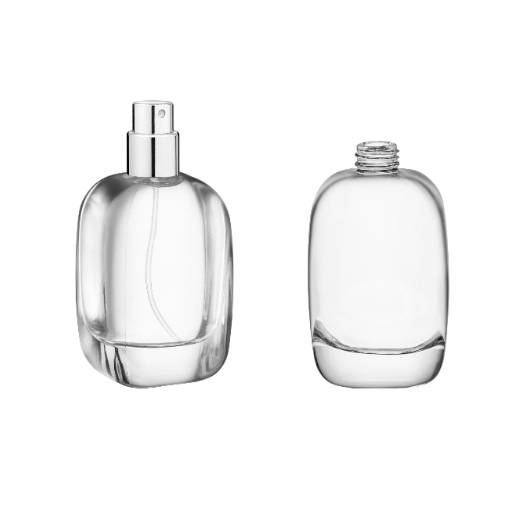
Every fragrance bottle is crimp or screw. Make that call deliberately, not by inheriting whichever bottle your designer liked.
FEA 15 crimp: the mainstream retail standard
Crimp is what most commercial fragrance uses. The pump goes on, the collar folds closed, and the assembly can’t be removed without damaging it.
The advantages are practical. It’s the most secure seal available, it can’t loosen in transit, it’s unmistakably tamper-evident, and the tooling is universal. The costs are equally practical. You need a crimping press on the line, and the customer can’t refill the bottle.
Screw 15 and 18/415: tool-free and refillable
Screw finishes let a pump thread on by hand or on a simple capping head. No press, no crimp tooling, faster line setup, and the customer can replace the pump. That suits indie brands, short runs where a crimping setup is hard to justify, and ranges built around refill.
The trade-off is engagement. A crimp grips a bead with a formed metal fold. A screw thread relies on turns of contact and a liner or plug. It’s secure when specified correctly, and more sensitive to a mismatched neck.
Screw versions of the perfume necks are covered by the Cetie GME data sheets, and your pump supplier will tell you which sheet its tooling runs before you order glass.
When a supplier says “Screw 15” and your drawing says “15/415”
This is the most common way a screw-neck order goes wrong. A bottle drawing is annotated 15/415. The pump supplier quotes against “Screw 15”. Both are correct, and both parties believe they have agreed.
Nobody compared the thread profile on the two drawings. The pump threads on, but only part way, and the assembly fails a leak test at the filling line. The fix is a revised glass drawing, not a revised pump. A single shared drawing prevents this.
The Four Figures Your Pump Supplier Asks For
When you send a photo of a bottle, you get a guess. When you send these four numbers, you get a quotation you can hold someone to.
Bead diameter and bead height
These decide whether the crimp grips. The bead has to be wide enough for the collar to fold under, and tall enough to give the crimp something to bite.
Neither figure is in the collar name. Two bottles from two factories can both be FEA 15 and still differ enough to matter.
Bore
The bore is the internal opening. Your filling nozzle passes through it, and your dip tube hangs in it. Too narrow and filling slows down; too wide and the seal rests entirely on the gasket.
T, E, H and S on the drawing
Bottle drawings use a fixed set of letters: T across the threads, E at the thread root, H the finish height, and S the distance from the sealing surface down to the top of the first thread.
On a crimp neck there’s no thread, so the equivalent figures are the bead and the land. Never accept a drawing that shows only one dimension.
Tolerance, and why glass and plastic drawings disagree
Every dimension has a tolerance, and the tolerance is where fit problems live. Published SPI figures for plastic closures commonly allow ±0.20 mm on T and ±0.25 mm on the larger 28 mm finish. Glass is a different process with wider variation, and published glass neck finish figures for the same nominal finishes sit a few hundredths of a millimetre under the plastic chart.
So a cap made to the plastic figures can be slightly loose on a glass bottle made to the glass figures, even when both are “24/410”. Your quotation must state which drawing the bottle is made to. For flaconnage glass, ISO 12818 is the tolerance standard commonly referenced in Europe.
How to Measure a Perfume Bottle Neck
You can check a perfume bottle neck size in two minutes with calipers. It won’t replace a drawing, but it will stop you ordering the wrong family.
Measure across the threads with calipers
For a screw neck, measure the outside diameter across the threads, not across the opening. Take two readings at 90 degrees to each other and average them, because a blown neck is rarely perfectly round. For a crimp neck, measure the outside diameter of the bead. That number should land on 13, 15, 17, 18 or 20 mm.
Count the thread turns
Turn count separates the series: 400 carries one full turn, 410 one and a half, and 415 two. That’s why diameter alone never settles compatibility. A 24/400 cap and a 24/410 cap share a diameter and don’t interchange.
Read the bead, not the opening
The most common mistake is putting calipers inside the neck. That gives you the bore, which is useful, but it won’t tell you the finish. Measure outside, at the widest structural feature: the bead on a crimp neck, the threads on a screw neck.
Then ask for the bottle drawing and the pump drawing together, and compare them before approving samples. It takes ten minutes and it’s the cheapest insurance in the process.
Why a Correct Perfume Bottle Neck Still Fails
Even a correctly named neck can fail if the drawing and the tooling disagree.
| Symptom | Likely cause | What to do |
|---|---|---|
| Collar splits during crimping | Bead oversize, or glass at the top of tolerance | Check bead diameter against the pump maker’s drawing |
| Pump turns freely after crimping | Bead undersize, or bead height too short for the crimp to bite | Measure bead height, not just diameter |
| Leak at the collar after transit | Gasket not compressed, often because the land is uneven or the neck is short | Inspect the sealing land; check H against the drawing |
| Pump bottoms out and will not seat | Neck too short for the pump’s plug depth | Compare H on both drawings |
| Cross-threading on a screw finish | Thread series mismatch, or the first turn damaged in packing | Confirm the series matches; inspect threads on arrival |
| Filling nozzle will not fit | Bore undersize for the line speed | Specify bore on the purchase order, not just collar size |
Two lessons run through the table. The crimp has one attempt, so an out-of-tolerance bead isn’t a rework problem, it’s a scrap problem. And almost every row is a drawing problem rather than a pump problem. If a pump genuinely won’t spray once fitted, that’s a different fault: our perfume spray pump reference covers the pump side, and the closure side is under perfume bottle caps.
What to Send Your Supplier for an Accurate Quote
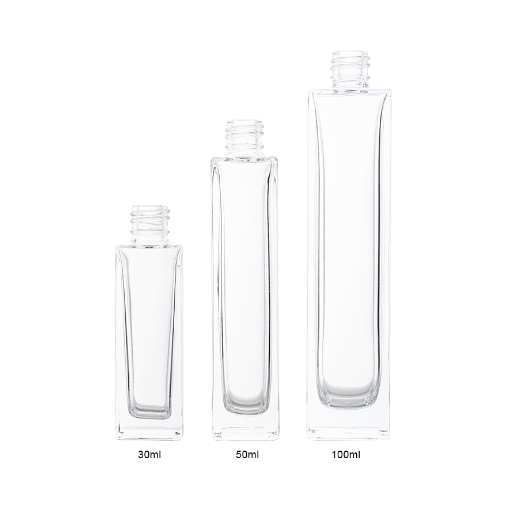
A good enquiry gets a matched set back. A vague one gets a catalogue page and a guess. Send these, in this order:
- The pump assembly or its drawing. If you’ve chosen a pump, this comes first, because the pump defines the neck.
- The format, in ml and oz. Both, because your market and your factory may work in different units.
- The glass grade and colour. Flint, extra-flint or coloured, and the clarity you need.
- The decoration. Frosting, spray, screen print, hot stamp or plating all affect price and lead time.
- Target dose per actuation. This narrows the pump and therefore the collar.
- Dip tube length, or the bottle’s internal height. So the tube is cut to the bottle, not to a standard.
- Formula viscosity. A fragrance oil and an alcohol-based EDP behave differently in the same pump.
Most buyers start with the bottle, because the bottle is what they can see, then discover the pump they want doesn’t exist for the neck they chose. Sending the pump drawing first reverses that. Buyers who start with the bottle usually pay for a tooling revision.
FAQ
What does FEA 15 mean on a perfume bottle?
FEA 15 is a 15 mm crimp neck. Fragrance pump collars come in a standard range of 13, 15, 17, 18 and 20 mm, and the number names the collar diameter. The glass carries a plain neck with a bead, and a crimping tool folds the collar over that bead permanently.
What neck size does a 30 ml perfume bottle use?
FEA 15 in almost every case. A 30 ml flacon typically takes a 15 mm crimp collar, the same neck used across the 15 to 50 ml range. FEA 13 usually stops below about 15 ml, and FEA 18 or 20 starts around 75 ml.
Is 15/415 the same as Screw 15?
Same neck, two names. Screw 15 is what pump makers use, and 15/415 is what some bottle suppliers use, because 415 is a two-turn thread series on a 15 mm diameter. Ask which drawing your pump supplier works to, and put that drawing in front of the glass factory.
Can I use a 24/410 bottle for perfume?
No. 24/410 is a lotion and soap finish. Fragrance pumps and collars are made for FEA crimp necks, Screw 15 and 18/415. A 24/410 bottle won’t accept a standard fragrance pump, and adapting it creates leak and fit problems that appear after filling.
What is the difference between FEA 15 and FEA 18?
The collar diameter, and with it the pump. FEA 15 carries most flacons up to about 50 ml. FEA 18 takes the larger formats from roughly 75 ml upward, where a wider collar suits a heavier bottle and a larger dose. Neither fits the other.
How much does a perfume pump dispense per spray?
Typically 0.075 to 0.15 ml per actuation, depending on the pump and collar size. Larger collars usually carry larger pumps. The neck size doesn’t set the dose, the pump does, so specify the dose and let the supplier match a pump to your neck.
Conclusion
Perfume bottle neck size comes down to one of two systems, and the number in the name tells you which collar or thread you’re dealing with.
Here is the short version. FEA 15 is the fragrance default for 15 to 50 ml. FEA 13 covers miniatures, and FEA 18 or 20 takes the larger formats. Screw 15, sometimes written 15/415, and 18/415 are the refillable alternatives. And 24/410 belongs to lotion and soap, not to fragrance, however it is listed.
Beyond the number, bead diameter, bead height, bore and tolerance decide whether the pump actually fits, and all of them live on a drawing rather than in a catalogue.
If you want the fit confirmed before you commit to tooling, send our team your capacity and neck finish. We will return a matched bottle, pump, collar and cap set with the drawings cross-checked, so the set is known to fit before the mould is cut. If you are still choosing a format, browse the wider perfume bottles range first.