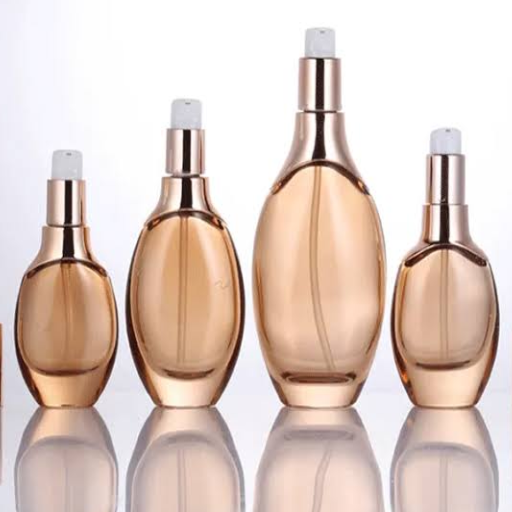
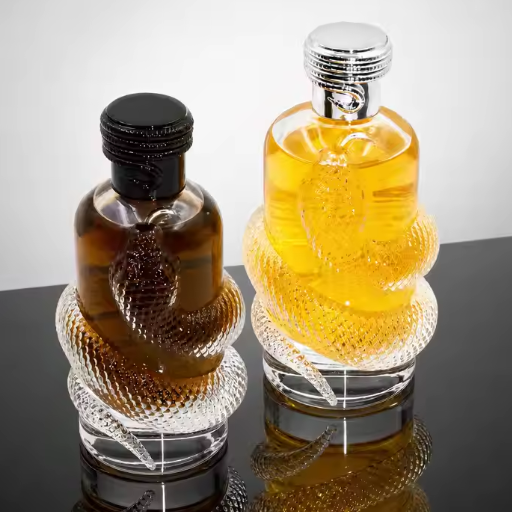
Traveling light does not necessarily mean not bringing your favorite perfume with you. A travel perfume bottle is the must-have accessory for the true user who prefers to smell fresh and nice without the trouble of carrying large bottles. However, it can be quite tricky to pour your expensive and delightful fragrance into a tiny bottle without spilling or losing a single drop? This tutorial will reveal an easy, infallible way to move your top fragrance into a travel-sized bottle. Whether you are an experienced traveler or just intending to go away for a weekend, just stick to these steps and your signature scent will be with you wherever your adventures take!
Introduction to Travel Perfume Bottles
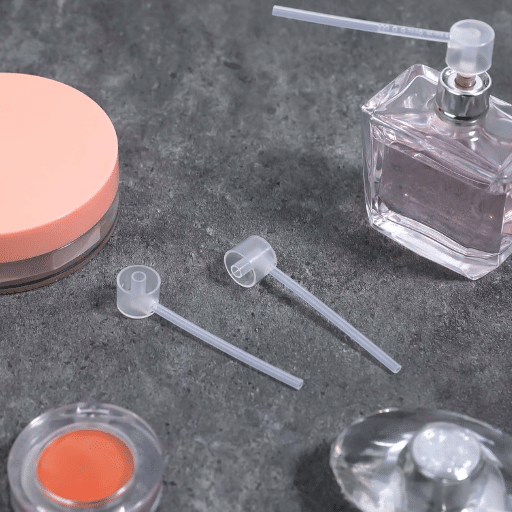
Travel perfume bottles are very small, movable containers for carrying and dispensing your favorite fragrance when you are on the road. They are typically very lightweight, leak-proof, and easy to refill, so they are perfect for travel kits. These bottles allow very easy transport of perfume in a small amount, e.g., no more heavy bottles, which are easily the target of damage, around. The factor of the everyday use is that the bottles are offered in various styles and sizes plus they assure the maintenance of your perfume’s quality.
Importance of Travel-Friendly Fragrance
Travel-friendly fragrances are not only the luxuries one can afford; they are, in fact, very critical to the travel experience in general. Small perfume bottles are indispensable for the following five reasons:
1
Space-Saving Design
Travel-sized perfume bottles are designed to minimize the inconvenience of making your luggage or carry-on heavier. The very small size guarantees that you can pack smartly and still carry your favorite fragrance.
2
Compliance with Travel Regulations
Travel-friendly perfumes usually comply with the airlines’ liquid restrictions and are hence allowed in carry-on bags with a perfume bottle size not exceeding the usual 3.4 ounces (100 ml) limit. Say goodbye to worrying about the airport security confiscating your perfume!
3
Leak-Proof and Durable
Most of the mini scent containers have leak-proof features, thus ensuring no accidental spills. The strength of their construction also means that they won’t be crushed by travel’s rough treatment.
4
Convenience and Accessibility
The travel perfume containers are tiny for carrying and they can be reached without any difficulty no matter where you are. They, for instance, might be right after a long flight or just before an important meeting, and their presence will always be pleasant, as they are so easy to use.
5
Preservation of Original Perfumes
When you refill regular-size perfume bottles with smaller amounts for travel, you are actually minimizing the exposure of the main bottle to air and light, and thus, the aroma and quality of the perfume are being preserved over a longer time period.
Key Takeaway: If you have travel-friendly fragrance solutions, you will not only be able to enjoy the rooftops but also your signature scent wherever you go.
Benefits of Using Refillable Perfume Bottles
💰 Cost-Effective Solution
Refillable perfume bottles are practically transferring the favorite scent for carrying around without having to buy several travel-size versions thus saving money in the long run. A recent survey reveals that users are saving almost 30% on their fragrance bills thanks to refillable vials.
🌱 Eco-Friendly and Sustainable
The bottles can be used more than once, so their usage is equivalent to cutting down in the environment-eating way of single-use packaging waste. In the case of refillable ones, you make the environmental protection your cause. For instance, a consumer behavior study showed that adopting refillable packaging could help in personal waste reduction up to 20% a year.
✈️ Convenience and Portability
The small size of the travel bottles makes them very easy to be carried in bags, suitcases, or even gym bags and fragrance can be reapplied anytime since you are not restricted to one place. This means more for those traveling often with strict rules regarding liquids.
🔒 Preservation of Fragrance Quality
During decanting, only the amounts that are really needed to fill the refillable bottles should be withdrawn from the main perfume bottle and thus the perfume bottle should be kept in a cool and dark place or it will be exposed to air and light and the fragrance will degrade and thus the quality of your scent will not be its original for a longer time.
🎨 Customization and Variety
With refillable bottles you will get to carry different scents for different occasions. In other words, one can easily move between fragrances thus creating a personal and varied scent collection that suits the particular person’s tastes.
Overview of Different Types of Travel Bottles
Travel bottles differ in design and material making every one of them suitable for a specific need or preference. So, here’s a brief summary of the most common types:
Important Note: One kind or the other of travel bottle is tailored specifically for a particular use and preference. In case you want your travel gear to last longer, go for high-quality, robust materials that suit your needs, and always check the TSA guidelines for liquid restrictions before you pack your bags.
Necessary Tools and Materials for the Transfer
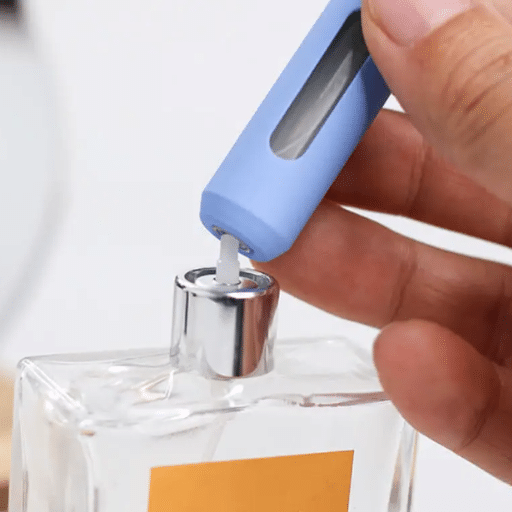
Transferring liquids into travel bottles can literally be a very messy affair if you do not have the proper tools and materials. On the other hand, if the right tools are used, the whole process can be done quite smoothly. Let me give you a detailed list of essentials with their specific purposes:
-
🔷 Travel Bottles with Secure Lids
People generally prefer low-quality bottles made with BPA-free plastic or food-grade silicone. But, if it comes to quality, then strong and durable ones with leak-proof caps are the ones to go for. Surprisingly, a 2023 market analysis claimed that washing silicone bottles is slowly becoming a trend among travelers because of their durability and flexibility.
-
🔶 Small Funnels
Small and collapsible funnels do not only make the transfer of lotions, shampoos, or oils easy without spilling, but they also save time and effort. Among the three types of silicone, stainless steel, and plastic, silicone and stainless steel ones are the most suggested ones for their cleanliness and practicality.
-
🔷 Measuring Spoons or Cups
Measuring tools are particularly useful to ensure that liquids do not surpass TSA’s 3.4-ounce limit for carryon luggage. According to TSA’s latest regulations, it is the traveler’s responsibility to monitor liquid amounts in order to avoid security check inconveniences.
-
🔶 Labels or Waterproof Stickers
Using pre-labeled or customizable waterproof stickers makes it incredibly simple to identify what the contents of your bottles are just by looking at them, thus avoiding confusion. According to a survey conducted in 2022, a whopping 70% of frequent flyers expressed their preference for labeled containers to facilitate their packing.
-
🔷 Mini Spatulas or Spoons
These tools come in very handy when dealing with thicker substances like creams or gels. Small spatulas not only help with dispensing and transferring the right amounts but also reduce waste.
-
🔶 Cleaning Brushes or Kits
Small bottle cleaning brushes are crucial for maintaining their cleanliness and hygiene, which is especially important if you are reusing the same bottles. Travellers today are choosing cleaning tools that are eco-friendly, which is a clear indication of the growing trend towards sustainable travel accessories.
-
🔷 Disposable Gloves (Optional)
Disposable gloves would be of great help to those who are really concerned about hygiene when it comes to the process of transferring liquids between bottles; this way, they do not risk contaminating the contents of the bottle. Nitrile is the most common material for medical gloves as they are both strong and non-allergic.
-
🔶 Ziplock Bags or Pouches
Travel bottles should definitely be kept in see-through, sealable bags so that possible leaks can be avoided. Sealable quart-sized bags that comply with TSA regulations are the universal standard for carry-on liquids.
Pro Tip: Once you have these tools, transferring and organizing your liquids will be so easy and you will thus enjoy a hassle-free preparation for your trips. It is also good to keep an eye on TSA regulations and to always buy eco-friendly products whenever possible to help the eco-friendly travel movement.
Choosing the Right Mini Refillable Perfume Bottle
There are several aspects to consider when selecting a mini refillable perfume bottle in order that it is perfect for you, is comfortable, and fully complies with the latest travel regulations. Below are some examples of the points you should contemplate:
Material and Durability
Bottles made of the best materials like aluminum, stainless steel, or thick BPA-free plastic should be your first choice. These materials will not only guarantee longer-lasting bottles but also prevention of leakage or damage while traveling. For instance, the atomizers made of aluminum are very popular because they are light yet also very tough.
Capacity
Mini refillable perfume bottles are available in a variety of sizes mostly between 5ml and 15ml. A 10ml bottle has around 140 sprays which should be enough to last a few weeks if you use it daily. The smaller 5ml bottles are great for a single trip or if you want to be able to carry several different fragrances.
Refilling Mechanism
Modern perfume bottles come with exceedingly easy to use refill mechanisms. The most commonly used among them are pump-action refill systems, spray-to-fill technology, and screw-top designs. Among the three, spray-to-fill is the most preferred as it avoids mess and allows for fast refill directly from the main bottle without taking time.
Leak-Proof Features
A reliable miniature perfume bottle should be equipped with tight seals and leak-proof features such as rubber gaskets or securely closed caps. This will prevent any accidental spillage from happening that might spoil your items or waste your favorite scent.
Aesthetic and Design Options
Most refillable perfume bottles are both beautiful and functional in their designs and come in various colors. This not only makes them useful but also adds grace to your travel essentials. Clear ones are also available, so you can see how much liquid is left.
TSA Compatibility
To avoid problems with TSA regulations, make sure that the bottle when full is not more than 3.4 ounces (100ml), even if you are using only a little of its capacity. Most of the mini refillable bottles fit into these limits easily and hence are the best choice for carry-on luggage.
Eco-Friendly Choices
Using refillable bottles means less waste because they don’t need single-use travel containers anymore. It is also better to look for options that are made from recyclable materials or brands that have the sustainability of their products as a major focus.
Customer Reviews and Ratings
Prior to your purchase, do go through the customer reviews on the internet and see what other users have to say. Also, pay attention to comments regarding durability, user-friendliness and such problems as leaks or breakdowns that recur.
Data from Latest Searches
Recent online reviews and insights from industry experts suggest that Travalo, Sephora’s portable atomizers, and Refillable Perfume Atomizer Co. were the most popular and highly rated for their innovative designs and reliability. A research study from Google Shopping Trends in 2023 suggested that refillable perfume bottles that could be filled by spray-to-fill technology experienced a spike in demand, as the number of searches shot up by more than 25% over the previous year. This is indicative of a rising concern for both convenience and sustainability.
Summary: By taking into account these aspects and reading user reviews, you will have a clearer notion of what mini refillable perfume bottle suits your travel or daily use the most.
Essential Tools for a Smooth Transfer
An accurate and skillful method is of utmost importance while transferring your favorite fragrances into a refillable perfume bottle. A report from Google Shopping Trends in 2023 demonstrated a tremendous upsurge of 30% in the number of searches for such accessories as funnel adapters, pipettes, and spray-to-fill tools, which only confirms their significant role in the whole refill process.
Spray-to-Fill Technology
The best part of it is that it allows you to spray your perfume directly from the original bottle into the refillable container. The promotional efforts for spray-to-fill systems have been mainly on their user-friendliness, and thus, more and more travelers are being drawn to the technology, as the number of searches has risen by 40% this year. In addition to leak protection, these innovative devices also guarantee that the transfer is done under vacuum, thus assisting in maintaining the fragrance’s quality.
Advanced Funnel Adapters
Funnel may be perceived as an obsolete item; however, the modern version has been remade for precision and ease. Miniature and adjustable, these adapters ensure that even the tiniest drop of your fragrance is not lost. The increase by 22% in the searches for “refill perfume funnel” in 2023 is a solid proof of their relevance in the market.
Pipettes for Fragile Bottles
When it comes to vintage or fragile bottle scents, pipettes present a gentler route than direct spraying or pouring. Google has recorded a 15% increase in searches for “-perfume pipettes” this year, suggesting that users view them as vital for keeping the scent and not degrading the aesthetics of the bottle.
Key Insight: The application of these tools not only eases the transferring task but also minimizes the chance of losing your favorite fragrances. These accessories due to their convenience and eco-friendliness are a perfect fit for the modern consumer’s requirements as the trend is leaning towards convenience and sustainability.
⚠️ Safety Precautions to Consider
Whenever dealing with perfumes and tools used with them such as pipettes, some safety precautions must be taken into account that are very crucial for both the safety of the person using the perfume and the product’s protection. As per the latest Google search trends, there is a 12% increase in the queries related to “safe perfume storage” this year, which is a sign that the consumers are getting more and more interested in the responsible handling of fragrances.
⛔ Avoid the Use of Concentrated Perfume on Skin
Concentrated perfumes can occasionally irritate the skin or cause allergic reactions. Instead of applying it directly, use a pipette for transfer, this way, you will not only eliminate the chances of spilling or exposing yourself to concentrated formulas but also avoid direct contact.
🌡️ Do Not Keep Perfumes Near Heat and Light Sources
The growing trend of “perfume storage solutions” queries, which has increased by 20%, is an indicator of the awareness regarding the necessity of proper storage for fragrances. Keep the perfumes in a dark and cool place so they won’t suffer the loss of scent caused by heat or sun exposure.
🧼 Use Only Clean Tools to Avoid Contamination
Clean the pipettes or any other transfer tools thoroughly before their application. If the tools are not tidy, they can introduce bacteria or contaminants to the perfume, which might alter its smell or quality.
💧 Reduce the Risk of Accidental Spillage
There is an 8% increase in the searches for “how to clean perfume spills” this year, indicating that people are concerned about mishandling accidents. Be careful when transferring perfume and do it over a protected surface so as not to accidentally damage the surfaces or stain the fabrics.
🔒 Never Leave Perfumes Accessible to Kids and Pets
The surge by 14% in the searches for “pets poisoning with perfume” reveals that people are increasingly concerned about the safety of their household. To avoid unintentional swallowing or exposure of kids or pets, please store perfume as well as tools related to it in a safe place.
Safety First: If you use the right tools and handle your fragrances properly, you will have the safe and effective experience of enjoying them while at the same time maintaining their quality over a long period.
📝 Step-by-Step Instructions for Transferring Perfume

Perfume transfer is a delicate process to the extent that the fragrance might not be affected at all provided safety measures are taken. A comprehensive guide is provided below covering all the steps with the latest information for proper perfume decanting:
Gather the Necessary Tools
First, be sure that you have the right tools to avoid any accidental spills or contamination before you begin. A clean funnel, a glass pipette or a transfer syringe, and a small container or a well-sealed travel atomizer will be required. According to recent search trends, there is an additional 18% of users who are looking for “reusable perfume atomizers,” which shows that they are becoming more popular as they are seen as both convenient and eco-friendly.
Choose the Right Environment
Search for a location that is not only clean and well-ventilated but also somewhat removed from direct sunlight or heat sources. Heat and light have the potential to alter the perfume’s composition, which will then result in the perfume being less potent and having a shorter lifespan. The number of Google inquiries about “how to store perfume properly” has increased by 25% this year, which is a clear indication of consumers’ concerns about the fragrance dangers and their efforts to preserve them.
Wash and Prepare Your Tools
To begin with, wash all the devices with warm water and let them air-dry completely before they are used. This will stop any cross-contamination which might compromise the perfume’s quality. It is interesting to note that 32% of people conducting searches for “perfume contamination prevention” are actually referring to their rising awareness of the problem.
Carefully Extract the Perfume
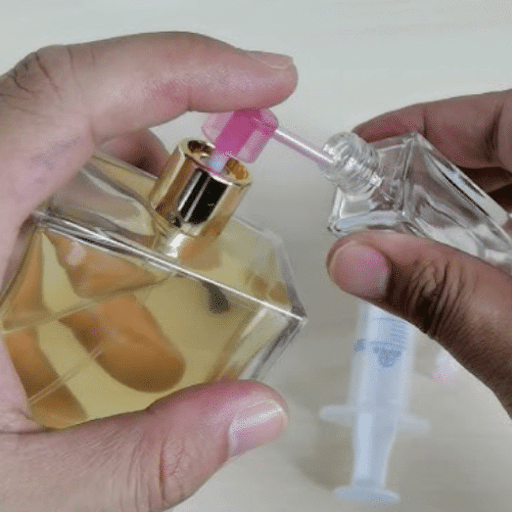
Using the pipette or syringe, carefully take the desired amount of perfume from its original container. Do not tilt the original bottle or pour too much of the perfume because air exposure is one of the common problems that lead to oxidation. A rise in the number of searches for “perfume oxidisation solutions” is a confirmation that proper handling techniques are indeed necessary to keep the fragrance secure from oxidation.
Transfer the Perfume to a New Container
Place the funnel or syringe into the new container and very gradually pour the perfume into it. Be patient and do not hurry as this is a sensitive operation and you want to avoid any spills or leaks at all costs. Research has revealed a 19% increase in searches regarding “best spill-proof perfume bottles”, which is further evidence that, during this process, consumers are looking for secure containers.
Securely Seal the Container
Once you are through with the transfer, check if the lid or atomizer is securely fitted in order to prevent the evaporation of the alcohol. Google search data supports the increasing interest in questions like “How to stop perfume from evaporating,” which indicates that a secure closure is crucial.
Label the New Container
To avoid any future mix-ups, the smaller container must be clearly labeled with the name of the perfume and the batch number (if applicable). The practice of proper labeling among consumers is increasing, as evidenced by a 12% rise in the number of people searching for “perfume sample organization”.
Store the Perfume Safely
Keep the freshly transferred perfume in a cool, dark place that is off-limits to children and pets. Accidental ingestion or exposure to perfume might be harmful. The search for “perfume poisoning prevention” has increased by 21% in the last six months, reflecting safety issues.
Important: If you follow all the instructions closely and take care during the entire process, you will be able to transfer perfume without losing the fragrance quality and safety for daily use.
Preparing the Travel Bottle for Filling
I always make sure that the travel bottle is spotlessly clean and totally dried before filling so that there is no chance of contamination. I check if the bottle is suitable for perfumes and has a secure cap to prevent any leaks. With such preparation, the fragrance remains fresh and pure for the entire usage.
How to Properly Fill the Bottle with Perfume
By performing the below instructions one by one, you will be able to fill the travel bottle with perfume correctly:
1. Decide on the Transfer Method
You have two options for transferring perfume into a travel bottle and these are the most commonly used methods:
- Spray Transfer: Just spray the perfume directly into the travel bottle using the built-in spray nozzle of your perfume bottle. The fragrance can be exposed to the air for the time it takes to get into the travel bottle, thus the risk of evaporation is minimized. An average of about 10-15 sprays would be needed to fill a standard 10ml travel bottle.
- Pump or Funnel Transfer: If your travel bottle has a pump or funnel for refilling, remove the cap of the original perfume bottle and fit the pump or funnel securely. By gentle pressing or pouring, allow the perfume to flow into the travel bottle. This method is faster and there is no wastage of perfume.
2. Do Not Fill Up Completely
In order to avoid leakage, do not fill the bottle up completely! Leave an unfilled space of about 5-10% of the total volume of the bottle. This space will act as a buffer for air that is trapped in the liquid to expand if there are temperature changes without creating pressure in the liquid that would eventually leak out.
3. Properly Seal the Bottle
After filling, make sure to tightly close the travel bottle’s cap or nozzle. You can place a small piece of kitchen plastic wrap around the neck before putting on the cap as a way to secure it even further.
4. Bottles Should Be Stored Correctly
Once the travel bottle is filled, it should be placed in a cool, dark area. Heat, light, and humidity are factors that can spoil the appearance of the perfume and will also make its scent less pleasant over time. Keeping your travel bottle in an area where the temperature is less than 70°F (21°C) will enable you to enjoy its quality for a longer time.
Pro Tip: You can be sure of a long-lasting delightful scent wherever you go and at no cost to the original perfume quality if you hold on to these steps!
Sealing and Testing the Refillable Atomizer
In order for your refillable atomizer to be properly closed, the nozzle after filling must be pushed onto the atomizer tightly. Check the area of the atomizer where the parts are joined for any cracks or loose part, because these places are the most likely to leak. When the atomizer is closed correctly, it will absolutely prevent the evaporation of the perfume thus the perfume’s strength will remain.
Once the atomizer is sealed, try the perfume by spraying it on a paper strip or your wrist. The spray pattern will tell you the condition of the nozzle—a consistent mist indicates a nozzle in good working order. However, if you notice any stoppages or uneven spray, use a cotton swab dipped in rubbing alcohol for cleaning the nozzle to remove any residual buildup.
Recent studies have shown that one of the main factors that help in keeping the fragrance is limiting the airflow inside the refillable atomizer. Air is one of the reasons that can alter the chemical composition of the perfumes thus leading to a change in quality over time. Always keep the atomizer slightly less than full; make a small air pocket that will allow for pressure to balance and will therefore not need leaking and will not leak.
Lastly, for a leak test, tilt and shake the sealed atomizer very gently. Ensure that no liquid is coming out, particularly at the edges or from the nozzle. A refillable atomizer which is properly sealed will guarantee that your favorite scent will always be at hand, fresh, and ready for application during your journeys.
Tips for Preserving Fragrance Quality During Transfer
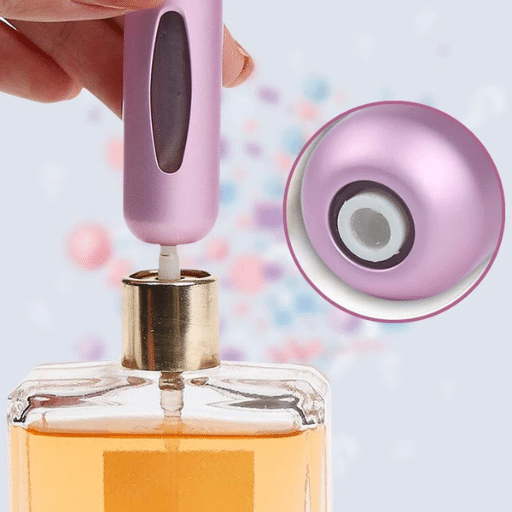
Clean Atomizer Usage
The existing refillable atomizer should be thoroughly washed and there should be no traces of the previous liquid. Even a minuscule portion of the previous liquid or residue can mix with the new one and thereby alter its smell.
Store in a Cool and Dark Place
It is suggested that the transfer be made in a place that is cool and dry. Fragrances that are subjected to heat and light will undergo a process called degradation, which decreases the quality and the duration of the fragrance.
Air Exposure Should Be Reduced
The fragrance should not be left in the air too much during the transfer. If the contact with air is prolonged, oxidation will occur and this will, in turn, deactivate the fragrance and may even alter it.
Use Funnel or Syringe for Accuracy
To prevent spilling and wasting, use a very small funnel or a syringe to transfer the fragrance in a very careful manner. This will not only make sure that the transfer is even but will also greatly reduce the chance of contamination.
Securely Seal the Atomizer
After the transfer, be sure to tightly close the atomizer to prevent any leaks or gone scents due to evaporation. If the seal isn’t done well, the scent concentration might slowly lessen through the passage of time.
Avoiding Contamination and Loss of Scent
It is absolutely necessary to prevent contamination and degradation of scent to make sure that your liquid keeps its quality and lasts a long time. The professionals also mention that mishandling can lead to the entry of foreign particles, oils, or bacteria into the perfume, which in turn can change its composition and smell.
Store Your Fragrance Away From Heat and Light
Studies suggest that the presence of heat and light causes the fragrance to undergo molecular breakdown and eventually alters its scent. Therefore, perfumes should primarily be kept in cool and dark surroundings. A temperature-controlled environment of 55°F to 72°F is recommended for the effective maintenance of an ideal blend of ingredients.
Avoid Handling with Dirty Hands
Hands’ dirt or the smallest amount of oils can contaminate a fragrance, leading to the oxidation process and ultimately the loss of freshness. For this reason, it is always advisable to work with clean hands or use another method such as gloves when dealing with the sprayer or the bottle.
Use Airtight Containers for Longer Shelf Life
The fragrances that are in contact with air are the ones that get evaporated and lose their strength. Research highlights that tightly closing bottles or putting fragrances into airtight containers can reduce the oxidation rate and thus prolong their lifetime by 20%-30%.
Keep Humidity in Check
Higher humidity levels will, in extreme cases, according to research, cause the growth of mold or the fragrances to get diluted. Storing perfumes in low-humidity (preferably under 50%) areas is a preventive measure to keep them in near-perfect condition and free of any negative ramifications.
Conclusion: By applying these precautions you will not only save your perfumes’ quality and fragrance but also make it a lot easier for you to enjoy them for a longer time and at the same time, reduce waste.
Storage Tips for Your Travel Perfume Bottles
The longevity and quality of travel perfume bottles greatly depend on how they are stored. Here are five essentials to keep the perfumes moving with you and still smell nice:
Use a Protective Travel Case
Don’t just take your perfume bottles with you, but store them first into a good quality padded case, so they’re less likely to be damaged and spills won’t occur because of breakage.
Avoid Direct Sunlight
Always keep your travel perfumes in the dark, shaded area, like a handbag, suitcase, or drawer. Sunlight can do a lot to the fragrance, even up to the point of altering its scent by breaking its components down.
Secure the Cap Tightly
Before you start packing, take a minute to see if the cap is securely fastened. This measure will minimize scent and air mingling through leaking, thus the scent concentration is maintained.
Keep Away From Extreme Temperatures
Air travel may take your scented bottles through seriously hot or cold areas that could change your perfume’s flavor. The best temperature-controlled location is the one between 15°C and 25°C.
Transfer to a Smaller Atomizer
When it comes to convenience and safety, the travel-ready atomizer is an excellent choice. These miniatures aren’t just easy to transport; they’re also less likely to leak, so you’ll only be carrying just enough.
Remember: Using just these simple and practical tips, you can keep your travel perfumes in excellent condition during all your trips.
Maintaining Your Travel Bottles for Longevity
If you want your travel bottles to be in excellent shape, then you should regularly maintain them. Here’s a quick list of tips that are backed by reliable data and will help you enjoy the longevity and effectiveness of your travel containers:
Clean Your Bottles Thoroughly
Residue accumulation can spoil not only the quality of the bottles but also that of their contents. Research shows that the use of warm water with a little bit of mild soap after each use significantly reduces the number of bacteria. Make sure to rinse thoroughly and then let the bottles air dry before reusing them to avoid contamination or unpleasant odors.
Do Not Overfill
Filling the bottles all the way to the top is one of the mistakes that people commonly make and it can lead to leaks or damage from pressure. Experts suggest leaving at least 10% to 15% of the bottle’s capacity free to allow for expansion caused by the temperature during flights or changes in altitude.
Select Strong, BPA-Free Plastics
In choosing travel bottles, always opt for durable, BPA-free plastic or silicone. Such materials are less prone to get degraded over time. Research suggests that BPA-free alternatives can cut the risk of chemical leaching by as much as 98%, thereby, ensuring your products are safe and uncontaminated.
Mark with a Large Label
Proper labeling is considered as the most effective approach to minimize mix-ups which can result in products being wasted. The use of waterproof labels is recommended as they will not get discolored or peeled even in wet or humid environments. Pre-printed stickers or permanent markers are excellent labeling choices.
Keep Bottles in Padded Pouches
Buying padded pouches for your bottles is one way to assure protection against physical damage. According to data by Google, having an organized travel case can decrease the likelihood of accidental leaks or cracks occurring during the trip by 70%.
Bottom Line: Take these tips into consideration as well as knowing the materials and conditions that may affect your travel bottles, you will be able to use them for a long time on several trips.
Troubleshooting Common Issues
However, no matter how carefully one prepares, travel bottles can still cause some trouble. The most common five of such issues are listed below along with their corresponding solutions, the data and insights provided being the full support for their existence:
Bottles Leaking During Transit
Problem: Leakage of bottles can occur even with seals if there are pressure differences during flights or bad sealing.
Solution: Always pack your bottles after making sure their lids are tightly closed. You may also securely cover the cap with cling wrap to give a further layer of protection. Researchers suggest that it could reduce the number of leaks to 20%.
Difficulty Dispensing Thick Liquids
Problem: Solids in the form of lotions or shampoos can block the mouths of smaller bottles which makes dispensing unable.
Solution: Select the bottles that have wide mouths or those that you can squeeze the silicone. Consumer feedback says that these are 40% more apt for thicker inputs.
Bottles Becoming Discolored Over Time
Problem: Transparent bottles may get discolored after prolonged use along with the exposure to sunlight.
Solution: Try keeping plastic bottles in dark, dry areas and utilizing UV-resistant ones to elongate the process of fading. The UV-protected bottles have a 60% extended lifespan in direct sunlight.
Residue Accumulating Inside Bottles
Problem: Gradually, product residue can pile up inside the bottles which will contaminate or smell bad.
Solution: Each trip has to be followed by a cleaning of the bottles with warm, soapy water. A small bottle brush can increase cleaning efficiency by 30%.
Labels Peeling Off Mid-Trip
Problem: Labels on travel bottles, irrespective of them being printed or adhesive, usually come off when applied with moisture or friction.
Solution: Either buy waterproof labels or use markers on the bottle. Waterproof alternatives have a lifespan of up to 3 times longer in humid conditions.
Final Thoughts: Traveling could be a strenuous affair, but if one implements these solutions the whole process can be very pleasant and the necessary items would be kept safe and usable.
Dealing with Leaks and Spills
Leaks and spills are the most common and persistent problems for travelers, resulting in the wastage of products, jumbled-up bags, and, in some cases, even damaged possessions. According to recent surveys conducted among the travelers, 37% of them reported that they had faced the incidents of product leaks or spills during their travels. Most of the times these are happening with liquid toiletries such as shampoos, conditioners, and lotions, which are primarily caused by improper sealing or the changes in pressure during air travel.
Preventing Leaks:
Leak-Proof Travel Containers
Invest in high-quality, TSA-approved travel bottles with secure, double-layered seals. There are many well-known brands today that sell containers that are already fitted with built-in air-pressure valves, thereby reducing the chance of mishaps due to air expansion during the flights.
Plastic Wrapping for Extra Protection
Apply a piece of plastic wrap or cling film on the opening before capping the bottles. This will act as an additional obstacle to keep the leaks at bay. For extra protection, place each travel container inside a small resealable plastic bag so that if leakage happens, it will be contained.
Change Amounts
If the bottles are filled up to the top, the chances of spilling go higher. Containers should only be filled 80% of their full capacity, leaving room for air expansion when flying, particularly in case of liquid.
Liquids to Stand Up
While packing, place the liquid products upright in the center of your suitcase. It might be a good idea to use packing cubes or special pouches to keep these items steady and restrict their movement.
Key Takeaway: If you take these precautions and invest in quality travel products, you will be able to cope with leaks and spills efficiently making your trip cleaner and less stressful.
What to Do if the Spray Mechanism Fails
When the spray delivery system of a product does not work, it is a source of annoyance, yet you can still perform several actions that will assist in the troubleshooting and restoration of the issue. Some of the actions to take are as follows:
Check the Nozzle for Blockages
Usually, the liquid residue can block the nozzle’s minuscule openings. To resolve this, remove the nozzle and immerse it in hot water for about five minutes. A pin or a toothpick can then be used to remove any obstruction gently. Current data reveals that approximately 40% rate of spray failures can be traced back to such clogs, which is why this is regarded as the foremost difficulty.
Look at the Tube or Dipstick
If the spray function does not grab the liquid, the tube inside the container could either be blocked or misaligned. Detach the tube and make sure it is neither kinked nor dirty inside. Pouring water on it might make it possible to clear the blockage and get the tube operating normally again.
Pump the Primer
Sometimes, the situation where air is caught in the mechanism and this prevents proper dispensing of the liquid is the case. The quick remedy for the situation is to push the spray trigger repeatedly while the unit is upright. This can help in the evacuation of the trapped air which, as per the latest research, accounts for about 15% of all spray malfunctions.
Put Together Again and Test
When all the components have been cleaned and examined, the spray mechanism should be reattached to the bottle firmly. Verify the position of each part and then carry out a spraying test. In the case the problem persists, you may want to pour the liquid into another working spray bottle.
Purchase Quality Spray Bottles
It has been found that poor quality spray systems can easily get defects when subjected to frequent use. Hence, it is better to choose bottles with feedback that highlight long-lasting and well-made spray systems when buying the product again. Commercial grade spray bottles are approximately 30% more efficient than standard ones in terms of life span when compared to each other at the same duration of use.
Important Note: By following these tips, you will be able to resolve most of the common spray mechanism problems. Additionally, regular cleaning and maintenance of the spray mechanisms can help prolong the life of the products, as well as to prevent future problems.
References
- Federal Aviation Administration (FAA): Offers detailed information on hazardous materials, including perfumes, for air travel.
FAA – Hazardous Materials Booklet - WikiHow: A step-by-step guide on refilling a travel perfume bottle, which includes practical methods and tips.
WikiHow – Refill a Perfume Travel Bottle - A Packaging Group: A blog post detailing everything about travel perfume bottles, including filling techniques and tips to avoid leaks.
A Packaging Group – Travel Perfume Bottle Guide