The fine mist sprayer vs trigger sprayer decision depends on your product’s viscosity, intended use, and target audience. Fine mist sprayers deliver micro-droplets ideal for cosmetics and personal care, while trigger sprayers handle higher output volumes for cleaning and industrial applications.
Last quarter, a skincare brand approached us after their facial toner launch underperformed. Customers complained about uneven application and oversaturation. The culprit? They had paired a trigger sprayer with a water-thin formula that needed a delicate, cloud-like mist. Switching to a 24/410 fine mist pump, a type of precision pump sprayer, cut over-application by 40% and lifted their review scores within weeks.
If you have ever stared at a catalog of spray closures wondering which mechanism fits your formula, you are not alone. The packaging industry offers hundreds of combinations, and the mechanism you choose dictates the user experience, formula efficacy, and brand perception. In this guide, we break down the fine mist sprayer vs trigger sprayer technical differences, mechanics, and use cases. You will learn how each mechanism works, when to use one over the other, and how to match the right dispensing top to your product, budget, and sustainability goals. If you already know a fine mist sprayer is the right direction, our guide on how to choose a fine mist sprayer walks you through neck sizes, output, and material selection.
Key Takeaways
- Fine mist sprayers atomize liquid into droplets smaller than 100 microns, making them ideal for cosmetics, perfumes, and facial toners with water-thin viscosity.
- Trigger sprayers produce larger droplets (150-400+ microns) and higher output per stroke, suiting cleaning products, automotive chemicals, and gardening sprays.
- Liquid viscosity, application surface, bottle size, and brand positioning are the four most important factors when deciding between the two.
- Mini trigger sprayers offer a hybrid solution for hair care and salon products that need ergonomic handling with finer output.
- Sustainable options, including mono-material designs and PCR plastic, are now available for both sprayer types.
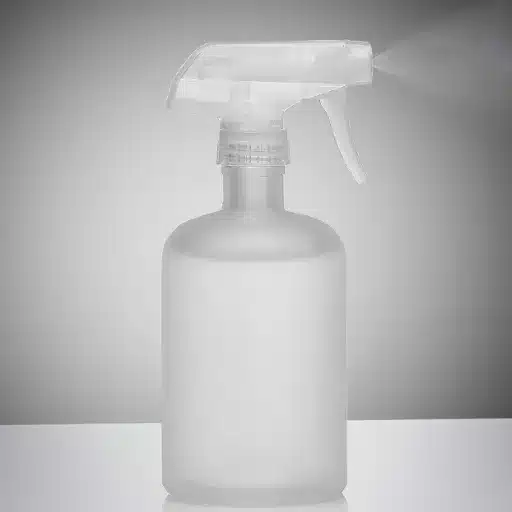
Visual comparison of fine mist and trigger sprayer mechanisms in action.
What Is a Fine Mist Sprayer?

The pump that is used to dispense liquid in fine particles due to the fine orifice size of the nozzle is referred to as the fine mist sprayer or the finger sprayer. By pressing the head downwards, the actuator lowers and compresses the spring that is housed within the pump propagating the liquid. In turn, it creates a low pressure zone prompting the suction of the liquid through the dip tube using the one way and the check valve system. The check valve then allows the passage of the liquid through the tiny nozzle thus dispersing it in the form of a smooth, foggy spray.
How It Works
The principle behind its operation is as explained by Pascal. It contains a spring-loaded piston seal which can move up and down within an enclosed cylinder. While reciprocating in the downward stroke the fluid outlet valve at the top of the chamber opens whereas the suction valve closes expelling the liquid sited within the swirl chamber through the nozzle. When moving in the upward stroke the suction valve opens and allows the chamber to be refilled from the bottle. Such cycles are very short and ensure coating the target surface with their very thin, uniform and stable films as found necessary in cosmetic products of high cosmetics sprays.
Technical Specifications
Fine mist sprayers typically produce droplets ranging from 20 to 100 microns in diameter. Output per stroke falls between 0.12 ml and 0.4 ml, depending on the actuator design and spring tension. These pumps are engineered for water-thin liquids with a viscosity below 5 cP (centipoise, a viscosity measurement). Standard neck finishes include 18/410, 20/410, 24/410, and 28/410, giving brands flexibility across mist sprayer bottle sizes from 30 ml travel containers up to 120 ml retail bottles.
Common Applications
You will find fine mist sprayers throughout cosmetics packaging and personal care packaging: on facial toners, setting sprays, body mists, perfumes, hair refreshers, and essential oil blends. Any product that demands gentle, even coverage without oversaturating the surface benefits from this mechanism. If your formula contains expensive active ingredients, the low output per stroke also helps control dosing and reduce waste.
Want to explore specifications in more detail? Our guide to fine mist sprayer neck finish sizes breaks down how 18/410, 20/410, 24/410, and 28/410 closures match different bottle types.
What Is a Trigger Sprayer?
A trigger or squeeze spray is a hand-held pump with a piston, a handle, and a trigger lever and requires relatively low nozzle pressure but has the high output features and generates large sized droplets when compared with other types of spray devices. The users, while pressing the trigger, operate a horizontal piston causing it to press against a relatively bigger spring placed inside a pressure housing. This in turn helps the liquid to be sucked up the longer dip-tube while the additional modification of the nozzle allows the liquid to be in the form of a fine mist or thin beam or foam.
How It Works
The structural mechanism of a trigger sprayer is different from that of a fine mist one although the working pinciples of both classes of sprayers are the same. This feature assists the user in spraying the dense fluids easily even for multiple times because the lever is able to augment the manual force. Some triggers are engineered with a joystick-like spray pattern selector allowing the operator to change from one spray pattern to the other. In most cases, the closure is equipped with a locking mechanism or a built-in safety clip designed to prevent children from accidental opening.
Technical Specifications
The droplets produced by the sprayers of trigger types tend to fall within the range of 150 to 400 microns in size, although some of the extreme fine-mist trigger types have the capability of producing the droplet sizes smaller than that. The volume released in one stroke lies within 0.8 ml and 1.5 ml for common versions, whereas the high yield version reaches 3.4ml per stroke. Apart from the fact that they are convenient since they allow spraying over a rather wide range of dilutions and liquids starting from water and ending up with 50 cP light gels and oils, the nozzles can hardly be described as sparing or gentle. The neck finish is often 28/400 or 28/410. While bottles have a capacity of at least 250 ml and above one liter.
Common Applications
The trigger spray bottle is essential in homes, motor vehicles, horticulture and pest control or rather these markets are saturated with such bottles. However, trigger sprayers provide ample force and volume for all the above mentioned products. Cleaners, sterilizers, general purpose and glass cleaners, cleaners for every surface, sponges and cleanser all use the power and volume in triggers. This is due to the fact that the nozzle is adjustable by the consumer. For instance a consumer can have a wide spray when applying it to countertops but then switch to a direct spray to reach the underneath of the counters where staining is hard to reach.
Fine Mist Sprayer vs Trigger Sprayer: Side-by-Side Comparison
When you lay the two mechanisms side by side, the differences become clear. The table below summarizes the technical and practical distinctions, including output volume, droplet size, and viscosity limits, that matter most during product development.
| Feature | Fine Mist Sprayer | Trigger Sprayer |
|---|---|---|
| Droplet size | 20-100 microns | 150-400+ microns |
| Output per stroke | 0.12-0.4 ml | 0.8-1.5 ml (up to 3.4 ml) |
| Viscosity range | Water-thin only (under 5 cP) | Thin to moderate (up to 50 cP) |
| Spray pattern | Fixed wide mist | Adjustable (mist / stream / foam) |
| Typical bottle size | 30-120 ml | 250 ml to 1 L+ |
| Ergonomics | One-finger press | Full-hand grip |
| Best industries | Cosmetics, skincare, perfume, hair care | Cleaning, automotive, gardening |
| Neck finishes | 18/410, 20/410, 24/410, 28/410 | 28/400, 28/410 |
| Customization | Color, metallization, aluminum accents | Child locks, foam heads, chemical-resistant materials |
Why Droplet Size Matters
Droplet size is not just a technical specification. It directly affects how your product performs and how customers perceive it. Smaller droplets evaporate faster, creating that dry-to-the-touch feel consumers love in facial mists and setting sprays. Larger droplets stay wet longer, which is exactly what you want when a disinfectant needs dwell time on a countertop to kill bacteria. The wrong droplet size can turn a premium serum into a dripping mess or render a glass cleaner ineffective because it dries before it cleans.
Ready to see how these differences play out for your specific product? Contact our team to request samples of both mechanisms with your formula.
Fine Mist Sprayer vs Trigger Sprayer: 6 Key Decision Factors
Choosing between a fine mist sprayer and a trigger sprayer comes down to six practical considerations. Walk through each one with your product specs in hand, and the right answer will emerge quickly.
1. Liquid Viscosity
This is something so imperative that everything else comes secondary. The structure of the fine mist sprayer mechanisms adequately functions when used with liquids which have thickness closer to that of water. Anything more viscous than, say, toning solution or alcoholic fluid is rendered useless as it will clog the spout and burst the spring. If your product contains surfactants, oils, gels or some particles in them, it will be best to not use them in this fine mist sprayer and instead opt for trigger sprayer. The ones with trigger systems have big pistons, powerful springs and are less narrow, withstanding over ten times greater thickness of liquids than the mist pump.
2. Application Surface
Refer to the appropriate place that you would like the product to reach. When it comes to soft areas such as face, hair and skin, there is need for a very gentle as well as wave coverage without leaking. However, it is a different case for hard surfaces such as tiles, counters or even car tires as they require drenching. A low pressure, dry mist sprayer provides an uncontaminated surface splash of product over the skin. A trigger sprayer, on the other hand, dispenses large quantities of liquid quickly and with more control. Therefore, it is important to match the application medium to the surface, which in turn is in harmony with the user’s needs and desires.
3. Bottle Size Compatibility
Fine mist sprayer use typically is associated with small, compact ready-to-hand spray bottles. This is because a 30ml glass bottle is easy to place in a handbag or a travel kit with 20/410 mist pump. Similarly, a high-density polyethylene bottle of 500ml with a trigger sprayer of 28/410 is meant for placing under the kitchen sink or in the garage. The size of a given object is rather important than the aesthetic beauty of that object. The reason is that the trigger in a bottle of 60ml appears excessive and inappropriate. On the other hand, a fine mist sprayer vs trigger sprayer does not last long, but the length of the container will require, a one-liter bottle; hundreds of thrusts to finish the liquid in a fine mist.
4. User Experience and Brand Positioning
Silently, in a subtle way, the ‘kind’ of mechanism you select, reflects the ‘kind’ of brand you are. Use of hps fine mist sprayers shows elegance, sophistication and refinement aimed at personal care industry consumption. The beauty sector customers expectations are such that it is easy for them to expect such aerosols to contain expensive cosmetics or scents and even indulge themselves in Indian spas.
Trigger sprayers have a lot of connotations that include functionality, strength and even result. When it comes to cleaning products it is more playful and they want to conquer their craving for efficiency – do the job and clean the mess. Analyze your packaging and choose the mechanism which supports the narrative of the brand story.
When GreenClean was introduced into the market in 2024 with its all purpose cleaner, it was brought in with a standard mist pump first, to change the strategy of the competition. When uptake of the product was very low after 3 months, they moved to an adjustable trigger sprayer and a chemical-resistant HDPE bottle.
This helped achieve a 25% increase in repurchase rate. In reviews, customers particularly pointed out that the stream-to-mist conversion made it convenient to work with in different cleaning situations. The prices of the formula, which was the same, different perceptions about its efficacy were induced in the mechanism.
5. Formula Value and Dosing Control
If your item has substances that are costly, important in essential oils, or hard to come by extracts from plants, then every single unit of volume is imperative. This is because, for such products, a fine mist sprayer vs trigger sprayer swill provide an accurate and efficient dosage. The capacity of a fine mist sprayer is 0.12 ml, that is, for 100 ml bottle it will produce approximately 800 mists. This extends others and allows for a product to be sold at a higher price.
The trigger sprayers are used for more heavy duty applications. If the nature of the business encourages customers to use more of the product at one sitting, then there is a trigger spray which facilitates this. If part of the brand’s proposition is to save the contents while retaining the said use, a fine mist pump would be the appropriate option.
6. Sustainability Goals
Newly developed variants of both types of sprayers are more efficiently-designed in terms of environmental concerns, yet they vary in how they are applied. For instance, it is worth noting that fine mist pumps of single-material construction, easy to recycle as they contain one type of plastic, are becoming more common. Then there are metal-free atomizers, meaning they don’t contain a stainless steel spring, which would have complicated recycling. Also, these trigger sprayers can be made out of PCR (Post-Consumer Recycled) plastic, and some brands additionally produce fully recyclable ones that come in detachable parts. If you, as a brand, have taken the initiative and decided to invest in recyclable packaging, it is essential to consider the mono-material or PCR version with the support of your supplier, before making the decision on the mechanism.
For a deeper look at sustainable dispensing options, read our article on eco-friendly fine mist sprayer materials and certifications.
The Hybrid Option: Mini Trigger Sprayers

When assessing even a fine mist sprayer vs trigger sprayer, not all items of concern can be perfectly segregated into one group or the other. On those occasions, it is helpful to have mini-trigger spray bottles. These small machines operate on a lever and are fixed on containers that are mostly 100 – 250 ml in size with each stroke being able to give approximately 0.2 – 0.4 ml in output. Flare patterns resulting from this nozzle are larger than those produced by a traditional mister or squirt nozzles attached to a gun but smaller than those from handgun spray nozzles thus perfect for incorporation into the product when there is a need for better than a fingertip pump ergonomic but when the trigger unit is too wide.
When to Consider a Mini Trigger
Medium application products, including detanglers, leave in conditioners, even pet grooming and hair salon products, however require bottle necks for both hotel and retail sizes. Professional hair stylists working in Velvet Strand – the network of ‘boutique’ salons – feel that the heat protectants are better with mini triggers than with mists, and aa electronic mist pump applicator. In what way, the smaller lever helps fingers from going numb after several uses, while also assuring the output does not land on the clients. If your formula’s usage rests primarily in the professional settings, or in stretching it out for long occasions, the advantage of the mini trigger can be considered beyond the question of a new effective delivery system.
Pros and Cons
Mini triggers offer better grip comfort and slightly higher viscosity tolerance than standard mist pumps. However, they are not as widely available in cosmetic-grade finishes, and their output is still higher than a precision mist pump. They also require a larger bottle neck, usually 24/410 or 28/410, which limits pairing with very small containers.
Material and Customization Guide
When developing custom spray bottle packaging, the material and decoration options you choose should complement the sprayer mechanism, not fight against it.
Bottle Materials by Sprayer Type
Due to the extended lengths and thicknesses of the products, fine mist sprayers used in clear PET bottles come hand in hand with frosted glass bottles or aluminum bottles. Glass has an elegant appearance which is useful for keeping perfumes and serums. PET bottles are clear, light and strong, making them suitable for cosmetic products in travel. Aluminum is used in body mists and makeup setting sprays for a more luxurious, lighter touch experience to the bottles.
More commonly for a trigger sprayer, the bottle housing it is HDPE or PET. None of the cleaning liquids or automotive fluids are a problem for HDPE plastic. PET plastic offers transparency if consumers would like to see the liquid inside. Colorants can be put into both plastics and PCR resins can be added to enhance environmental considerations in both cases.
Decoration and Branding
Various The cosmetic level finishes can be applies on fine mist closures. Allothing like metallizing, soft touching, screen printing or hot foil stamping can be finished on also such a small area as an actuator. This also relates to the small size of a mist pump, which is quite compatible with economic no frills packaging.
There is a certain degree of function in the customization of trigger sprayers. Familiarity with spray patterns is enhanced by the use of color-coded nozzles. The brand also strengthens its image by inserting its embossed logo on the trigger lever. Exposure to chemicals is minimized by producing sprayer components using chemical-resistant materials and adding safety features, such as child-resistant locks.
If you are planning a fully custom design, our article on custom fine mist sprayer options covers color matching, logo placement, and low-MOQ personalization.
Sustainability Considerations
The demand for environment-friendly spray packaging has significantly increased by more than 20% over the last few years due partly to the efforts of brands in the search for an aerosol replacement that is more environmentally acceptable. For those who are interested in sustainable products, this is what will be found: items that are not single-use but can be refilled and used again, together with products with non-interchanging or continuous mist designs.
Single plastic made fine mist pumps are those pumps that use only one type of plastic, mostly PP, to make the actuator, the housing of the pump, and the closure so that the efforts of separating springs or different resins during recycling are relieved. In addition, some production designs have gained APR certification, signifying that the designs adhere to properly defined recycling procedures.
For fine mist sprayers and trigger sprayers, PCR plastics can be used. For this type of content use, as little as 30% to as much as 100% of the content has been retrieved and depends on the travel conditions of the time the supplier delivered it to the designs of the mechanism. Triggers whose dynamical problems are more complicated may require a mixture of PCR and virgin resin to ensure that the spring can still perform.
Another developing craze comprises refillable systems. More companies are making bottles made of long lasting materials and buying into the idea of making alterations to these structures, such as inner cartridges or refillable bags. With these facilities, a consumer can keep the sprayer unit while the contents are replaced and single-use plastics are slashed.
Fine Mist Sprayer vs Trigger Sprayer: Which Should You Choose?

There’s no contest in fine mist sprayer vs trigger sprayer. It all boils down to, which is best for your particular product, formulation and clientele. Fine mist sprayers prove to be the best at offering subtle and inexpensive sprays for beauty and grooming products. On the other hand, trigger sprayers offer the strength, amount and flexibility required by cleaning and industrial products.
First is the thickness of the product. Next is the surface in question, the shape of the bottle and what the customers should feel in their hands. Run actual products through samples before embarking on mass-production. A design that promises heaven in illustrations can deliver nothing close once the specific liquid comes into play.
Fuzhou Longlu Packaging Co., Ltd. is a manufacturing company that produces both fine mist and trigger sprayers with various color, finish, output, and material options for clients. If it’s a high-end cosmetics product that needs tailored spray bottle packaging or a tough trigger spray bottle for industrial compounds, each and every detail will be attended to make sure your custom packaging is as effective as the contents.
Ready to choose the right sprayer for your product? Contact us today for a free sample kit and personalized recommendation.