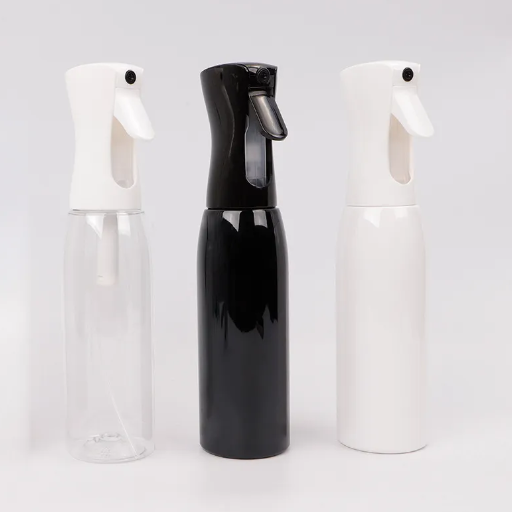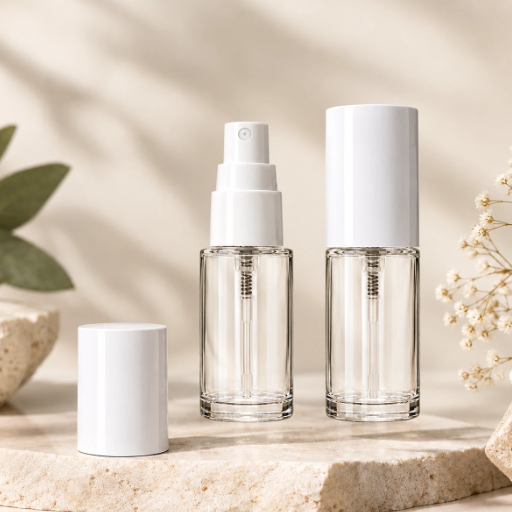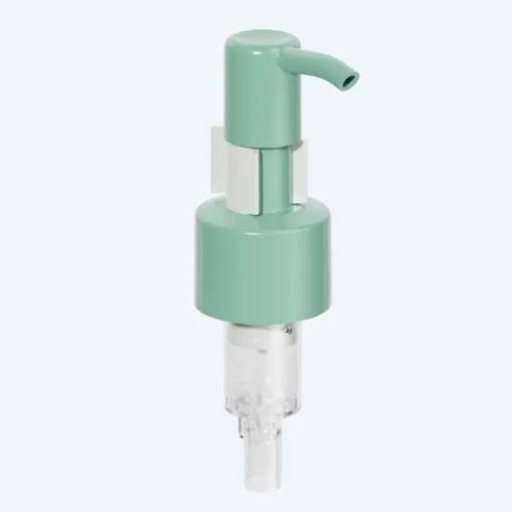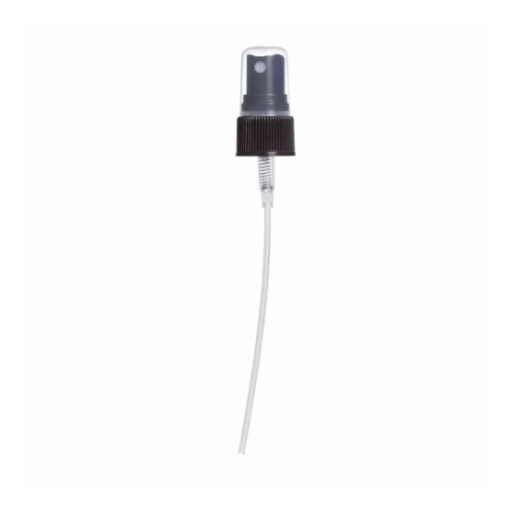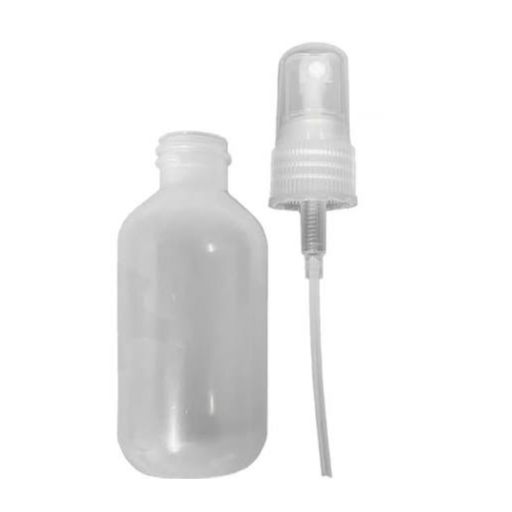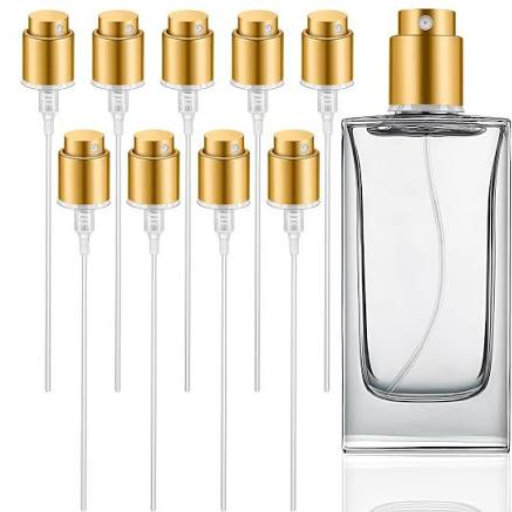
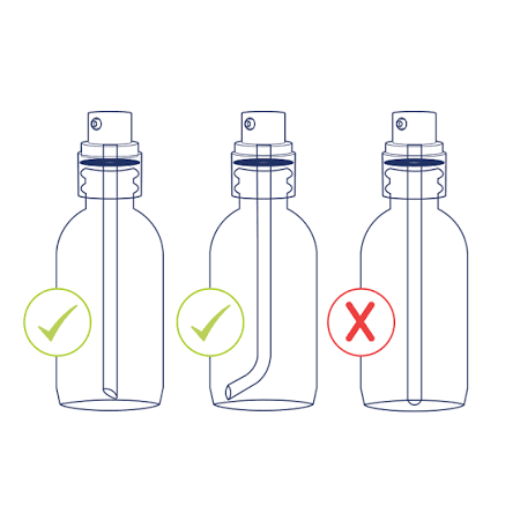
Dip tube length is measured from the sealing face of the closure, the underside that rests on the bottle rim, down to the tip of the tube. The target length is the bottle’s inside depth minus a small clearance, usually 3 to 5 mm for a fine mist sprayer or perfume pump.
Too long and the tube kinks, lifts the closure, or starves the pump. Too short and the customer pours out a bottle that stopped spraying with product still inside.
The confusion comes from where the ruler starts, inside versus outside bottle height, and how much clearance the dispenser needs. This guide settles all three. Our fine mist sprayer guide covers the pump anatomy around the tube.
Key Takeaways
- Measure from the sealing face, the underside of the closure or the face of the gasket, to the tube tip. Never from the cap top or the bottle’s outside height.
- Target length equals the bottle’s inside depth minus 3 to 5 mm. Crimp perfume pumps on flat-base flacons often use 1 to 4 mm; 3 to 6 mm is the wider industry band.
- A tube that’s too long kinks, blocks flow, or stops the closure from seating. A tube that’s too short leaves product behind and sputters early.
- Cut once, at a slight angle, with a sharp blade. You can shorten a plastic tube; you can’t add length back.
- Stock tubes run from about 83 mm to 299 mm (3 1/4″ to 11 3/4″). Put the length and a tolerance on the PO, then test a filled sample.
What Dip Tube Length Actually Measures
A dip tube is the flexible plastic tube that hangs below a pump, sprayer or trigger and reaches into the product. When the user presses the actuator, the pump creates suction and pulls liquid up the tube into the pump chamber.
The length on a spec sheet isn’t the tube’s loose, cut length. It is the installed distance from the sealing face of the closure to the tube tip.
That distinction matters because a pump has height. A 24/410 lotion pump might stand 35 mm above the bottle rim, but that height isn’t part of the dip tube length. Measure from the actuator and you add the pump height, then cut the tube far too short.
The sealing face is the datum
Start at the flat face that contacts the bottle rim when the closure is fully tightened. On a screw pump, that is the underside of the closure. If there is a gasket, it is the gasket face that compresses against the rim.
Citadel Packaging describes the same datum in its dip tube guide: measure from the underside of the closure straight down to the tip, and if the tube is cut at an angle, measure to the longest point. SKS Bottle calls the measurement “gasket to tip” in its measuring guide. Both point to the same plane.
What they rule out is the top face of the gasket, which some guides mention. If the gasket is 1.5 mm thick, starting at its top makes the tube 1.5 mm too short.
Three measurements that give the wrong answer
| Starting point | What it includes | Result |
|---|---|---|
| Top of the actuator or cap | The full pump height | Tube cut far too short |
| Top face of the gasket | The gasket thickness | Tube slightly too short |
| Bottle outside height | Base thickness, plus any punt or dome | Tube too long; it bottoms out and kinks |
The only reliable pair is the sealing face on the closure and the inside base of the bottle. If you are specifying a new pump, send us the bottle drawing and we’ll check the tube length against the fit.
How to Measure Dip Tube Length on the Bottle Side
The bottle side of the equation is the inside depth: the distance from the top of the neck, at the sealing surface, to the inside of the base. Don’t use the overall height from a catalog. That figure includes the base wall. A glass flacon with a thick base can lose 4 to 8 mm to glass alone, and a domed base loses more at the center.
The dowel method
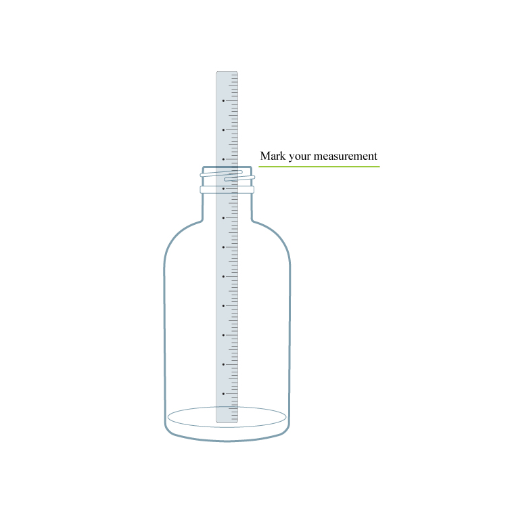
- Stand the empty bottle on a flat surface.
- Lower a thin dowel, skewer or straight piece of wire into the bottle until it touches the inside base.
- Hold the dowel against the neck and mark it level with the sealing surface, not the top of the neck thread.
- Pull it out and measure from the mark to the end.
Citadel recommends this method in its measurement article, and it works on opaque glass where you cannot see the bottom.
The drawing method
If you have the bottle drawing, take the overall height, subtract the base thickness, then subtract any dome height at the center. This is faster for a new mold, but it depends on the drawing being current.
Domed and curved bases
A domed base is the most common reason a tube that measured correctly on paper still bottoms out in production. The center sits higher than the rim, so the tube hits the dome before the closure seats. Add clearance, or let the tube curve into the lowest part of the base.
Dip Tube Length Calculator
Once you have the inside depth, subtract the clearance. The table gives target tube lengths at 3, 4 and 5 mm gaps.
| Bottle inside depth | Tube at 3 mm gap | Tube at 4 mm gap | Tube at 5 mm gap | Inside depth (inches) |
|---|---|---|---|---|
| 60 mm | 57 mm | 56 mm | 55 mm | 2.36″ |
| 80 mm | 77 mm | 76 mm | 75 mm | 3.15″ |
| 100 mm | 97 mm | 96 mm | 95 mm | 3.94″ |
| 120 mm | 117 mm | 116 mm | 115 mm | 4.72″ |
| 150 mm | 147 mm | 146 mm | 145 mm | 5.91″ |
| 180 mm | 177 mm | 176 mm | 175 mm | 7.09″ |
| 200 mm | 197 mm | 196 mm | 195 mm | 7.87″ |
Worked example. A 50 ml flacon measures 112 mm from the sealing surface to the inside base. A 4 mm gap gives a target dip tube length of 108 mm. A stock 110 mm tube can be trimmed by 2 mm. If the only stock option is 100 mm, choose a different pump or a longer tube variant.
Domed base. The same flacon has a base that rises 3 mm at the center. The usable depth is 109 mm, so a 4 mm gap gives 105 mm.
Round to the nearest millimeter on the PO. Tube cutting isn’t precision work.
When the Tube Should Curve, and When It Must Stay Straight
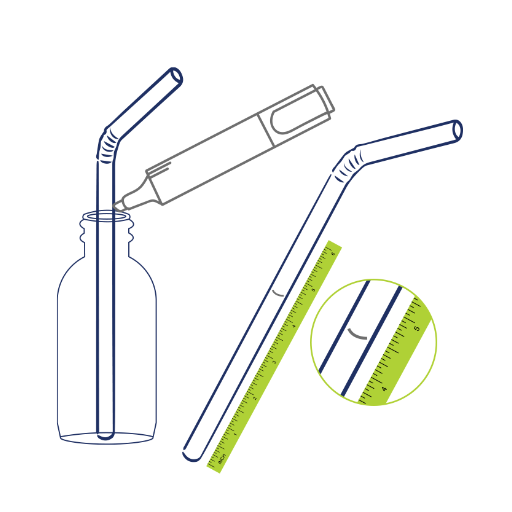
The standard rule is a small gap: the tube tip sits just above the base. SKS Bottle adds an exception worth understanding. Its dip tube guide says fine mist sprayers often dispense better when the tube curves at the bottom of the bottle, and its example pairs a bottle with a 5″ shoulder-to-base measurement with a 5 1/4″ dip tube.
That is 6.35 mm longer than the bottle depth, so the tube bends gently into the base corner instead of standing on the floor.
Both approaches suit different assemblies:
| Condition | Better choice | Why |
|---|---|---|
| Flexible PE tube, straight-sided bottle, fine mist sprayer | A gentle curve, tube 3 to 6 mm longer than the depth | Reaches the last product in the corner; the bottle wall controls the curve |
| Rigid PP tube, narrow shoulder, tall slim bottle | Straight tube with a 3 to 5 mm gap | A rigid tube cannot curve without kinking |
| Lotion or cream pump with viscous product | Straight tube with 3 to 6 mm clearance | A folded tube can starve a thick product entirely |
| Domed or irregular base | Shorter tube or a controlled curve into the low point | The center isn’t the lowest point |
The failure mode decides it. A gentle curve that follows the base is useful. A fold, a pinch or a tube that presses on the base is a defect. If you cannot see the base through the bottle, cut a tube, fit it, fill with water and watch the flow near empty.
Tube stiffness matters too. Our perfume spray pump specifications list PP or PE as the common tube materials. PE bends; PP resists. A pump specified with a rigid tube should not be given a curved-tube allowance.
How to Cut a Dip Tube Without Creating a New Problem
Most plastic dip tubes can be trimmed. Glass dropper pipettes cannot. Citadel makes that distinction explicitly, and it matters if your package uses a dropper rather than a pump.
For a plastic tube, the cut is simple but not careless:
- Fit the pump first. Insert the uncut tube into the empty bottle and screw the closure down. See how far the tip extends past the base line.
- Mark from the sealing face. Hold the pump upright with the tube hanging straight. Measure from the sealing face, not the cap top.
- Cut once with a sharp tool. Sharp scissors or a utility blade. A dull blade crushes the tube and narrows the bore.
- Cut at an angle. A 45-degree cut is the common workshop instruction; Citadel and SKS both say a slight angle is enough. The point is that the inlet cannot seal flat against the base.
- Measure to the longest point. An angled tip has a long side and a short side. The length on the PO refers to the longest point.
- Deburr. Trim any flap. A sliver can block the inlet.
- Test, then trim again if needed. Cut long first. You can remove more material; you cannot put it back.
Hand cutting is fine for a small batch. For a production run, ask the pump or sprayer supplier whether they cut tubes to length. Citadel offers the service with minimums, and Cambrian Packaging demonstrates the operation here:
If you cut in-house, make a simple depth jig. A block with a stop at the target length removes the ruler from the operator’s hand and makes the cut repeatable. Then measure ten tubes from the first hour of production. If the spread is wider than your tolerance, the jig or the blade is moving.
Diameter and Material Matter Too
Length gets the attention because it is easy to measure. Diameter and material decide whether the tube can move the product at all.
Citadel’s guide explains the pattern: a fine mist sprayer moves a small dose of thin liquid, so it uses a narrow sprayer dip tube. A lotion pump dip tube is noticeably wider because it moves a thicker product in a larger dose. A high-output pump or trigger uses a wider tube still. The tube is matched to the dispenser, not chosen from a generic tubing catalog.
That’s why you can’t swap a lotion-pump tube onto a fine mist sprayer and expect the same performance. The pump-body fit may look close. The bore, wall stiffness and formula resistance are wrong for the application.
Material follows the same logic. Our perfume spray pump guide lists PP or PE. PE is more flexible and suits a tube that follows a curve. PP is stiffer and holds a straighter line.
For alcohol-based fragrance, the tube also has to resist swelling and hardening, so it belongs in formula-compatibility testing.
One rule: specify the tube with the pump. The five-part sprayer compatibility check treats the dip tube, gasket, neck finish, closure and actuator as one assembly, because that is how they fail.
Why Tubes Arrive Too Long
Almost every pump and sprayer ships with a tube longer than your bottle needs. That’s a stocking decision.
One tube length can serve a range of bottle heights, so a supplier can hold one SKU instead of twenty. SKS separates two cases:
- Pre-cut: the tube arrives at a standard length for a specific bottle height.
- Adjustable: the tube arrives long so the customer can trim it.
At volume, dip tube cutting moves to the supplier. Citadel’s cutting service confirms the final length and cuts before shipment, which removes the hand operation from your fill line.
Either way, the length belongs on the purchase order. “Standard dip tube” isn’t a specification. Write the length in millimeters, state the tolerance, and name the bottle drawing it was calculated from.
Test the Dip Tube Length Before the Bulk Run
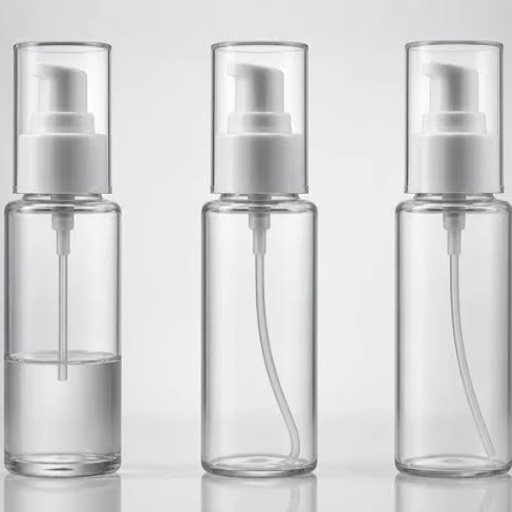
A tube that measures correctly can still fail in use. The test is cheap and catches failures a ruler cannot.
Water test. Fill the bottle with water, fit the pump, and prime it. Then tilt the bottle and draw until it is nearly empty. Watch for the point where flow starts to sputter. That point tells you whether the tube reaches the low corner of the base.
Formula test. Repeat with the real product. A tube that works with water can starve with a thick lotion or a surfactant-heavy cleaner.
Inverted leak test. Fill a sample, invert it and leave it for 24 hours, then check the neck and tube connection. A long tube can push the closure up and break the gasket seal. Our compatibility guide uses this test.
Batch check. Measure ten tubes from the lot, not one. If the supplier quotes a tolerance, verify it before the fill line does.
For a new bottle and pump combination, test a small sample before the bulk order. Twenty to thirty pieces catches a datum error, a domed base or a tube that is too stiff for the bottle shoulder.
Symptoms and Fixes
| Symptom | Likely cause | Fix |
|---|---|---|
| Pump or sprayer will not screw all the way down | Dip tube too long; tip is pressing on the base | Shorten the tube or specify a shorter length |
| Sputters or stops with product still in the bottle | Tube too short, or the inlet is sealed against the base | Use a longer tube; cut the tip at an angle |
| Product left in the bottom corner | Tube does not reach the low point | Allow a controlled curve, or shorten the bottle’s shoulder gap |
| Weak first press after the bottle sits | Tube not submerged, or air entering at the pump connection | Check length and the tube-to-pump fit |
| Tube curled or folded inside the bottle | Tube too long, or too soft for the bottle height | Shorten it, or use a stiffer PP tube |
| Leak at the neck after capping | Tube bottoming out and lifting the closure | Shorten the tube; recheck the gasket |
| Dose varies between strokes | Tube bore or pump model mismatch | Match the tube to the dispenser; do not swap tubing |
The first two rows cover most complaints. They’re opposite errors, so “make it longer” and “make it shorter” are both bad blanket instructions.
What to Put in the RFQ
A dip tube is a one-line item, but the line needs four numbers: length, tolerance, material and the bottle it fits.
Dispenser type: [fine mist sprayer / lotion pump / trigger sprayer]
If you don’t know the tube length, send the bottle drawing and inside depth; the supplier can calculate it. Request a wholesale quote with both. What you should not send is the outside height alone, because that produces a tube that bottoms out.
Our wholesale sprayer guide explains how the same specification feeds into MOQ, inspection and landed cost. For the tube itself, the fields above are enough to get comparable quotes.
FAQ
How long should a dip tube be? Measure the bottle’s inside depth from the sealing surface to the inside base, then subtract 3 to 5 mm. Use 1 to 4 mm for a crimp perfume pump on a flat-base flacon. The exact number belongs to the bottle and pump pair.
Do you measure a dip tube from the top or the bottom of the gasket? From the sealing face: the underside of the closure, or the face of the gasket that presses on the bottle rim. Starting at the top of the gasket adds its thickness and makes the tube too short.
Can I cut a dip tube shorter? Yes, if it is plastic. Cut once with a sharp blade at a slight angle, then test the fit. You cannot add length back, so cut long first. Glass dropper pipettes cannot be trimmed.
Why does my pump not screw all the way down? The tube is probably too long and pressing on the bottle base. It lifts the closure, the gasket never compresses, and the bottle can leak. Shorten the tube or order a shorter length.
Are dip tubes universal? No. Length, diameter, material and the connection to the pump are matched to the dispenser. A tube from a lotion pump will not perform like a fine mist tube, even if it fits the pump body.
Conclusion
Dip tube length is a small number with a large effect on how a bottle performs at the end of its life. Measure from the sealing face to the tube tip, measure the bottle from the sealing surface to the inside base, and subtract the clearance your dispenser needs.
Three habits prevent most failures: put the length and tolerance on the PO with the bottle drawing, cut long and test with the real formula, and measure a batch of tubes before the fill line runs.
If you are specifying a new perfume or cosmetic pack, send us the bottle drawing and the pump or sprayer model. We will match the neck finish, dip tube length and gasket before anything is tooled. Request a free wholesale quote.