The most common perfume box sizes are 30 ml (≈ 9 × 4 × 4 cm), 50 ml (≈ 10 × 5 × 5 cm), and 100 ml (≈ 11.5 × 6.5 × 6.5 cm), but the right size depends on your bottle shape, insert thickness, and board caliper, not just volume. Get any of those wrong and you risk cracked glass, inflated shipping bills, or a box that feels cheap on the shelf.
When Maya launched her niche fragrance line in early 2026, she ordered 1,000 “standard” 50 ml boxes based on a supplier’s generic chart. The bottles arrived intact, but the fit was so loose that every shipment needed extra void fill.
Her dimensional weight jumped 18%. Customers complained that the unboxing felt “mass-produced.” A month later, she switched to a custom-sized rigid box with a 3 mm foam insert. Working with an experienced custom box manufacturer let her prototype the fit before committing to 1,000 units.
That is the difference size makes. In this guide, you will learn the standard perfume box sizes for every common bottle volume, how to calculate custom dimensions from your own bottle, and how sizing decisions affect protection, cost, and brand perception for brands investing in custom perfume packaging.
Key Takeaways
- Standard perfume box sizes follow bottle volume: 30 ml ≈ 9 × 4 × 4 cm, 50 ml ≈ 10 × 5 × 5 cm, 100 ml ≈ 11.5 × 6.5 × 6.5 cm.
- Always add 2–4 mm of internal clearance per side for inserts and cushioning.
- Bottle shape changes the footprint: round, oval, and heart-shaped bottles need different dimensions than rectangular ones.
- Board thickness (caliper) increases outer dimensions without changing interior space.
- Right-sizing reduces dimensional-weight shipping charges and material waste.
- A physical prototype is the only way to verify fit before production.
Need help calculating your exact box size? Request a free sample or quote and we’ll prototype the perfect fit for your bottle.
Why Perfume Box Size Matters More Than You Think

A perfume box has three jobs: protect the bottle, present the brand, and survive the supply chain. Size touches all three.
Protection and shipping safety. Glass bottles are fragile. A box that is too tight strains the bottle during transit; a box that is too loose lets the bottle rattle until it cracks. The right size holds the bottle firmly with just enough cushion.
Shelf presence and retail fit. Retailers often have fixed shelf depths and planogram slots. A 100 ml box that is 2 cm too tall can get rejected or buried on the bottom shelf. A sample box that is too large wastes premium counter space.
Unboxing experience and perceived value. Luxury buyers judge packaging before they smell the fragrance. A snug, well-proportioned box signals precision. A sloppy fit signals corners cut.
Cost, waste, and dimensional weight. Every extra centimeter of empty space is material you pay for twice: once in the box and again in shipping. Carriers price by dimensional weight, so oversized boxes can raise freight costs by 20–40%.
Standard Perfume Box Sizes by Bottle Volume
The global perfume packaging market is projected at USD 3.96 billion in 2026, according to Fortune Business Insights, and continues to grow as fragrance sales shift online. Most retail volume falls into four standard sizes.
| Bottle Volume | Typical Box Dimensions (L × W × H) | Common Use |
|---|---|---|
| 5–15 ml | 45–75 × 35–60 × 20–30 mm | Samples, testers, travel sprays |
| 30 ml | 90–110 × 40–75 × 30–35 mm | Travel size, small retail |
| 50 ml | 100–130 × 50–90 × 40–45 mm | Standard personal fragrance |
| 100 ml | 115–170 × 65–120 × 60–65 mm | Full-size luxury |
| 125–250 ml | 170–210 × 120–160 × 65–85 mm | Jumbo, signature, gift editions |
| Gift sets | 250 × 200 × 100 mm and up | Multiple bottles or accessories |
These ranges are starting points for standard perfume box sizes and perfume box dimensions. Your final dimensions depend on bottle shape, insert type, and material thickness.
30ml Perfume Box Size
The 30ml perfume box size is ideal for travel and entry-luxury fragrances. A typical folding carton measures about 90 × 40 × 30 mm for a slim rectangular bottle, while a rigid setup box for a round 30 ml bottle may run 100 × 100 × 35 mm.
50ml Perfume Box Size
The 50ml perfume box size is the workhorse of the fragrance industry. Standard boxes run roughly 100–120 × 50–80 × 40–45 mm. If you sell a single fragrance, this is the size you will likely order most.
100ml Perfume Box Size
The 100ml perfume box size is the standard full-size luxury format. Full-size luxury bottles need more interior space and stronger boards. Typical rigid boxes measure 115–170 × 65–120 × 60–65 mm, with generous clearance for velvet or EVA foam inserts.
How Bottle Shape Affects Perfume Box Size
Volume alone does not determine dimensions. A 50 ml rectangular bottle and a 50 ml round bottle need very different boxes.
Rectangle and square bottles pack efficiently. Their boxes can be close to the bottle’s footprint with minimal wasted space.
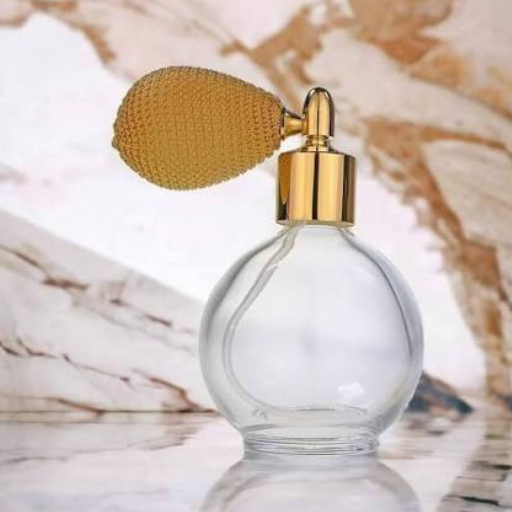
Round and oval bottles need extra width and depth to prevent the curved edges from touching the box walls. Add 3–5 mm of clearance on the width and depth for round bottles.
Heart and novelty shapes are the least efficient. The box must follow the widest point of the bottle, which often leaves visible gaps unless a custom insert fills them.
Tiered and asymmetric bottles require careful measurement at multiple points. Measure the base, the shoulder, and the widest diameter separately.
Calculating Custom Perfume Box Sizes from Your Bottle
Getting from bottle to box size is simple if you measure in the right order.
Step 1: Measure the bottle with the cap on. Record length, width, and height in millimeters. The cap is part of the package, so never measure the bottle alone.
Step 2: Add internal clearance. Add 2–4 mm per side for a paperboard or foam insert. Add 4–6 mm per side for molded pulp or thick velvet. This gives you the interior box dimensions.
Step 3: Add board thickness. A 350 gsm folding carton adds roughly 0.4–0.5 mm per wall. A 2 mm rigid board adds 4 mm total to length and width, and 2 mm to height. This gives you the exterior dimensions.
Worked example. A rectangular 50 ml bottle measures 55 × 35 × 110 mm with the cap. Adding 3 mm clearance per side gives 61 × 41 × 116 mm interior. Using a 2 mm rigid board adds 4 mm to length and width and 2 mm to height, for a final exterior size of 65 × 45 × 118 mm.
That is the number you send to your manufacturer.
Common Perfume Box Styles and Their Size Requirements

Different styles need different tolerances. Here is a quick overview of how structure changes sizing.
Straight tuck end (STE) folding cartons are slim and efficient. They work best for standard 30 ml and 50 ml bottles. Allow 1–2 mm assembly tolerance.
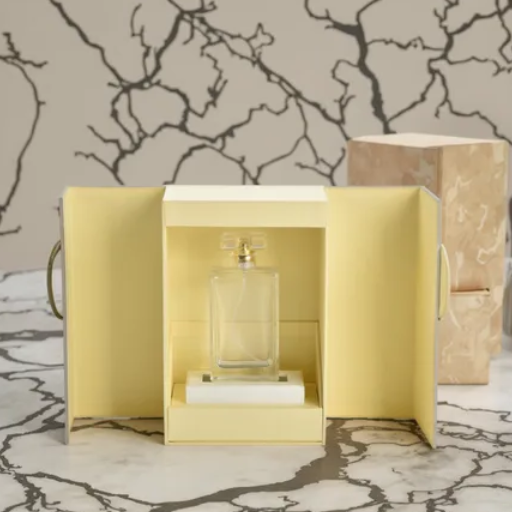
Lid and base / rigid setup boxes feel premium and have thicker walls. They are common for 50 ml and 100 ml luxury fragrances. The lid needs a small overhang, so height dimensions are slightly larger than the base.
Drawer and sleeve boxes add a sliding mechanism. They need extra length and precise tolerances so the drawer moves smoothly without binding.
Round tubes match round or oval bottles. The diameter must be at least 6–10 mm larger than the bottle’s widest point.
Magnetic closure boxes use a hinged lid with a magnet. They need extra board thickness and careful hinge placement, which adds 5–10 mm to the overall height.
Material Thickness and How It Changes Outer Dimensions
Many brands forget this step. The material you choose changes the outside size even when the inside stays the same.
| Material | Typical Thickness | Impact on Exterior |
|---|---|---|
| 300–350 gsm folding carton | 0.4–0.5 mm | Minimal |
| 400–450 gsm SBS board | 0.6–0.8 mm | Moderate |
| 1.5–2 mm rigid board | 1.5–2 mm per wall | Significant |
| Corrugated shipping carton | 3–5 mm per wall | Used for outer shipper, not retail box |
If you are selling in retail, design for the exterior dimensions so your box fits display slots. If you are shipping direct-to-consumer, also check whether the retail box fits inside your corrugated shipper without excess void fill.
Travel-Size and TSA Considerations
Travel-size perfumes must fit TSA’s 3-1-1 rule: containers of 3.4 oz (100 ml) or less inside a quart-sized bag. That means 5–15 ml sample boxes and 30 ml travel boxes should be compact enough for airline trays and retail impulse displays.
Compact travel boxes also reduce material waste. A right-sized 10 ml sample box can use half the board of an oversized one, which matters when you are producing tens of thousands of units.
Gift Set and Multi-Bottle Perfume Box Sizes
Gift box packaging breaks the single-bottle rules. A typical two-bottle gift set for 50 ml fragrances measures roughly 220 × 120 × 90 mm, while a three-bottle set with accessories can reach 280 × 200 × 100 mm.
The key is compartment spacing. Dividers or molded trays should hold each bottle with 5–8 mm of clearance. Lids need extra height to avoid pressing down on caps or sprayers.
When Linnea prepared her holiday trio for retail, she assumed she could simply triple the single-bottle dimensions. The first sample arrived warped: the bottles touched, the lid bulged, and the sprayers were compressed. She added 8 mm between compartments and raised the lid by 12 mm. The final box sat flat, protected the bottles, and looked substantial on the shelf.
How Perfume Box Size Affects Cost and MOQ
Size is one of the fastest ways to control packaging cost.
Material usage and waste. Larger boxes use more board. A 20% increase in each dimension can nearly double the material volume. Efficient sizing reduces both raw material and scrap.
Shipping dimensional weight. Carriers charge by whichever is greater: actual weight or dimensional weight. An oversized 100 ml box can cost significantly more to ship than a right-sized one, even if both weigh the same.
MOQ implications. Smaller boxes often have lower custom packaging MOQs because they use less material and fit more units per production sheet. Larger luxury boxes may require higher minimums to justify setup costs.
When James scaled his DTC fragrance brand, he reduced his 50 ml box height by 8 mm after prototyping. The change saved roughly $0.12 per unit in material and cut his air-freight bill by 14%. On a 10,000-unit order, that was real money.
Want to see how right-sizing affects your quote? Contact our team with your bottle dimensions and we’ll calculate the most efficient box size for your budget.
Prototyping and Sampling: Verify Size Before Production
Spreadsheets and supplier charts are useful, but glass is unforgiving. A physical prototype reveals problems that numbers hide.
Why prototypes matter. A bottle may tilt in the insert. A cap may catch the lid. A board may flex more than expected. You will not see these issues on paper.
What to test. Check fit with the cap on. Drop-test the sealed box from desk height. Stack five units to see if the bottom box deforms. Ship one to yourself to see how it arrives.
If you are sourcing overseas, request a pre-production sample before approving the full run. The cost of one sample is far less than the cost of remaking 5,000 boxes.
Common Perfume Box Sizing Mistakes to Avoid

- Measuring without the cap. The cap is part of the package. Omit it and the box will be too short.
- Ignoring insert thickness. A velvet insert can add 5 mm per side. Design for the insert, not just the bottle.
- Forgetting board caliper. Rigid board eats interior space. Always convert interior dimensions to exterior.
- Oversizing for “premium feel.” A larger box does not feel more luxurious if the bottle rattles inside.
- Skipping structural testing. A beautiful dieline is useless if it collapses under its own weight.
For a deeper look at how perfume packaging works as a complete system, see our complete guide to custom perfume packaging. It covers bottles, caps, labels, materials, and costs alongside the box.
Conclusion
Perfume box sizes are not just numbers on a spec sheet. They are a balance of protection, presentation, and profitability. The standard sizes, 30 ml, 50 ml, and 100 ml, give you a starting point, but the right box is the one measured around your bottle, your insert, and your shipping method.
Start with the dimension tables, add the right tolerances, and verify everything with a prototype. When you get perfume box sizes right, you protect your product, reduce costs, and give customers the unboxing experience that turns a first purchase into a repeat buyer.
Ready to get the exact size for your fragrance line? At Fuzhou Longlu Packaging, we build custom perfume boxes around your bottle measurements, not generic charts. Request a free sample or quote and we’ll help you prototype the perfect fit.