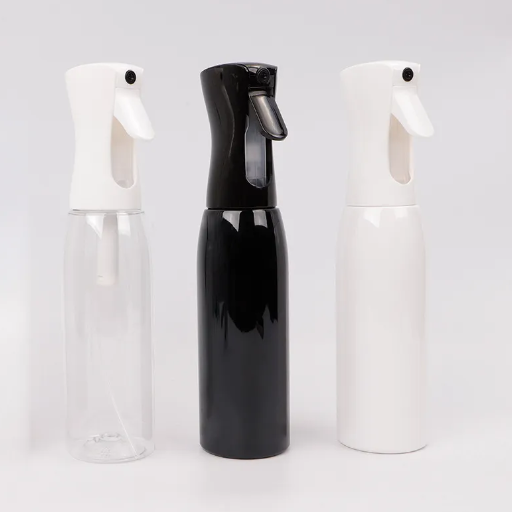
A trigger sprayer manufacturer is only worth a bulk order when it can tie a named model to your bottle neck, your formula, a target output and a closure in writing, then prove it with a sample from the production line. Everything else is a catalogue.
Injection moulders, assembly shops, trading companies and agents all call themselves manufacturers. Directories list names and prices but rarely say who owns the mould, who moulds the parts, or who leak-tests. Most trigger sprayer manufacturers look identical in an email.
This guide gives you a sequence: a spec sheet that produces comparable quotes, the numbers that decide performance, the sample tests that catch failures, and the audit questions that separate a factory from a storefront. If you’re still choosing between dispenser types, our covers that first.
Key Takeaways
- Output is set by the model and nozzle orifice, not the category name; published model outputs run from 0.16 mL to 3.2 mL per stroke.
- 28/400 and 28/410 share a 28 mm diameter but not a thread profile, so a mismatched head can engage and still leak.
- Published factory prices span about USD 0.08 to 0.38 because MOQ, spring, seals, finish and testing differ.
- Test samples with your real formula: priming, output by weight, spray pattern, leak, inversion, drop, cycle and chemical compatibility.
What a Trigger Sprayer Manufacturer Actually Makes
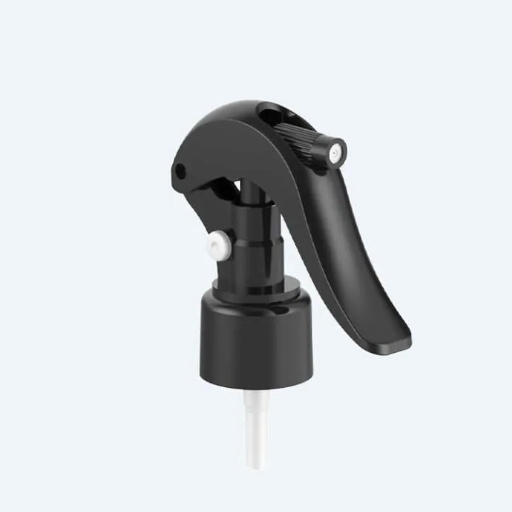
A trigger sprayer is an assembly, not a single moulded part. The parts that decide performance are the trigger lever, piston and cylinder, return spring, ball valves, nozzle or orifice insert, shroud, closure and dip tube.
Each part carries a failure mode. A piston outside its tolerance leaks. A nozzle orifice outside its tolerance drips or clogs.
A carbon steel spring rusts in an alcohol-based formula. A dip tube cut too long can lever the closure off its sealing land.
That’s why the supply route matters more than the brochure:
| Route | What it does | What it controls | What it may not control |
|---|---|---|---|
| Component factory | Moulds parts and assembles the sprayer | Tooling, tolerances, assembly, leak test | Bottle fit if it never sees your bottle |
| Assembler | Buys moulded parts and assembles them | Assembly, spring and seal selection | Part tolerances and mould maintenance |
| Trader | Buys finished units and resells them | Price and delivery | Production, change control, claims |
| Agent | Introduces a factory for a commission | Communication | Anything after the introduction |
Three questions locate the actual production:
- Who owns the mould for this model, and when was it last maintained?
- Which company moulds the trigger, piston, cylinder and shroud?
- Where is the unit assembled, and where is it leak-tested?
If all three answers name the same legal entity and site, you’re dealing with a real trigger sprayer factory. If they split across three companies, you’re dealing with a supply chain. That isn’t automatically bad, but the quotation and change control should name who is responsible.
The Spec Sheet That Produces Comparable Quotes
Most quotes aren’t comparable because the buyer sends a category, not a specification. “Quote 28/410 trigger sprayers” can produce a USD 0.08 unit and a USD 0.28 unit that look identical and behave nothing alike.
Start with the formula. State the measured viscosity in centipoise, the temperature and the shear rate, using a method such as ASTM D2196-15. “Gel” and “cleaner” aren’t specifications. A shear-thinning formula can read differently at two spindle speeds, and that reading decides the orifice and valve.
Then lock the mechanical fields:
- Output per stroke and tolerance. State the target in mL per stroke, the acceptable range, the test fluid and the stroke rate. A Calmar TS800 specification, for example, defines average output on water at 90 strokes per minute as at least 0.75 mL. Without that basis, the number is marketing.
- Neck finish. Give the full code and a bottle drawing. A 28/410 trigger sprayer is the dominant household format in supplier catalogues; 28/400 is the older variant with a different thread profile. 24/410 is common for mini and personal-care formats, and 28/412 appears in some cosmetic lines. The explains the code.
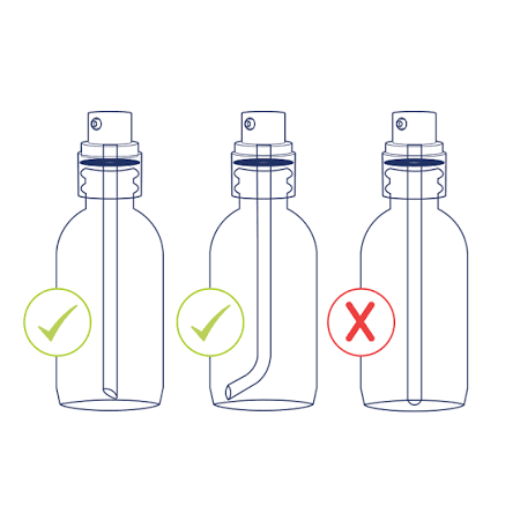
- Dip tube. Give the interior depth and clearance. Suppliers commonly cut to bottle depth minus 1 to 2 mm, within about plus or minus 2 mm. State whether the tube must reach the corner or stop above a sump.
- Spring and seal material. Carbon steel is the economy option. Stainless 304 is the water-based upgrade; 316 is for salt or acidic formulas. Seals may be EPDM, FKM or silicone. For aggressive solvents, an all-plastic fluid path removes the metal. Ask for the bill of materials.
- Lock and closure. Twist lock, clip lock, child-resistant ratchet or tamper-evident overcap.
For a custom trigger sprayer, ask which tools are standard, which are new, and who owns each.
The 12-field trigger sprayer RFQ
Send this table to every supplier. The vague answer in the right column is the follow-up trigger.
| Field | Why it changes the quote | Vague answer that needs a follow-up |
|---|---|---|
| Formula and measured viscosity | Sets orifice, valve and seal material | “It is a cleaner” |
| Target output and tolerance | Sets the chamber and nozzle | “Standard output” |
| Test basis for output | Makes two quotes comparable | “About 1 mL” with no fluid or stroke rate |
| Bottle neck finish and drawing | Sets the closure tooling | “28 mm” without the full code |
| Bottle interior depth | Sets the dip tube length | “Standard tube” |
| Spray pattern | Mist, stream, foam or adjustable | “Normal spray” |
| Spring and seal material | Sets corrosion and chemical resistance | “Good quality material” |
| Lock or child resistance | Adds parts and tooling | “With lock” |
| Colour and decoration | Adds setup and minimums | “Any colour” |
| First order and annual volume | Sets the price tier and capacity slot | “We will see” |
| Destination market and documents | Sets testing and compliance work | “Export standard” |
| Sample and delivery dates | Sets the clock and the start event | “Soon” |
Output, Viscosity and Spray Pattern: The Numbers That Decide
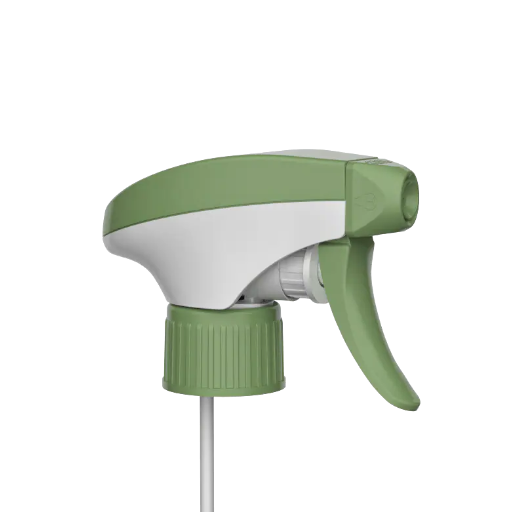
“Trigger sprayer output” isn’t one number. It is a property of the model. Published manufacturer data shows the spread:
| Model | Output per stroke | Closure options |
|---|---|---|
| Silgan Mini-Trigger Curve | 0.16–0.30 mL | Mini format |
| Silgan TS-800 | 0.65, 0.90, 1.30 mL | 28-410 US, 28-410 EU |
| Silgan Mixor HP | 1.3, 1.6 mL | 28-410 |
| Silgan Maxi | 2.2 mL | 28-400 |
| Silgan Maxi T/N | 2.5, 3.2 mL | 28-400 |
| NuoBang NB-201 | 0.8 mL, plus or minus 0.08 | 28/400, 28/410, 28/415 |
| NuoBang NB-204-D | 3.0 mL, plus or minus 0.3 | 28/400, 28/410 |
Sources: Silgan Dispensing product guide and NuoBang product pages.
Berlin Packaging summarises the market as roughly 0.16 mL for a fine mist to 1.5 mL per stroke, with high-output units reaching 4 mL. That orients you. It doesn’t specify your bottle. The model, tolerance and test basis do.
The dose changes the consumer experience. A 500 mL cleaner at 1.2 mL per stroke gives about 417 full strokes; a 2.2 mL head gives about 227. Neither is wrong. One may be wrong for the product’s concentration and routine.
Viscosity: zones, not a universal ceiling
One supplier’s engineering guide maps formulas into three practical zones:
| Zone | Typical formulas | What works | What fails |
|---|---|---|---|
| Up to about 300 cP | Glass cleaners, disinfectants, light degreasers | Standard trigger architecture | Expecting a special design to be necessary |
| About 300–1,500 cP | Liquid soaps, diluted detergents, light lotions | High-viscosity design with wider channels | Standard triggers sputter and drip |
| About 1,500–3,000 cP | Heavy gels, concentrated detergents, dense serums | Tolerance-engineered orifice, wide-bore dip tube | Off-the-shelf units with inconsistent flow |
| Above about 3,000 cP | Very thick gels and pastes | Usually a different closure | Most trigger sprayers |
Treat these as one supplier’s guide, not physical law. Measure your formula at filling and at the coldest expected storage temperature, then test the candidate. A 2,500 cP gel on a warm line can cross a zone boundary in a cold warehouse.
Spray pattern and application fit
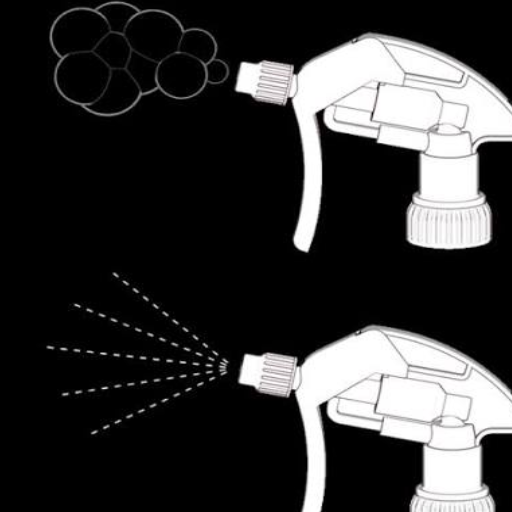
A trigger can deliver a mist, stream, foam or adjustable combination. Foam triggers add a mesh screen; match its density to the formula. Some nozzles rotate between patterns; some units spray upside down.
Application fit is the fastest filter:
- Household cleaning: 0.8–1.5 mL, adjustable spray and stream, 28/410, EPDM or FKM seals by chemistry.
- Garden and automotive: 28/400 or 28/410, stream or coarse spray, UV-stabilised or chemical-resistant resin.
- Personal care and hair: mini trigger sprayer formats, 24/410 or 28/410, 0.16–0.8 mL.
- Sanitiser and alcohol formulas: stainless 316 or an all-plastic fluid path; carbon steel springs corrode.
Price, MOQ and Lead Time: How to Read a Trigger Sprayer Manufacturer’s Quote
Published factory ranges explain most of the price gap. These are indicative, not quotes, from two Zhejiang trigger sprayer suppliers’ public guides:
| Configuration | MOQ | Published price (USD, FOB) |
|---|---|---|
| Standard 28/410, carbon steel spring | 50,000+ | 0.08–0.12 |
| Standard 28/410, stainless spring | 50,000+ | 0.10–0.15 |
| Foam trigger, mesh nozzle, stainless spring | 20,000+ | 0.14–0.20 |
| Industrial, reinforced, chemical-resistant | 10,000+ | 0.18–0.30 |
| Standard 28/410 PP head | 5,000 | 0.18–0.28 |
| Fine mist hair-care sprayer, 24/410–28/412 | 5,000 | 0.22–0.35 |
| Mini trigger, 28/410 | 5,000 | 0.15–0.25 |
| Strong PP/PE trigger, 28/410 | 20,000 | 0.25–0.38 |
The same nominal part spans USD 0.08 to 0.38 because the quotes cover different things. A 50,000-unit carbon-spring order isn’t comparable to a 5,000-unit stainless unit with custom colour and a foam nozzle. Higher prices at lower MOQs aren’t overcharging; setup is amortised.
Ask every trigger sprayer supplier for the same volume ladder, with the same spring, seal, closure, colour and test package. Then compare.
What moves the price: spring and seal material, closure finish, custom colour, new tooling, decoration, test reports, packaging, resin grade and order volume.
MOQ is a range, not a rule. Stock designs commonly start at 5,000 to 10,000 units. Custom colour and custom PP blends often start at 20,000. A new mould can require 50,000 or more. Our sets out the same volume and inspection logic for the sister format.
The only number that matters is the one in your quotation. Trigger sprayer wholesale lists often quote a headline price against a different MOQ.
Lead time needs a start event. Published figures run from 15 to 30 days, and stock samples from 3 to 10 days. “15 days” means nothing without knowing whether the clock starts at order confirmation, deposit receipt or artwork approval. Put the start event in the purchase order. CustomPackingCo’s published production window is 4 to 6 weeks.
Compare total cost, not unit price. At 50,000 units, USD 0.10 versus 0.12 is USD 1,000. A failed leak test or a late season costs more. Add tooling, samples, freight, duty, inspection and a defect allowance before you declare a winner. Our walks through the same arithmetic for the fine mist side.
How to Test a Trigger Sprayer Manufacturer’s Samples
Ask for a production-line sample, not a hand-picked golden one. Run the tests the factory should be running, with your formula, and record the results.
| Test | Method | Pass criterion | Record |
|---|---|---|---|
| Priming | Fill from empty; count strokes to first consistent spray | 3–5 strokes is good; 8–10 suggests a loose check valve | Count, formula, temperature |
| Output by weight | Prime, then 10 full strokes; convert with density | Mean within tolerance; unit CV at or below 7% | Mean, range, CV, basis |
| Spray pattern | 10 consecutive sprays on a target | Centred, consistent, no spitting | Photo, distance, setting |
| Leak | Upright, inverted, side-laid for 24–48 hours | Zero leakage at thread and nozzle | Orientation, result |
| Inversion | Invert a filled unit for 60 seconds | Zero loss for a non-spill claim | Loss in grams, valve type |
| Drop | Filled bottle dropped 1.2 m onto concrete, three faces | No breakage, no leak, trigger works | Face, damage, result |
| Cycle | Run on a cycler or request the supplier’s record | No cracking, flow loss below 10% | Count, flow before and after |
| Chemical compatibility | 72 hours at 40 °C in your formula | No cracking, swelling, colour change or corrosion | Mass change, seal material |
Add one recorded check: dip-tube fit. Cut to the bottle, confirm bottom clearance, tilt the bottle and watch evacuation. A tube that touches the base can starve the pump or lever the closure.
Cycle claims vary widely: 10,000 actuations in one QC protocol, 30,000 to 50,000 for consumer use in another, more for an all-plastic design. None means anything without the test conditions. Ask for the protocol, fluid and acceptance criterion.
A supplier that can’t state a nominal output with a tolerance isn’t ready for a bulk order. Neither is one that can’t send a production-line sample before you commit.
Audit Questions, Documents and Customs
A sample proves the sample. The audit proves the supply.
Ask any trigger sprayer supplier for:
- Legal entity name and business licence, matched to the quotation.
- Export records for your destination market.
- Mould list: own, customer-owned and bought-in.
- Process scope: in-house injection, assembly, leak test, decoration, or subcontract.
- Capacity per SKU, not aggregate factory output.
- QC equipment: leak rig, output test, torque test, dimensional inspection, AQL plan.
- Change control when a mould is repaired or a resin batch changes.
- A COA template and one historical inspection report.
On certificates, ask for the certificate, its scope and its expiry. A logo isn’t a certificate. Relevant documents may include ISO 9001 for the quality system, REACH SVHC declarations for the EU, FDA 21 CFR 177.1520 for polypropylene food-contact grades, and EU 10/2011 migration reports where applicable. Don’t accept a certificate whose scope excludes the product you’re buying.
Red flags: a quote with no model number; “any output is possible” with no tolerance; no question about the neck or dip tube; the same MOQ for every SKU; certificate logos with no certificate; a price far below the band with no explanation; full payment before a sample; more than 45 days for a stock-tooling PP unit.
Customs and shipping. US Customs classified a plastic trigger sprayer under HTSUS 8424.20.1000. It rejected the plastic-closure heading 3923.50 because the sprayer does more than close a bottle. The CBP ruling NY N312381 is a useful reference.
Classification can differ by destination and by whether the unit ships whole or as parts, so confirm with your forwarder. Trigger sprayers aren’t pressurised and not hazardous, but assembled units should be capped or locked to prevent accidental actuation. Additional duties may apply to China-origin goods; confirm the measures in force at shipment.
Where CustomPackingCo Fits
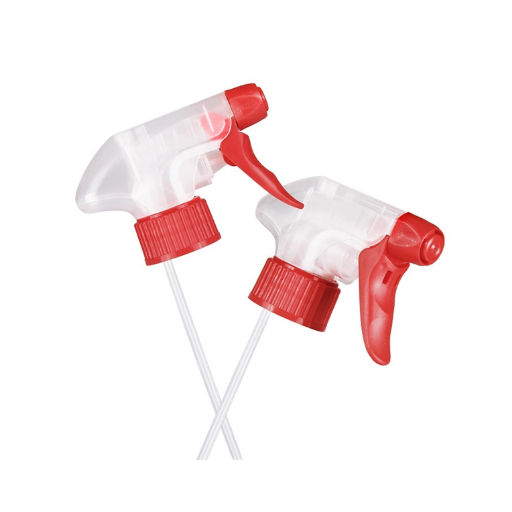
CustomPackingCo is the trading name of Fuzhou Longlu Packaging Co., Ltd., a packaging manufacturer in Fuzhou, China. Our public catalogue is perfume packaging: bottles, caps, boxes, sprays and testers.
Our sprayer comparison page states that the company produces both fine mist and trigger sprayers. Trigger sprayers are quoted as part of a dispensing programme, not as a standalone catalogue line. We can quote the sprayer and bottle as one assembly, check neck and dip-tube fit, coordinate samples, and consolidate trigger sprayers with fragrance packaging.
Our published production window is 4 to 6 weeks. We don’t publish a trigger-sprayer MOQ; it’s quoted per project. The site lists no certifications, so we don’t claim any.
If you have a bottle drawing, a formula profile and a target quantity, . We will tell you which configuration fits, what needs a sample, and what we can’t verify.
Conclusion
Vetting a trigger sprayer manufacturer is a sequence, not a vibe check.
Verify the production scope: who owns the mould, who moulds the parts, who assembles and leak-tests. Write a spec that makes quotes comparable: viscosity, output with tolerance and basis, full neck code, dip tube, spring and seal.
Test a production-line sample with your formula. Audit the paperwork, capacity and change control. Then classify and ship the part correctly.
The best trigger sprayer manufacturer answers in specifications, not adjectives. If a supplier can’t name the model, the tolerance and the test, the price isn’t a price. It is a guess.
For the wider dispensing picture, our covers the pump and sprayer families this article did not. When your specification is ready, for a project review.
Frequently Asked Questions
What does a trigger sprayer manufacturer do?
A trigger sprayer manufacturer moulds or assembles the trigger, piston, cylinder, spring, valves, nozzle, closure and dip tube. A full manufacturer controls tolerances, assembly and leak testing; an assembler or trader may control only part.
How do I verify a trigger sprayer manufacturer is a real factory?
Ask who owns the mould, who moulds the parts, and where the unit is assembled and leak-tested. Match the legal entity to the quotation, then ask for a production-line sample and a COA.
What is the MOQ for custom trigger sprayers?
Stock designs commonly start at 5,000 to 10,000 units. Custom colour and PP blends often start at 20,000; a new mould can require 50,000 or more. Confirm the MOQ for your exact configuration.
How much does a trigger sprayer cost?
Published factory ranges run from about USD 0.08 to 0.15 for a standard 28/410 head at 50,000 units, depending on spring material. Foam, industrial and low-MOQ units run higher. Compare only when MOQ and specification match.
What is the lead time for trigger sprayers?
Published production times run from 15 to 30 days; stock samples take 3 to 10 days. Define the start event: order confirmation, deposit or artwork approval. CustomPackingCo’s window is 4 to 6 weeks.
Can I get a free sample?
Many Chinese suppliers offer free stock samples with freight paid by the buyer, and charge for custom colours or tooling. Ask whether the sample comes from the production line. A sample that doesn’t match production isn’t a sample.
Is 28/410 or 28/400 better?
Neither is better in isolation. 28/410 is the dominant household finish in supplier catalogues; 28/400 is the older variant. They share a 28 mm diameter but the thread profiles differ, so they aren’t reliably interchangeable.
Can CustomPackingCo supply trigger sprayers?
Yes, as part of a dispensing programme. Our comparison page states that the company produces both fine mist and trigger sprayers. Our public catalogue is perfume packaging, and trigger sprayers are quoted per project.