The best luxury perfume packaging in 2026 combines sustainable materials, multi-sensory unboxing experiences, and structural innovation that turns a simple box into a brand statement. Leading fragrance houses now spend 15 to 20 percent of their product cost on packaging because they know it drives the purchase decision before a customer ever smells the scent.
Here is the surprising part. A 200fragranceanda200fragranceanda40 fragrance can contain nearly identical raw materials. The difference? Often, it is the weight of the glass, the texture of the box, and the satisfying click of a magnetic closure. Your packaging does not just hold your product. It sells it.
When Elena launched her niche fragrance brand in Milan last year, she invested heavily in perfumery. She sourced rare oud oils and hired a celebrated nose. But she skimped on packaging, choosing a standard folding carton with basic printing. Her first batch of 1,000 units sat in warehouse inventory for six months. Then she redesigned everything. She switched to a rigid magnetic box with velvet lining, embossed gold foil, and a custom-molded EVA insert. The same fragrance, in new packaging, sold out in three weeks at double the price.
That is the power of luxury perfume packaging. And in 2026, the stakes have never been higher.
In this guide, you will learn: what makes perfume packaging truly luxurious, which materials and finishes define premium quality, the top design trends shaping the industry, how to balance sustainability with aesthetics, what to budget for different packaging tiers, and how to choose a manufacturing partner that delivers on time and on spec.
Key Takeaways
- The luxury perfume packaging market reached $4.52 billion in 2026 and is growing at 7.1% annually.
- Refillable systems, mono-material construction, and lightweighting are the three sustainability trends reshaping the industry.
- Magnetic closure rigid boxes, drawer boxes, and book-style boxes are the most effective structures for high-end fragrances.
- Premium finishing techniques like foil stamping, embossing, and soft-touch lamination increase perceived value by up to 40%.
- Working with an experienced one-stop manufacturer reduces lead times, simplifies quality control, and often cuts costs by 20 to 30% compared to sourcing components separately.
What Makes Perfume Packaging Truly Luxurious?
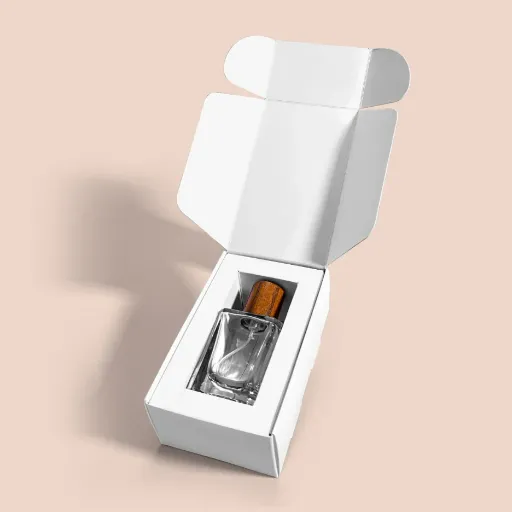
Luxury is not about excess. It is about intention. Every element of luxury perfume packaging serves a purpose. The weight of the bottle signals quality. The texture of the box invites touch. The unboxing sequence builds anticipation. Together, these elements create what psychologists call the “halo effect”, where premium packaging elevates the perceived quality of the product inside.
The Psychology of Perceived Value
Research shows that consumers form their first impression of a product within seven seconds. For fragrances, that impression happens entirely through packaging. A heavy glass bottle with a polished zamac cap feels substantial in the hand. A rigid box with soft-touch lamination invites the fingertips to linger. These tactile cues bypass rational analysis and trigger emotional responses associated with luxury, trust, and desirability.
The unboxing experience amplifies this effect. When a customer slides open a drawer box, lifts a ribbon pull, and reveals a bottle nestled in velvet, they are not just opening a package. They are entering a brand story. The most successful fragrance brands of 2026 treat unboxing as theater, designing every moment for maximum emotional impact.
Key Differentiators vs. Mass-Market Packaging
Luxury perfume packaging stands apart from mass-market alternatives in five critical ways:
- Material quality. High-density rigid board replaces lightweight folding carton. Thick glass replaces thin molded plastic. Solid wood or metal caps replace injection-molded alternatives.
- Finishing precision. Foil stamping with micron-level accuracy. Embossing and debossing that creates measurable depth. Spot UV that catches light at exactly the right angle.
- Structural complexity. Magnetic closures, nested inserts, and multi-layer reveals that transform opening into an experience.
- Interior detail. Velvet, satin, or custom-molded EVA foam that cradles the bottle with tailored precision.
- Sustainability credibility. FSC-certified materials, post-consumer recycled content, and transparent messaging that builds trust with eco-conscious consumers.
The Luxury Perfume Packaging Market in 2026
Understanding the market landscape helps you make smarter packaging decisions. It also reveals where the greatest opportunities lie for emerging and established brands alike.
Market Size and Growth Forecasts
The high-end perfume packaging market is valued at 4.52billionin2026,accordingtoindustryforecasts.Itisprojectedtoreach4.52billionin2026,accordingtoindustryforecasts.Itisprojectedtoreach6.81 billion by 2034, growing at a compound annual growth rate of 7.1%. The broader fragrance packaging market sits at $13.8 billion and is expanding steadily as consumer demand for premium experiences continues to rise.
Within the total luxury packaging market, cosmetics and fragrance is the dominant end-user segment, accounting for roughly 51% of all revenue. This means fragrance brands are driving innovation across the entire luxury packaging industry.
Consumer Behavior Insights
Consumer expectations have shifted dramatically. Approximately 62% of luxury consumers are now willing to pay more for environmentally friendly perfume packaging. This is not a niche preference. It is a market imperative. Brands that ignore sustainability risk losing relevance with the very audience they aim to attract.
At the same time, 80% of young consumers prefer products with simple, minimal packaging. The “quiet luxury” movement has moved from fashion into fragrance. Clean lines, restrained color palettes, and generous negative space now signal sophistication more effectively than ornate decoration.
Regional Market Dynamics
Packaging preferences vary significantly by region, and smart brands adapt accordingly.
Europe leads the perfume packaging market with a 31.98% share, driven by heritage brands in France, Germany, and Italy. European consumers favor understated elegance. Soft-touch finishes, muted palettes, and drawer or slanted-opening boxes perform well here.
North America holds approximately 25.6% of the market. North American consumers respond to texture-focused designs, classic shapes with modern finishes, and small-batch customization options.
Asia-Pacific is the fastest-growing region, with a CAGR of approximately 11.3%. China, India, and Japan are fueling explosive demand. This market rewards bold innovation, social-media-ready designs, and collectible limited editions.
The Middle East demands visual richness. Deep jewel tones, dramatic gold foil stamping, 3D embossing, and display-worthy formats like book-style and pedestal boxes align with cultural gift-giving traditions.
Top 8 Luxury Perfume Packaging Trends for 2026
The fragrance packaging landscape evolves rapidly. Here are the eight trends that will define success in 2026 and beyond.
1. Quiet Luxury and Minimalist Design
The era of logo-heavy, ornate packaging is fading. In its place, “quiet luxury” emphasizes restraint and precision. Think clean lines, limited color palettes, and generous negative space. Neutral tones like sand, slate, charcoal, warm beige, and soft pastels dominate. Gold foil appears not as decoration but as a single, perfectly placed accent.
This trend is particularly powerful for niche and artisanal brands that want to signal sophistication without shouting. A well-executed minimalist design has nowhere to hide. Every material choice, every alignment, every finish must be flawless.
2. Sustainable Materials and Refillable Systems
Sustainability is no longer optional in luxury perfume packaging. It is expected. The most significant development is the rise of refillable systems. Brands like Dior, Mugler, and Le Labo have proven that consumers will embrace refillable bottles when the experience feels premium rather than compromised.
Beyond refills, brands are adopting FSC-certified paperboard, post-consumer recycled glass with up to 85% recycled content, bio-based plastics, and mono-material construction that simplifies end-of-life recycling. Over 40% of new fragrance packaging launches will incorporate eco-friendly features by 2027.
3. Multi-Sensory Unboxing Experiences
Packaging in 2026 engages every sense. Tactile surfaces like soft-touch coatings, linen textures, and embossed papers invite touch. Magnetic closures create an audible, satisfying snap. Some brands even use custom-scented paper or inserts that release the fragrance upon opening. The unboxing moment has become shareable theater, designed for social media and emotional connection.
When Marcus, a product manager at a Dubai-based fragrance house, redesigned his brand’s packaging to include a velvet-lined drawer box with a slow-slide mechanism, customer unboxing videos on Instagram increased by 340% within the first quarter. The packaging itself became marketing.
4. Architectural and Structural Innovation
The traditional rectangular box is giving way to bold architectural forms. Drawer boxes, double-lid reveals, slide-out mechanisms, and nested constructions unveil the product in stages. High-precision die-cutting enables irregular geometric structures. Book-style boxes and pedestal displays transform packaging into collectible objects.
These structures do more than look beautiful. They protect fragile glass bottles during shipping, create memorable reveal moments, and encourage customers to keep and repurpose the packaging.
5. Smart Packaging and Anti-Counterfeiting Technology
Counterfeiting costs the luxury perfume market approximately $3.2 billion annually. In response, brands are integrating NFC tags, QR codes, and blockchain verification into their packaging. A customer taps their phone to the box and instantly verifies authenticity, accesses the product’s provenance, or joins an exclusive digital community.
Smart packaging also bridges physical and digital experiences. QR codes can link to video content about the perfumer, the sourcing of ingredients, or the brand’s sustainability story.
6. Mass Personalization and Digital Printing
Digital printing and variable data technology now allow brands to create packaging tailored to individual customers. Engraved caps, personalized names on boxes, custom messages, and occasion-specific designs drive higher conversion rates in direct-to-consumer and gifting channels.
This trend is especially powerful for niche brands that want to create emotional connections without the volume requirements of traditional printing methods.
7. Lightweighting Without Compromising Premium Feel
“Heavy glass equals luxury” was the old rule. In 2026, the new luxury signal is engineering precision. Brands are achieving a premium feel with less material by focusing on geometric stability, closure engineering, and fit tolerance. Lightweighting reduces shipping emissions and raw material costs while maintaining the heft and balance that customers associate with quality.
This shift requires sophisticated manufacturing partners who understand how to engineer precision into every component. It is not about using less material carelessly. It is about using exactly the right amount, in exactly the right way.
8. Regional Design Adaptations
Global fragrance brands are moving away from one-size-fits-all packaging. Instead, they use modular systems with core design constants and regional adaptations. A European market might receive understated drawer boxes in muted tones. The same fragrance in the Middle East ships in book-style boxes with gold foil and deep jewel tones. Asia-Pacific markets see bold, collectible formats designed for social sharing.
Want to see how these trends translate into real packaging options? Browse our full range of custom perfume boxes to explore magnetic, drawer, book-style, and velvet designs tailored to your brand vision.
Essential Materials for Luxury Perfume Packaging
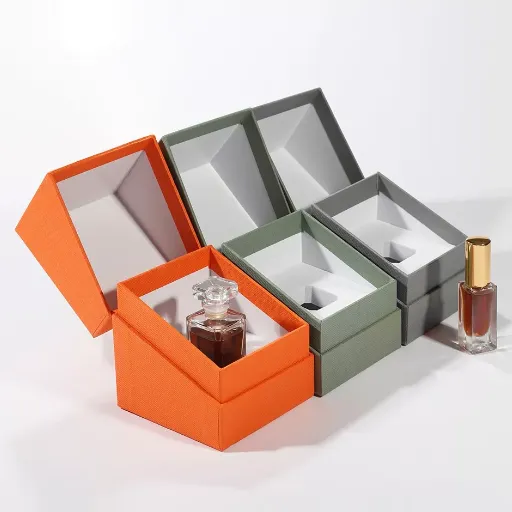
Material selection is the foundation of every packaging decision. The right materials protect your product, communicate your brand values, and justify your price point.
Primary Box Materials
Rigid board is the industry standard for luxury perfume packaging. Unlike folding carton, rigid board maintains its shape under pressure and delivers a substantial, premium feel. Typical constructions use 1.5mm to 3mm greyboard wrapped in specialty paper.
Specialty papers elevate the exterior. Options include metallic paper, textured linen, velvet-flocked surfaces, leatherette, and art paper with premium lamination. Each creates a different tactile and visual impression.
Kraft paper appeals to eco-conscious brands. When paired with minimalist design and soy-based inks, it signals authenticity and environmental responsibility.
Bottle Materials
Glass remains the dominant material for luxury perfume bottles. Crystal and lead-free glass offer superior clarity and weight. Frosted glass creates a soft, diffused aesthetic. Colored glass adds personality and brand recognition.
PCR glass (post-consumer recycled) is gaining traction. Leading suppliers now achieve up to 85% recycled content while maintaining the clarity and finish that luxury brands demand.
Acrylic offers lighter weight and greater design flexibility. It is particularly useful for travel sizes, sample formats, and novelty shapes where glass would be impractical.
For brands seeking premium glass options, our crystal and luxury perfume bottles collection offers clear, frosted, and custom-colored varieties with full decoration support.
Cap and Closure Materials
Zamac (zinc alloy) is the gold standard for luxury caps. It delivers substantial weight, precise machining, and a premium metallic finish.
Wood caps made from beech, ash, walnut, or maple are trending in 2026. They offer eco-friendly appeal and a warm, natural tactile quality that differentiates brands in a crowded market.
Metal caps in aluminum, brass, or stainless steel provide durability and a modern industrial aesthetic.
Ceramic and resin caps enable intricate molded designs and custom colors that would be impossible with metal or wood.
Sustainable Alternatives
The material landscape is expanding rapidly. Bamboo offers rapid renewability and natural texture. Bio-based plastics derived from sugarcane or corn reduce fossil fuel dependence. Mycelium-based packaging (mushroom roots) provides compostable alternatives to foam inserts. Molded pulp replaces plastic vac trays with fiber-based protection.
Premium Finishing Techniques That Define Luxury
Finishing is where good packaging becomes great. These techniques add depth, texture, and visual impact that mass-market packaging cannot replicate.
Surface Finishes
Foil stamping applies metallic or pigment foil to the surface using heat and pressure. Gold, silver, rose gold, and holographic foils are standard. The precision of registration and the depth of impression separate luxury finishes from basic alternatives.
Embossing raises a design element above the surface. Debossing presses it below. Both create tactile interest and catch light in ways that flat printing cannot. When paired with foil stamping, they produce dimensional effects that command attention.
Soft-touch lamination applies a matte coating with a velvety texture. It makes customers want to hold the box longer. It also masks minor surface imperfections that gloss finishes would highlight.
Spot UV applies a selective gloss coating to specific design elements. The contrast between matte and glossy surfaces creates sophisticated visual depth without overwhelming the design.
Structural Details
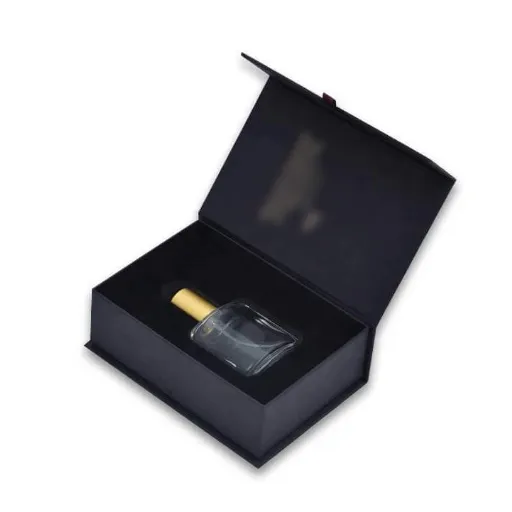
Magnetic closures have become the hallmark of luxury packaging. The satisfying snap communicates quality and ensures the box stays closed during handling and display.
Ribbon pulls add elegance and functionality, guiding the customer through the unboxing sequence.
Hinged lids with reinforced creases allow repeated opening without wear. This matters for retail displays and for customers who keep packaging as storage.
Interior Treatments
The inside of the box deserves as much attention as the outside. Velvet lining creates softness and luxury. Satin adds a subtle sheen. Custom-molded EVA foam cradles the bottle with precision. Molded pulp offers eco-friendly protection. The interior is the first thing a customer sees when they open the box. Make it count.
Choosing the Right Box Structure for Your Fragrance
Box structure affects everything from perceived value to shipping durability. Here is how the most popular options compare.
| Box Style | Best For | Key Features | Price Range |
|---|---|---|---|
| Magnetic closure rigid box | Premium and niche brands | Satisfying snap, reusable, display-worthy | 3–3–15 per unit |
| Drawer / slide box | Gift sets and limited editions | Smooth reveal, ribbon pull option | 2.50–2.50–12 per unit |
| Book-style box | Collectible and heritage brands | Dramatic opening, story-driven | 4–4–18 per unit |
| Sleeve box | Minimalist and modern brands | Clean lines, cost-effective luxury | 1.50–1.50–8 per unit |
| Top-and-bottom (telescope) | Retail displays and travel sizes | Stackable, protective | 1–1–6 per unit |
| Pedestal display box | Limited editions and flagship scents | Maximum impact, showcase design | 5–5–20 per unit |
Selection Criteria by Brand Tier
Niche and artisanal brands should prioritize differentiation. Unconventional shapes, mixed materials, and handcrafted details signal small-batch authenticity. A book-style box with hand-tied ribbon and wax seal communicates exclusivity.
Prestige brands need consistency at scale. Magnetic closure rigid boxes with standardized dimensions enable efficient production while maintaining luxury standards. Consistent finishing across seasonal collections builds brand recognition.
Mass-premium brands balance cost and quality. Sleeve boxes with foil stamping and soft-touch lamination deliver perceived value without premium structural costs. Smart material choices and efficient design keep per-unit costs manageable.
Sustainability in Luxury Perfume Packaging: Beyond the Trend
Sustainability in 2026 is not a marketing angle. It is a business requirement. Here is how to implement it without compromising luxury.
Refillable Systems and Circular Design
Refillable packaging is the most impactful sustainability strategy for fragrance brands. A reusable outer bottle with replaceable inner cartridges reduces waste, encourages repeat purchases, and creates an ongoing customer relationship.
Engineering is critical here. Silicone or EPDM seals, ultra-fine screw threads, and guided alignment mechanisms ensure bottles handle 20 to 30 refill cycles without leakage or evaporation. Without this precision, refillable systems fail and damage brand trust.
Mono-Material Construction
Mixed-material packaging is difficult to recycle. Mono-material construction uses a single material throughout, simplifying end-of-life processing. All-paper boxes with water-based coatings. All-glass bottles with easily separable metal caps. These designs meet tightening Extended Producer Responsibility regulations, particularly in the European Union.
Certifications That Matter
FSC certification verifies that paper materials come from responsibly managed forests. Cradle to Cradle evaluates products for circular design. EPR compliance ensures your packaging meets regional recycling requirements. Displaying these certifications on your packaging builds consumer trust and satisfies retailer requirements.
Cost vs. Value of Sustainable Choices
Sustainable materials typically command a 25 to 40% premium over conventional alternatives. But the value proposition extends beyond the material cost. Refillable systems increase customer lifetime value. Sustainable credentials attract retailer partnerships. Compliance avoids regulatory penalties. When Elena, the Milan-based founder we met earlier, switched to FSC-certified board and water-based coatings, her per-unit packaging cost increased by 18%. But her wholesale buyer acceptance rate jumped from 40% to 78%, and her direct-to-consumer conversion rate improved by 22%. The packaging investment paid for itself within two production cycles.
How to Source Luxury Perfume Packaging: A Buyer’s Guide
Finding the right manufacturing partner is as important as choosing the right design. The wrong partner causes delays, quality issues, and budget overruns. The right partner becomes an extension of your brand team.
Defining Your Requirements
Before contacting manufacturers, document your needs clearly. What is your target per-unit cost? What is your minimum order quantity? What is your timeline from design approval to delivery? What level of customization do you need, standard shapes with custom printing, or fully bespoke structural designs?
Be specific about materials, finishes, and dimensions. Vague requests lead to mismatched quotes and production surprises.
Evaluating Manufacturers
Experience matters. A manufacturer with 15+ years in fragrance packaging understands the unique challenges of your industry. They know how to engineer foam inserts that prevent breakage. They understand how different coatings interact with fragrance oils. They have established relationships with material suppliers that ensure consistency.
Look for full-service capabilities. A one-stop manufacturer that handles bottles, caps, boxes, and sprayers simplifies logistics, reduces coordination overhead, and ensures component compatibility. You avoid the “tolerance gap” problem that occurs when separate suppliers produce parts that do not fit together perfectly.
Quality control processes should be rigorous. Ask about inspection protocols, sampling procedures, and defect rate history. Request references from existing clients in your target market.
At Fuzhou Longlu Packaging, we have specialized in luxury perfume packaging since 2007. Our custom perfume packaging
solutions cover everything from concept development to final delivery, with rigorous quality control at every stage.
Prototyping and Sampling
Never commit to full production without seeing and handling physical prototypes. Digital mockups and renderings cannot communicate weight, texture, or opening dynamics. A prototype reveals issues that no screen can show.
Request pre-production samples that use the exact materials, finishes, and construction methods planned for the full run. Test them in real-world conditions. Ship them. Drop them. Open them repeatedly. If the prototype does not feel right, the production run will not either.
Understanding Lead Times and Logistics
Production timelines vary significantly by region and complexity. Chinese manufacturers typically require 30 to 45 days for custom orders. U. S.-based suppliers average 6 to 10 business days but at higher per-unit costs. Factor in shipping time, customs clearance, and any potential delays.
E-commerce brands have additional considerations. Packaging must protect glass bottles through the shipping process while still delivering a luxurious unboxing experience. This often requires a dual-layer approach: protective outer shipping packaging and a premium inner gift box.
Cost Breakdown: What to Budget for Luxury Perfume Packaging
Understanding costs helps you plan realistically and avoid surprises.
Price Ranges by Component
Boxes: Basic custom perfume boxes start around 0.50perunitforsimplefoldingcartons.Mid−tierrigidboxeswithfoilstampingandsoft−touchlaminationrangefrom0.50perunitforsimplefoldingcartons.Mid−tierrigidboxeswithfoilstampingandsoft−touchlaminationrangefrom2 to 8perunit.High−endcustomstructureswithmagneticclosures,velvetlining,andcomplexinsertscanreach8perunit.High−endcustomstructureswithmagneticclosures,velvetlining,andcomplexinsertscanreach15 or more per unit.
Bottles: Standard glass bottles range from 0.30to0.30to2 per unit depending on size, weight, and decoration. Crystal or heavy glass bottles with custom shapes and silk-screen printing range from 2to2to10 per unit. PCR glass typically adds 15 to 25% to the base cost.
Caps: Plastic injection-molded caps start around 0.10perunit.Zamacormetalcapsrangefrom0.10perunit.Zamacormetalcapsrangefrom0.50 to 3perunit.Woodorcustom−moldedcapsrangefrom3perunit.Woodorcustom−moldedcapsrangefrom0.30 to $5 per unit depending on material and complexity.
Factors That Drive Cost
Material selection is the biggest variable. FSC-certified specialty papers, imported textiles, and precious metal foils increase costs significantly. Order volume affects per-unit pricing dramatically. A 5,000-unit order typically costs 40 to 60% less per unit than a 500-unit order. Customization complexity adds cost with each additional process. A box with foil stamping, embossing, spot UV, and magnetic closure requires multiple production stages.
ROI: How Premium Packaging Pays for Itself
Premium packaging is an investment, not an expense. Studies show that luxury packaging can increase perceived product value by 30 to 40%. For a 150fragrance,thatmeanspackagingthatsignals150fragrance,thatmeanspackagingthatsignals200+ quality justifies the price and reduces price sensitivity.
Premium packaging also reduces returns. Better protection means fewer broken bottles. Better presentation means fewer “not as described” complaints. Better unboxing experiences drive social sharing that generates organic marketing.
When you work directly with a perfume bottle manufacturer that offers factory-direct pricing, you eliminate intermediary markups and often reduce total packaging costs by 20 to 30% compared to sourcing through distributors.
Common Mistakes to Avoid in Luxury Perfume Packaging
Even experienced brands make these errors. Learn from them.
Over-designing at the expense of functionality. A box covered in every possible finish looks cluttered, not luxurious. Restraint signals confidence. Choose two or three finishing techniques and execute them flawlessly.
Ignoring e-commerce shipping requirements. A beautiful box that arrives crushed destroys the brand experience. Design for the entire journey, from warehouse to doorstep.
Neglecting sustainability messaging. If you use eco-friendly materials, say so. Silent sustainability misses the marketing opportunity and can trigger skepticism.
Inconsistent brand storytelling across touchpoints. Your bottle, box, website, and social media should tell the same story. A minimalist digital brand paired with ornate packaging creates confusion.
Underestimating lead times. Custom packaging takes time. Rushing production compromises quality. Plan your packaging development at least three to four months before your product launch.
Choosing the cheapest option. The lowest quote often hides costs in rework, delays, and quality issues. Evaluate total value, not just unit price.
Frequently Asked Questions
What makes perfume packaging look luxurious?
Luxury perfume packaging relies on material quality, finishing precision, and sensory design. Thick rigid board, specialty textured papers, foil stamping, and soft-touch coatings signal high value. The weight of the glass bottle, the quality of the unboxing experience, and the consistency of brand storytelling all contribute to perceived luxury.
What is the best material for high-end perfume boxes?
High-density rigid greyboard wrapped in specialty papers is the industry standard. This construction provides structural integrity and a substantial feel. For the exterior, metallic paper, velvet, textured linen, or art paper with premium lamination are most common. For interiors, velvet, satin, or custom-molded EVA foam cradle the bottle with precision.
Is refillable packaging popular in luxury perfume?
Yes. Refillable packaging has moved from a niche eco-feature to a structural industry shift. Leading brands like Dior, Mugler, and Le Labo have proven that consumers embrace refillable systems when the experience feels premium. Refillable bottles reduce waste, encourage repeat purchases, and allow brands to maintain a “forever bottle” aesthetic.
How much does custom luxury perfume packaging cost?
Costs vary by component and complexity. Custom rigid boxes range from 2to2to15 per unit. Glass bottles range from 0.30to0.30to10 per unit. Caps range from 0.10to0.10to5 per unit. Total packaging costs for a premium fragrance typically fall between 3and3and25 per unit depending on materials, finishes, and order volume.
What box styles work best for luxury fragrances?
Magnetic closure rigid boxes, drawer boxes, and book-style boxes are the most effective for high-end fragrances. Magnetic closures deliver a satisfying tactile experience. Drawer boxes create smooth reveals ideal for gifting. Book-style boxes provide dramatic openings perfect for limited editions and heritage brands.
Can small perfume brands afford luxury-style packaging?
Yes. Small brands can achieve a premium look by making smart design choices. Simplified but elegant box structures like sleeve or drawer boxes, efficient production runs, and focused finishing techniques deliver luxury perception without extravagant budgets. Working with an experienced manufacturer who offers flexible minimum order quantities makes luxury packaging accessible to brands of all sizes.
Conclusion
Luxury perfume packaging in 2026 is defined by a powerful tension. Consumers want sustainability and restraint. They also want sensory richness and emotional impact. The brands that succeed are those that resolve this tension through intelligent design.
The market is growing at over 7% annually. Consumer expectations have never been higher. And the gap between brands that invest in packaging excellence and those that treat it as an afterthought has never been wider.
Here is what to remember. Choose materials that protect your product and communicate your values. Select finishes that add depth without clutter. Design structures that transform opening into experience. Partner with manufacturers who understand your vision and can execute it at scale. And never forget that your packaging is your first and most lasting impression.
Ready to elevate your fragrance brand with luxury packaging that sells? Contact Fuzhou Longlu Packaging today for a custom quote. With nearly two decades of experience serving international fragrance brands, we deliver one-stop packaging solutions from concept to delivery. Browse our custom perfume packaging options or reach out directly to discuss your project.