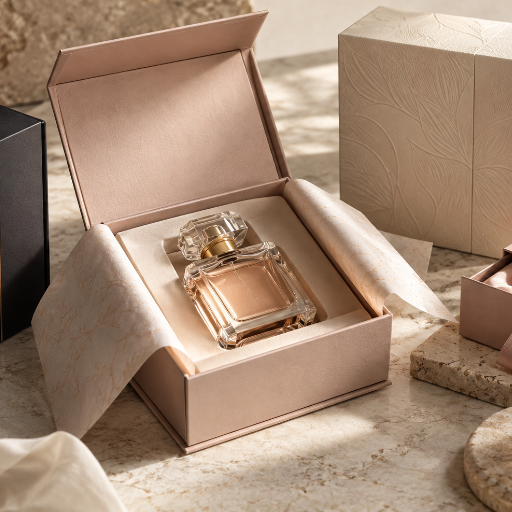
The best perfume box packaging materials depend on your brand tier, sales channel, and sustainability goals. Rigid board (800–1,500 gsm) works for luxury keepsake boxes. SBS folding carton (250–400 gsm) suits retail. Corrugated board protects e-commerce shipments.
Molded pulp or EVA foam inserts protect the glass bottle inside. Match the outer substrate to your finish plan. Foil stamping and soft-touch lamination perform better on rigid board. Cost-efficient cartons favor high-quality offset printing.
That decision sounds simple until you’re staring at a supplier catalog full of greyboard, chipboard, Kraft, and E-flute samples. Elena, a product manager launching her first niche fragrance, learned this the hard way.
She ordered rigid boxes with velvet inserts for a 45retailperfume.Herunitcostclimbedpast45retailperfume.Herunitcostclimbedpast8. Then bottles cracked during FedEx transit because the outer shipper was too thin.
Her second run used a rigid retail box with a molded pulp insert inside a corrugated shipper. Damage dropped by 90% and her packaging cost fell by 40%.
This guide gives you the same framework for choosing perfume box packaging materials. For the bigger picture on box styles, sizing, and sourcing, see our complete custom perfume packaging guide. You’ll learn which outer boards, inserts, and finishes work for luxury, retail, eco-conscious, and direct-to-consumer perfume brands, plus the specs and sourcing questions most manufacturer blogs skip.
Key Takeaways
- Rigid board at 1,200+ gsm creates the weighted “luxury feel” that supports foil stamping, embossing, and soft-touch lamination.
- SBS folding carton at 300–400 gsm is the workhorse for retail perfume boxes under $80 because it prints sharply and ships flat.
- Molded pulp inserts protect glass without plastic, while EVA foam remains the premium choice for heavy or unusually shaped bottles.
- EU PPWR rules take broad effect on 12 August 2026, pushing brands toward mono-material designs and verifiable recyclability claims.
- Request material certificates (FSC, GRS, ISO) and a drop-tested prototype before approving any bulk perfume box order.
What Are Perfume Box Packaging Materials?
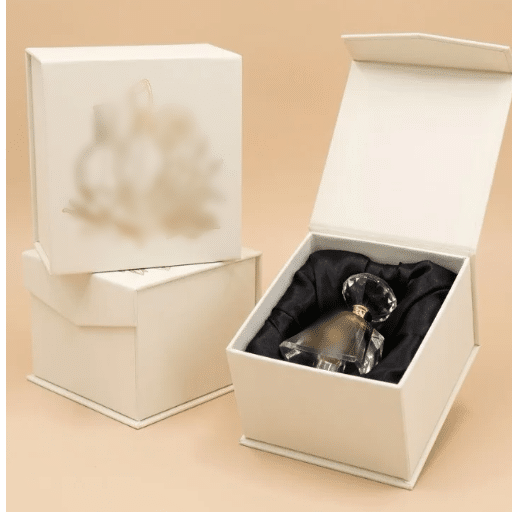
Perfume box packaging materials are the substrates, cushioning, and surface treatments that make up the secondary packaging around a fragrance bottle. Think of three layers working together:
- Outer structural board: the visible box that carries your print, finish, and brand identity
- Inner insert: the cavity or tray that holds the bottle steady and absorbs impact
- Surface finishing: lamination, foil, embossing, coatings, and inks that complete the look
Get one layer wrong and the whole package suffers. Choosing the right perfume box packaging materials means each layer works with the others. A gorgeous rigid box with a loose insert will let the bottle rattle. A perfectly sized foam tray inside a flimsy folding carton will collapse under warehouse stacking. The goal is harmony. Each layer should match the bottle’s weight, your retail price, and how the box travels to the customer.
The stakes are rising. The global perfume packaging market is projected to reach USD 3.96 billion in 2026, driven by premiumization, sustainability rules, and e-commerce growth. That makes material choice a business decision, not just a design one.
At Fuzhou Longlu Packaging, we see buyers arrive with two extremes: they either over-spec luxury materials for a mass-market SKU, or they under-spec protection for a fragile glass flacon. Both mistakes eat margin. The fix is a materials-first decision tree, which we’ll build through the rest of this guide.
Outer Box Materials Compared
The outer box sets the first impression and handles most of the physical load. Here’s how the main perfume box packaging materials compare in real-world use.
Rigid Board / Chipboard / Greyboard
Rigid board, also called chipboard or greyboard, is the default substrate for luxury perfume box materials and rigid perfume boxes. Suppliers wrap a thick paperboard core (usually 800–1,500 gsm, with luxury boxes often starting at 1,200 gsm) with printed art paper, specialty paper, or fabric.
The result is a box that feels substantial, opens with ceremony, and holds sharp corners after months on a shelf. Rigid board is the standard substrate for custom rigid perfume boxes in 800–1,500 gsm board with foil, embossing, and soft-touch finish options. Rigid board accepts foil stamping, embossing, debossing, spot UV, and soft-touch lamination better than thinner substrates because the surface doesn’t flex during finishing.
Best for: luxury fragrances, gift sets, limited editions, ceremonial unboxing
Watch out for: higher unit cost, larger storage footprint, and heavier dimensional weight in e-commerce
Folding Carton / SBS Paperboard
Solid Bleached Sulfate (SBS) paperboard is the most common material for retail cardboard perfume boxes. It arrives as a flat die-cut blank, folds into a tuck-end or auto-bottom box, and runs efficiently on high-speed packaging lines. Typical weights range from 250 gsm for lightweight samples to 400 gsm for standard 50–100 ml retail boxes.
SBS prints beautifully. For retail perfume box packaging materials, it delivers crisp colors, smooth gradients, and a white clay-coated surface that makes skincare and fragrance graphics pop. It’s also the easiest format to recycle curbside when you avoid heavy laminations and foil.
Best for: mass-market retail, sample vials, travel sizes, subscription discovery sets
Watch out for: limited protection against corner drops unless paired with a shipper or insert
Corrugated Board (E-Flute / F-Flute)
Corrugated board is the protective layer, not the pretty layer, though modern E-flute and F-flute grades can be printed well enough to serve as primary e-commerce packaging. The fluted middle layer absorbs shock and prevents crush damage when cases stack in a truck.
For perfume brands selling direct-to-consumer, corrugated is almost always the outer shipper that sits around a rigid or folding-carton retail box. Some brands skip the inner retail box and ship in a printed corrugated mailer with a molded pulp insert to cut weight. E-commerce perfume box packaging materials need to balance protection with dimensional weight.
Best for: e-commerce shipping, subscription boxes, wholesale master cases
Watch out for: thicker walls increase dimensional weight and freight cost
Kraft Paperboard
Kraft paperboard is unbleached, brown or off-white, and signals sustainable perfume packaging materials before a customer reads a word. It works beautifully for natural, botanical, or artisan fragrance brands that want an earthy, hand-crafted look. Weights typically run 280–350 gsm for lighter cartons and up to 450 gsm for sturdier boxes.
Because Kraft fibers are visible, printing behaves differently than on coated SBS. Bright whites need a base coat, and high-contrast photography can look muted. Many brands lean into the limitation with black ink, botanical illustrations, or stamped logos. These earthy perfume box packaging materials tell a sustainability story before the customer opens the box.
Best for: eco-conscious brands, natural fragrances, minimalist design systems
Watch out for: color fidelity and perceived value if your brand plays in the premium segment
Specialty Paper Wraps
Specialty papers turn a standard rigid box into a tactile experience. Options include soft-touch paper (velvet matte), linen-textured stock, pearlescent paper, metallic wraps, and dyed-through black card. These are usually laminated onto a rigid board core rather than used as structural board themselves.
The right specialty paper can communicate a scent profile before the bottle is opened: dark suedes for oud and amber, pastels for florals, crisp whites for fresh citrus. These are the perfume box packaging materials that create a tactile, emotional connection with the buyer.
Best for: niche and ultra-premium fragrances, limited editions, influencer/PR kits
Watch out for: cost, minimum order quantities, and scuff resistance during transit
| Material | Typical Weight | Cost Tier | Best For | Recyclability |
|---|---|---|---|---|
| Rigid board / greyboard | 800–1,500 gsm | High | Luxury gift boxes, keepsake boxes | Yes, if unlaminated |
| SBS folding carton | 250–400 gsm | Low–Medium | Retail, samples, travel sizes | Yes, widely accepted |
| Corrugated E/F-flute | Flute-based | Medium | E-commerce shippers, subscriptions | Yes, widely accepted |
| Kraft paperboard | 280–450 gsm | Low–Medium | Eco-conscious, artisan brands | Yes, often compostable |
| Specialty paper wraps | Varies | High | Ultra-premium, limited editions | Varies by coating |
| Outer box material options for perfume packaging: rigid board, SBS folding carton, corrugated board, and Kraft paperboard. |
Perfume Box Inserts: Protecting the Bottle
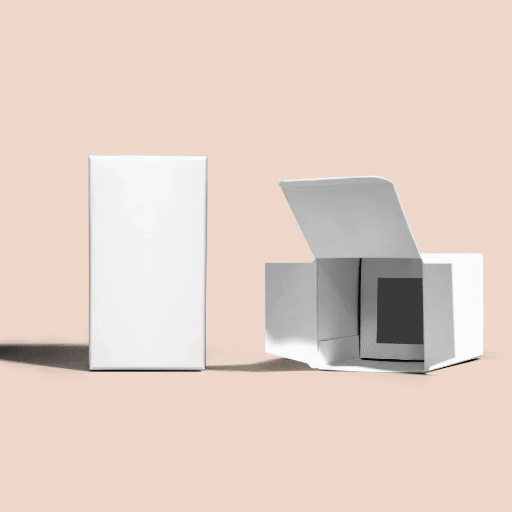
The right perfume box inserts are the unsung heroes of perfume packaging. A 100 ml glass bottle dropped from desk height can shatter on impact unless the insert absorbs the shock.
EVA Foam
Ethylene-vinyl acetate (EVA) foam is the premium standard for luxury perfume inserts. It cuts cleanly into precise cavities, holds the bottle snugly, and can be flocked with velvet or suede for a high-end feel. Dense EVA absorbs shock well and prevents the bottle from rotating inside the box. For heavy or unusually shaped bottles, EVA is often the safest choice among perfume box packaging materials.
Best for: heavy bottles, unusual shapes, luxury unboxing
Sustainability note: EVA isn’t biodegradable and is hard to recycle; avoid it if your brand claims plastic-free packaging
Molded Pulp / Molded Fiber
Molded pulp is made from recycled paper, bamboo, bagasse, or other plant fibers. It forms a protective cradle around the bottle and breaks down in compost or recycling streams. In 2026, molded pulp has moved from “eco alternative” to “default option” for clean-beauty and sustainable fragrance brands looking for plastic-free perfume box packaging materials.
The texture is more rustic than foam, which can be a feature for natural brands. Tolerances matter, a loose pulp tray lets the bottle tap against the box wall.
Best for: eco-luxury, subscription boxes, brands targeting Gen Z and millennial buyers
Watch out for: surface abrasion on delicate labels if the fit is too tight
Paperboard / Die-Cut Inserts
A die-cut paperboard tray is the lowest-cost insert that still looks intentional. It folds from a single piece of SBS or Kraft board, locks into place, and can match the outer box print. It offers light protection and works for smaller, lighter bottles.
Best for: samples, travel sprays, lightweight retail cartons
Watch out for: minimal shock absorption; not ideal for heavy flacons
Fabric-Wrapped Inserts
Velvet, satin, or suede-covered inserts sit at the top of the luxury ladder. They are usually built on a rigid paperboard or foam base and wrapped in fabric. The hand feel is unmatched, and they signal “keepsake” rather than “disposable.”
Best for: haute parfumerie, collector editions, ceremonial gift sets
Watch out for: cost, cleaning requirements, and recycling complexity
| Insert | Protection | Sustainability | Cost | Best For |
|---|---|---|---|---|
| EVA foam | Excellent | Low | High | Heavy or luxury bottles |
| Molded pulp | Good | High | Low–Medium | Eco-conscious brands |
| Paperboard tray | Moderate | High | Low | Lightweight bottles |
| Fabric-wrapped | Moderate–Good | Low | Very high | Ultra-premium gifts |
| Perfume box inserts: EVA foam, molded pulp, and die-cut paperboard trays protect glass bottles differently. |
How to Choose the Right Perfume Box Material
Choosing the right perfume box packaging materials is a matching exercise. Start with four questions:
- What is the retail price? A 35mass−marketperfumecan′tcarrya35mass−marketperfumecan′tcarrya6 rigid box. A $180 niche fragrance can.
- Where will it sell? Retail shelves need shelf appeal and compact footprints. E-commerce needs crush resistance and low dimensional weight.
- How heavy and fragile is the bottle? A thick 100 ml glass flacon needs more protection than a 10 ml sample roller.
- What sustainability claims do you want to make? Recyclable, compostable, FSC-certified, and plastic-free each point to different materials.
Marcus, a founder launching a men’s fragrance direct-to-consumer, started with a rigid magnetic box because it looked premium on Instagram. After three weeks of shipping, his damage rate hit 12%. He switched to a rigid retail box inside a printed corrugated shipper with a molded pulp insert. The unboxing still felt premium, but damage fell to 1.2% and his freight cost dropped because the shipper was right-sized.
| Positioning / Channel | Outer Box | Insert | Finish Notes |
|---|---|---|---|
| Luxury / niche | Rigid board (1,200+ gsm) | EVA or fabric insert | Specialty wrap, foil, embossing |
| Mass-market retail | SBS folding carton (300–400 gsm) | Paperboard or molded pulp | Sharp offset printing |
| Eco-conscious / botanical | Kraft or FSC-certified board | Molded pulp or honeycomb | Minimal coatings |
| E-commerce / D2C | Corrugated outer shipper | Molded pulp or foam | Optional retail box inside |
| Gift / ceremonial | Rigid magnetic or drawer box | Velvet or EVA insert | Premium unboxing |
This framework isn’t rigid. A 120nichefragrancesoldonlinemightusearigidretailboxinsideacorrugatedshipper.A120nichefragrancesoldonlinemightusearigidretailboxinsideacorrugatedshipper.A28 retail fragrance in boutiques might use a thick folding carton with a molded pulp tray.
Sustainable Perfume Box Materials in 2026
Demand for sustainable perfume packaging materials is no longer a niche selling point. According to industry research, 62% of consumers prefer sustainable packaging, and 59% of luxury buyers now favor refillable or modular designs. For perfume brands, that pressure shows up in material choices. Fuzhou Longlu Packaging’s sustainable perfume packaging options cover FSC sourcing, mono-material design, and PPWR compliance in depth.
FSC-Certified and Recycled Paperboard
Forest Stewardship Council (FSC) certification verifies that wood fibers come from responsibly managed forests. Recycled paperboard uses post-consumer waste and reduces demand for virgin pulp. Both are easy to specify and print well.
Molded Pulp and Agricultural Fibers
Bagasse (sugarcane fiber), bamboo, and wheat straw can be molded into protective inserts. They’re biodegradable, compostable, and increasingly cost-competitive with plastic trays.
Water-Based and Soy-Based Inks
Conventional solvent inks can interfere with recycling and emit volatile organic compounds (VOCs). Water-based and soy-based inks lower environmental impact and are easier to recycle alongside paperboard.
Mono-Material Design
A perfume box made entirely of paper-based materials is easier to recycle than a mixed-material box with plastic windows, magnets, foam, and metal closures. The EU’s Packaging and Packaging Waste Regulation (PPWR) takes broad effect on 12 August 2026 and pushes brands toward design-for-recycling. Mono-material builds are the simplest path to compliance.
Recyclability conflicts to avoid:
- Soft-touch lamination and foil stamping can make paperboard non-recyclable in some facilities
- Magnetic closures add metal that sorting lines reject
- EVA foam inserts mixed with paperboard complicate end-of-life processing
Printing and Finishing Options by Material
Your perfume box packaging materials determine which finishes will look professional and last through shipping. Fuzhou Longlu Packaging’s perfume packaging design services match substrates, inserts, and finishes to your brand tier and sales channel.
Offset Printing
Offset remains the gold standard for high-volume perfume packaging. It delivers consistent color, supports Pantone matching, and works on coated SBS, rigid board wraps, and smooth Kraft. Most luxury perfume boxes run offset before lamination and foil.
Digital Printing
Digital is ideal for short runs, prototypes, and variable data. It skips printing plates, so you can test three colorways without committing to thousands of units. The trade-off is slightly less color depth than offset on some specialty papers.
Foil Stamping
Hot foil stamping adds metallic or holographic accents. It adheres best to rigid board and coated paperboard. Foil can be recyclable if it covers less than a specified area of the surface, but heavy foil coverage can block recycling streams.
Embossing and Debossing
These techniques raise or depress the paper surface to create texture. They require enough board thickness to hold the impression without cracking, another reason luxury perfume boxes favor rigid board.
Soft-Touch and Matte Laminations
Soft-touch lamination gives a velvety feel that customers associate with premium fragrance. Matte lamination reduces glare and fingerprints. Both add durability but can complicate recycling unless you use a compatible film or aqueous coating.
Cost, MOQ, and Production Considerations
Perfume box packaging materials directly affect minimum order quantity, tooling cost, and lead time.
Folding cartons usually start at 1,000–3,000 units with no custom tooling beyond a die. Rigid boxes commonly require 500–1,000 units minimum and higher per-unit cost because they are assembled by hand or on slower equipment. Molded pulp inserts need a mold or die, which adds upfront cost but pays off at volume. EVA foam cavities also need a cutting die, though some suppliers offer CNC-cut prototypes without hard tooling.
Freight matters too. Folding cartons ship flat and nest efficiently. Rigid boxes ship assembled and consume more container space. If you’re importing from overseas, a folding carton order can cost 30–50% less to transport than the same unit count of rigid boxes.
Common Mistakes When Choosing Perfume Box Materials
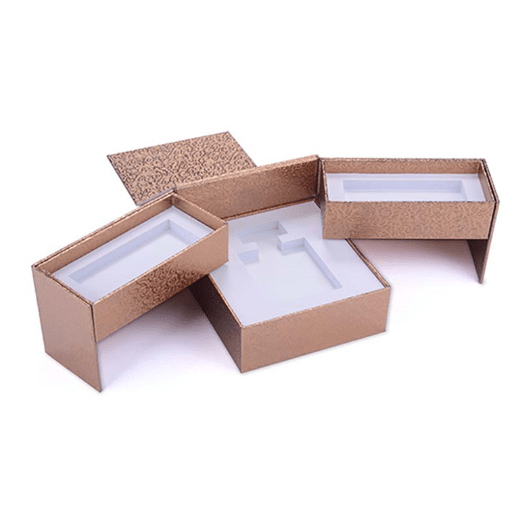
We’ve reviewed enough perfume box packaging materials prototypes to spot the same errors repeatedly:
- Over-engineering mass-market SKUs. A $40 perfume doesn’t need a 1,500 gsm rigid box with a velvet insert. The margin disappears.
- Claiming sustainability while using foam. EVA foam contradicts plastic-free or compostable claims.
- Ignoring dimensional weight. A heavy rigid box raises e-commerce shipping costs and can push customers past free-shipping thresholds.
- Specifying finishes that block recycling. Full-coverage soft-touch film or heavy foil can make an otherwise recyclable box landfill-bound.
- Skipping the drop test. A prototype that looks perfect on a desk may fail a 1-meter drop. Test before you order 10,000 units.
How to Evaluate a Supplier’s Material Quality
Before you approve a bulk order of custom perfume packaging materials, ask your supplier for three things:
- Material certificates. FSC for paper, GRS for recycled content, ISO 9001 for quality management, and REACH or RoHS compliance for coatings and inks.
- Production samples from the actual lot. A pristine prototype doesn’t guarantee the bulk run matches it. Request samples pulled from the production line.
- Drop-test data. Ask for ISTA 1A or 2A test results, or run your own ship-test with filled bottles.
A reliable supplier will answer these questions quickly. At Fuzhou Longlu Packaging, we provide material specs, certificates, and drop-tested prototypes before any bulk production begins. If a supplier dodges these requests, that’s a signal to keep looking.
Frequently Asked Questions About Perfume Box Packaging Materials
What are the most common perfume box packaging materials?
The most common perfume box packaging materials are rigid board (chipboard/greyboard) for luxury boxes, SBS paperboard for retail cartons, corrugated board for shipping, Kraft paperboard for eco-conscious brands, and specialty paper wraps for ultra-premium finishes. Inserts are typically EVA foam, molded pulp, paperboard trays, or fabric-wrapped cavities.
What is the best material for luxury perfume boxes?
Rigid board at 1,200+ gsm is the best material for luxury perfume boxes. It feels substantial, protects the bottle, and supports premium finishes like foil stamping, embossing, and soft-touch lamination. Pair it with an EVA foam or fabric-wrapped insert for the highest-end unboxing experience.
Are cardboard perfume boxes recyclable?
Yes, cardboard perfume boxes made from SBS paperboard, Kraft, or corrugated board are recyclable when they avoid heavy laminations, foil coverage, magnets, and plastic windows. Mono-material designs are the easiest for recycling facilities to process.
What is the most sustainable perfume box packaging material?
Molded pulp made from bamboo, bagasse, or recycled paper is the most sustainable insert material. For outer boxes, FSC-certified Kraft or recycled paperboard are the most eco-friendly options. Water-based inks and aqueous coatings keep the entire package recyclable.
How thick should a perfume box be?
Retail folding cartons typically use 300–400 gsm paperboard. Luxury rigid perfume boxes use 800–1,500 gsm board, with 1,200+ gsm being the most common threshold for a premium feel. E-commerce shippers use corrugated E-flute or F-flute for shock absorption.
What are perfume box inserts made of?
Perfume box inserts are made of EVA foam, molded pulp, die-cut paperboard, sponge foam, honeycomb paper, or fabric-wrapped rigid board. EVA foam offers the best protection and luxury feel. Molded pulp offers the best sustainability profile.
Conclusion
Perfume box packaging materials are not a one-size-fits-all decision. The right combination depends on your fragrance’s price, your sales channel, the bottle’s weight and shape, and the sustainability story you want to tell.
Rigid board delivers luxury. SBS folding carton delivers retail efficiency. Corrugated protects e-commerce orders. Molded pulp and EVA foam each protect bottles, but with very different environmental profiles.
Start with the four questions, price, channel, fragility, sustainability, and build outward. Test prototypes under real shipping conditions. Verify certificates. And remember that the box is the first physical experience a customer has with your fragrance; the material choice should feel as intentional as the scent itself.
Ready to source perfume box packaging materials for your next fragrance? Request a free quote for material samples and a drop-tested prototype tailored to your bottle.