
Custom perfume box design comes down to seven steps: define your brand strategy, measure the bottle, choose the structure, select materials, apply finishes, prepare the dieline and artwork, then sample and approve before production. Get those right and you get a box that protects the bottle, sells the scent, and stays within budget.
When Leila, a founder at a small fragrance house in Austin, ordered her first custom boxes, she sent her manufacturer a mood board and a photo of the bottle and hoped for the best. Six weeks later the samples arrived with her logo split across a fold line and a box two millimeters too shallow for the cap. She paid for a second round of tooling and lost her holiday launch window.
That one mistake cost her more than the boxes themselves.
Here is what most founders don’t realize: the “custom” in custom perfume box design isn’t about aesthetics. It’s about specs. You already know how you want the box to look. What decides whether it ships on time, on budget, and without a costly redo is how precisely you specify it for production.
We agree with you on one thing: your fragrance deserves packaging that feels as considered as the scent inside. That instinct is right. In this guide, we’ll walk you through how to design custom perfume boxes, from brand strategy to a print-ready dieline, and hand you a design brief you can send to any manufacturer today.
Key Takeaways
- Custom perfume box design is a seven-step process: strategy, measurement, structure, materials, finishes, dieline/artwork, and sampling.
- The dieline is where most designs fail: a 3 mm bleed and a clear safe zone keep logos and copy off fold lines.
- Your structure, material, and finish choices drive roughly 80% of the final cost, far more than the artwork itself.
- Custom rigid boxes typically run 1.50to1.50to3.50 per unit at a 500-piece MOQ; folding cartons cost a fraction of that.
- A one-page design brief, with bottle dimensions and finish specs, is the difference between a clean first sample and a costly redo.
What Is Custom Perfume Box Design?

Custom perfume box design is the process of turning a fragrance brand’s identity into a production-ready box specification. It combines structure, material, finish, and artwork, including the dieline, so the box protects the bottle, communicates the brand, and stays within budget.
A custom box isn’t a stock box with a logo printed on it. Stock boxes come in preset sizes and shapes. Custom boxes are engineered around your exact bottle, your brand colors, and your finish choices. That’s why the design process matters as much as the final look.
The box is the first physical touchpoint between a fragrance and its buyer. It has to do three jobs at once: protect glass in transit, catch the eye on a shelf, and set up the unboxing moment people photograph and share. A good design serves all three. A bad one does none of them well.
If you want to explore the creative side first, color psychology and typography, see our custom perfume packaging guide. This article focuses on how to get the box actually made.
Custom Perfume Box Design in 7 Steps
Here is the process we use with every client, from first sketch to approved sample.
Step 1: Define Brand Strategy and Target Market
Every design decision flows from who you’re selling to. A luxury niche brand positioning a 200extraitneedsadifferentboxthanacleanbeautystartupsellinga200extraitneedsadifferentboxthanacleanbeautystartupsellinga48 discovery set.
Nail down three things before you touch artwork: your brand story, your target customer, and the price point the box has to support. The price point matters because packaging should cost a predictable share of retail, usually 5 to 15 percent for most fragrance lines.
Step 2: Measure the Bottle and Plan Fitment
The most common design error isn’t measuring the bottle properly. You need the height, width, and depth of the glass, plus the cap height and the total weight. A box that’s two millimeters too short for the cap is a box you can’t use.
Add clearance and insert allowance to your bottle dimensions. A snug fit protects the glass; a loose fit lets it rattle. Write down the internal box height you need, not just the bottle height.
Step 3: Choose the Box Structure
Structure sets the tone and the budget. A rigid two-piece box signals luxury and costs more. A tuck-end folding carton is lighter, cheaper, and better for high-volume lines. We cover each option in detail below.
Step 4: Select Materials and Inserts
The outer board gives the box its weight and feel. The insert holds the bottle in place. Greyboard and SBS paperboard are the two workhorses; EVA foam, velvet, molded pulp, and cardboard are the common insert materials.
Step 5: Apply Finishes and Printing
Finishes are where a box earns the word luxury. Foil stamping, embossing, debossing, spot UV, and soft-touch lamination each add a different tactile cue. The trick is restraint: two well-chosen finishes beat five layered on top of each other.
Step 6: Prepare the Dieline and Artwork
The dieline is the flat template that shows where a sheet of board is cut, folded, and glued. Your artwork sits on top of it. This step is where Leila’s logo ended up split across a fold, because the safe zone was never defined. We dedicate a full section to it below.
Step 7: Prototype, Sample, and Approve
Before you commit to a full production run, get a physical sample. A white sample checks structure and fit. A pre-production sample checks color, finish, and print alignment. Approving a sample you have held in your hands is the single best insurance against a costly redo.
Choosing the Right Custom Perfume Box Structure
Your structure choice sets the cost floor and the brand ceiling. Here is how the common options compare.
| Structure | Best For | Design Feel | Typical Cost Tier | Typical MOQ |
|---|---|---|---|---|
| Tuck-end folding carton | High-volume, mid-range lines | Light, efficient | Lowest | 500 to 1,000 |
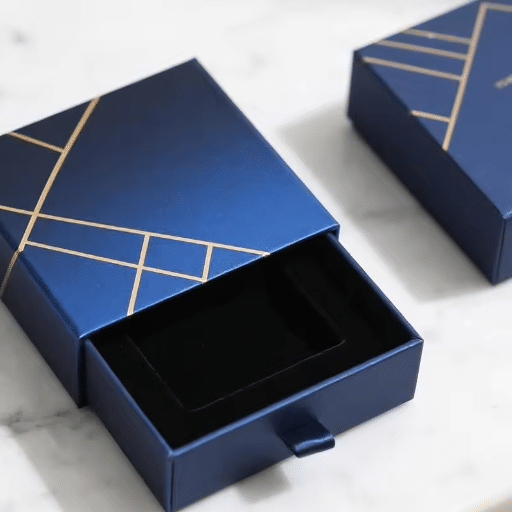
| Drawer / sleeve box | Travel sets, discovery kits | Sliding reveal | Medium | 500 to 1,000 |
| Window box | Showing the bottle | Visual, retail-friendly | Medium | 500 to 1,000 |
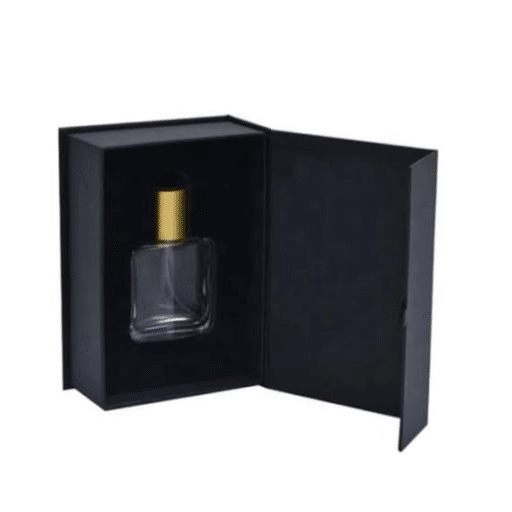
| Magnetic closure rigid box | Premium, giftable lines | Smooth open, high-end | High | 500 |
| Two-piece rigid / shoulder box | Luxury flagship launches | Weighty, substantial | Highest | 500 |

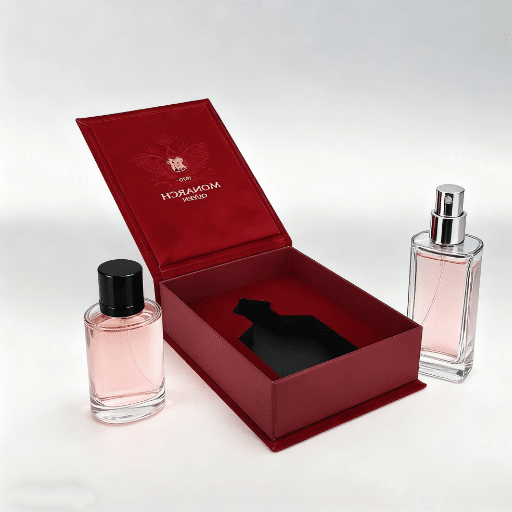
A magnetic closure box with a hidden magnet in the board gives a smooth open and close that reads instantly as premium. A shoulder box exposes a “waistline” of the inner tray, a classic luxury cue. Both cost more than a tuck-end carton because they use heavier board and more assembly labor.
When Marcus, a private-label seller, launched his first niche fragrance, he ordered the most elaborate rigid box he could find: magnetic closure, embossed pattern, velvet insert, and three foil colors. His per-unit cost hit nearly $4, and his margin disappeared by the time he paid for shipping.
A year later he relaunched with a tuck-end carton and one foil accent, kept the same retail price, and doubled his margin. The box still looked premium. It just stopped eating his profit.
The takeaway: match the structure to the price point, not the dream. For more on the broader sourcing picture, see our complete guide to custom perfume packaging.
Materials and Inserts for Custom Perfume Boxes

The outer board and the inner insert do two different jobs. Choose them separately.
Outer board. Greyboard, wrapped in specialty paper, velvet, or fabric, is the standard for rigid luxury boxes. It runs roughly 2 to 2.5 mm thick and gives the box its heft. SBS paperboard, at 16 to 24 pt, is the lighter, brighter choice for folding cartons and high-volume lines. Kraft is the eco-friendly option, often 60 percent or more recycled content.
Inserts. The insert cradles the bottle and prevents movement. EVA foam offers the most precise, molded fit and a premium feel. Velvet and satin trays add softness for gift sets. Molded pulp and folded cardboard are fully recyclable and plastic-free, ideal if sustainability is a selling point.
If you’re prioritizing sustainability, you’ve got real options today: FSC-certified paper, recycled greyboard with up to 92 percent recycled content, soy-based inks, and water-based coatings. For a deeper look at materials and certifications, read our sustainable packaging guide.
Want help matching material to budget? Our team can recommend a board and insert combination for your specific bottle and price point. Request a free design consultation →
Finishes That Make a Custom Perfume Box Look Luxury
Finishes are the fastest way to signal premium, and the easiest place to overspend. Custom perfume box printing, whether offset or digital, sets the ceiling for how sharp your artwork looks. Here are the finishes that matter.
- Foil stamping. Metallic logos in gold, silver, or rose gold. The single most recognizable luxury cue.
- Embossing and debossing. Raised or recessed texture you can feel. Blind embossing, with no foil, is a quiet, high-end choice.
- Spot UV and 3D raised UV. A glossy highlight on specific areas, like a logo or scent notes.
- Soft-touch lamination. A matte, velvety feel that makes people want to hold the box.
- Matte or gloss lamination. The baseline coating that also protects the print.
The rule we repeat to clients: combine two finishes with intent, not five by default. For luxury custom perfume box design, a soft-touch base with a single gold foil accent reads far more luxurious than a box that tries to do everything at once.
The Dieline and Artwork: Getting Print-Ready
This is the section that saves you from Leila’s mistake.
A custom perfume box dieline is the flat technical template that shows where the board is cut, scored, and glued. It is the blueprint that turns a printed sheet into a real box. Your custom perfume box artwork is built on top of it, never the other way around.
Three rules keep your artwork safe:
- Use a 3 mm bleed. Extend background colors and patterns 3 mm past the trim edge so no white slivers show after cutting.
- Keep critical elements in the safe zone. Logos and copy should sit clear of fold lines and trim, usually 3 to 5 mm inside. This is what keeps a logo from splitting across a fold.
- Build in vector with named layers. Keep cut lines, fold lines, foil, emboss, spot UV, and print on separate, clearly named layers. Never rescale the dieline when you apply artwork.
Your file also has to carry the required copy: fragrance name, concentration, volume, and any allergen or regulatory text your market requires. Design for this early, not as an afterthought.
Here is what a clean artwork handoff looks like in practice. Priya, a packaging designer, sends every client a labeled dieline with the bleed and safe zone marked before any artwork begins.
When her latest client’s first sample came back, the only note from the factory was a request to bump the foil one millimeter left. One tweak, one week, done. Her files were built for production, so production was smooth.
For a step-by-step reference on preparing artwork and specifications, see Best Greet Card’s artwork guide.
How Much Does Custom Perfume Box Design Cost?
The cost question is where most guides go vague. Here are real numbers.
Custom rigid perfume boxes typically run 1.50to1.50to3.50 per unit at a 500-piece MOQ, according to UColorPrint’s product specs. Magnetic essential-oil boxes can start as low as 0.23to0.23to2.35 per unit. Folding cartons and cologne boxes start under $0.30.
Five factors move the price, in rough order of impact:
- Structure. Rigid costs more than folding.
- Material. Greyboard and specialty wraps cost more than SBS or kraft.
- Finishes. Foil and embossing add tooling and per-unit cost.
- Quantity. Unit cost falls sharply as quantity rises.
- Inserts. EVA foam is pricier than folded cardboard or molded pulp.
For bulk buyers, negotiating these levers is its own skill. Our wholesale perfume boxes guide breaks down the buying process in detail.
The broader market supports investing here. The global perfume packaging market is projected at **3.72billionin2025∗∗,growingtoward3.72billionin2025∗∗,growingtoward6.89 billion by 2034, according to Fortune Business Insights. Buyers are spending more on packaging, and 62% of consumers favor sustainable options, so a well-designed box is doing real selling work.
Custom Perfume Box Design Brief Checklist

Copy this into an email or RFQ and you’ll get a faster, more accurate quote.
- Brand story and target market
- Bottle dimensions: height, width, depth, cap height, weight
- Desired structure and box dimensions
- Material and insert preference
- Color palette and reference images
- Copy and regulatory text to print
- Finishes: foil, emboss, spot UV, lamination
- Sustainability requirements and certifications
- Order quantity and budget range
- Timeline and sample requirements
A one-page brief like this is the difference between a first sample you approve and a second round of tooling you did not budget for.
Frequently Asked Questions
How do I design a custom perfume box?
Follow the seven-step process: define your brand strategy, measure the bottle, choose a structure, select materials, apply finishes, prepare the dieline and artwork, then sample and approve before production.
What is a dieline and why do I need one?
A dieline is the flat template showing where board is cut, scored, and glued. You need it because your artwork is built on top of it, and it keeps logos and copy off fold lines and trim.
How much does custom perfume box design cost?
Custom rigid boxes typically run 1.50to1.50to3.50 per unit at a 500-piece MOQ, while folding cartons can start under $0.30. Structure, material, and finishes drive most of the cost.
What material should I use for a custom perfume box?
Use greyboard wrapped in specialty paper for rigid luxury boxes, SBS paperboard for folding cartons, or kraft for a sustainable look. Match the board to your price point.
How long does custom perfume box design and production take?
Lead times generally run 10 to 30 business days after artwork approval, with samples in one to seven days. Sampling and approval are usually the longest single phase.
What file format do manufacturers need for perfume box artwork?
Vector files are standard: AI, PDF, or EPS, with cut, fold, foil, and emboss on separate named layers. Never send a flattened raster file or rescale the dieline.
Can I get a custom perfume box design with a low MOQ?
Yes. Many manufacturers offer MOQs from 100 to 500 pieces, with folding cartons at the lower end and rigid boxes typically starting around 500.
What box styles work best for custom perfume boxes?
Tuck-end folding cartons suit high-volume, budget-conscious lines. Magnetic closure and two-piece rigid boxes suit premium, giftable launches.
Conclusion
Custom perfume box design is brand strategy plus producibility plus cost control. Define your brand and measure the bottle first. Choose a structure and materials that fit the price point.
Apply finishes with restraint. Then get the dieline and artwork right, because that’s where most designs quietly fail.
The boxes that look effortless are almost always the ones that were specified precisely. When you hand a manufacturer a complete brief, with real dimensions and a clean dieline, you get a sample that matches the vision on the first try.
That is the outcome worth designing for. If you’re ready to start, we can help you specify a custom perfume box that protects the bottle, sells the scent, and ships on budget.