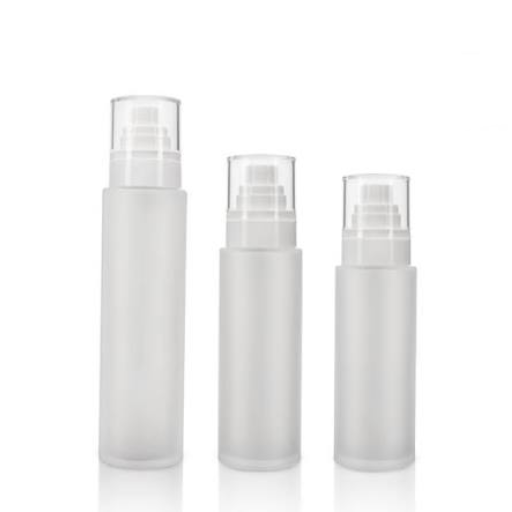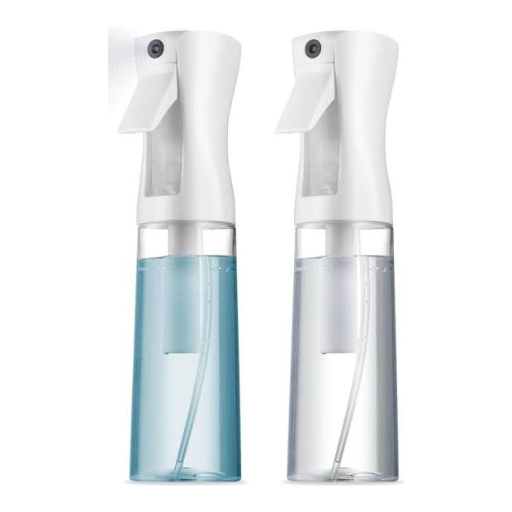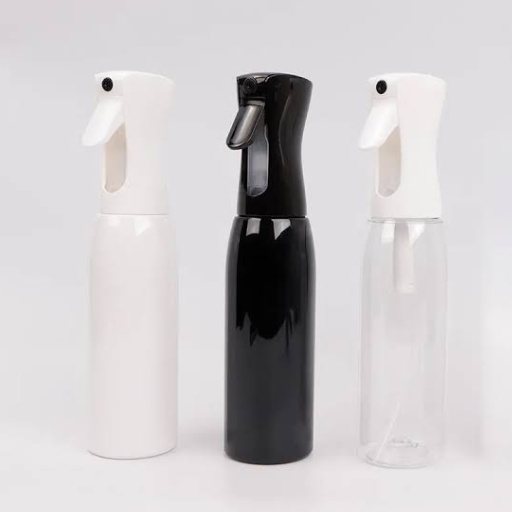

No packaging spray pump is recyclable on its own. Recyclability belongs to the whole pack: the pump, the bottle it screws onto, the spring and gasket inside it, the decoration on the actuator, and the waste stream that pack lands in. A metal-free pump on a PET bottle can leave a pack harder to recycle than a metal-spring pump on an HDPE bottle.
That’s why the question most buyers actually type, “is this pump recyclable”, returns a wall of product launches instead of an answer. This page is about the packaging spray pump, meaning the fine mist and trigger dispensers that sit on a cosmetic or household bottle. Not knapsack sprayers for a field.
You already know the direction of travel. Metal springs are out, polyolefins are in, and nearly every major pump maker now sells a plastic-spring version of its flagship. What is harder to find is a straight answer to three questions: which of the four claims you’re actually buying, what the switch costs, and what you give up to get it.
This guide separates the four claims the industry uses interchangeably, shows why your bottle decides the answer, puts real numbers on the premium and the minimum order, and ends with the specification to send a supplier.
Key Takeaways
- No spray pump is recyclable by itself. The bottle resin, the spring, the gasket and the decoration decide the answer together.
- Metal-free, POM-free, mono-material and recyclable are four different claims, with four different evidence standards behind them.
- A polypropylene pump on a PET bottle can downgrade the pack even when the pump itself is well designed.
- Metal-free construction typically adds 5% to 15% per piece, and stock options start around 10,000 units, based on supplier-published figures.
- The specification you send in the RFQ decides more of the outcome than the brand of pump you choose.
Working on a pack right now? Send us your bottle specification and we will tell you which pump options survive your target recycling stream.
What “Sustainable Spray Pump” Actually Means

A sustainable spray pump is a dispenser designed so the whole pack can re-enter a recycling stream: plastic-only or mono-material construction, no metal in the product path, compatible gaskets, and no decoration that contaminates the resin. That’s a design property of a system, not a product you can buy off a shelf.
When a brand asks for a sustainable spray pump, or an eco friendly spray pump, it usually means one of four things. They are not interchangeable, and they cost different amounts.
| Lever | What it changes | What it costs | Who checks it |
|---|---|---|---|
| Recyclable design | Spring, POM parts, gasket, resin mix | 5% to 15% per piece | Recycler, certification body, retailer |
| Recycled content (PCR) | Where the resin comes from | Batch minimums, colour variation | Brand, regulator, consumer |
| Refill and reuse | Closure, bottle neck, pump type | New tooling, new filling line | Retailer, regulation |
| Material reduction | Wall thickness, component count | Revalidation of the fill line | Everyone |
Most buyers asking for a sustainable spray pump mean the first lever. It’s also the hardest one to prove, because it depends on a facility you do not control.
Priya ran packaging for a mid-sized fragrance house. For a refillable 50 ml launch, her team moved from a crimp pump to a screw pump so customers could keep the bottle. The pump was metal-free and mono-material, which cleared the brief on paper. The problem surfaced when the brand’s EU distributor asked for a recyclability assessment of the assembled pack.
Nobody had one. The refill story was strong. The recyclability story wasn’t.
Why Most Spray Pumps Are Not Recyclable
A conventional spray pump contains five things that recycling systems do not want:
- A metal return spring, usually stainless steel, sitting in or near the product path
- POM (acetal) components, a third resin family that is not compatible with PP or PE streams
- Silicone or TPE gaskets, which many design guides flag as a source of contamination
- A mixed-resin nozzle insert, often a different grade from the body
- An LDPE dip tube, which blends a second resin into a supposedly single-material part
None of these is a manufacturing defect. They exist because steel springs are cheap, consistent and well understood after decades of use. The problem is that recycling sorts by resin and by behaviour, not by good intentions.
The bottle decides, not the pump
Recycling systems separate materials in two main ways: by resin type, and by density. Components that float are easier to capture with the plastic fraction. Components that sink are lost or become contamination.
That is why the APR design-recognition programme for pumps and dispensers requires all components to float, with a density below 1.0 g/cm³, and asks for floatation test data. It is also why a pump’s recyclability rating only means something when it is stated for a specific bottle material.
The practical rule: a sustainable spray pump is sustainable relative to a bottle. Ask which bottle, in which market, in which stream. If the supplier cannot answer all three, you have a product feature, not a claim. Our pump-side specifications and neck finishes guide covers the component details that go into that question.
Metal-Free, POM-Free, Mono-Material, Recyclable: Four Different Claims
These four words get used as synonyms in supplier decks. They are not. A metal free spray pump and a recyclable spray pump may be the same product, or nothing like it. Each claim requires different evidence, and only one of them is a statement about a real recycling facility.
| Claim | What it means | What proves it | What it does not mean |
|---|---|---|---|
| Metal-free | No metal spring or ball bearing | Bill of materials, or a teardown | That the pump is recyclable. An all-plastic pump can still mix PP and PE |
| POM-free | No acetal components | Supplier declaration | That the remaining material mix suits the stream |
| Mono-material | One resin family, usually PP or PE | Resin breakdown by weight | That the pack is recyclable. Gaskets, decoration and the bottle still count |
| Recyclable | Compatible with a named stream in a named market | Third-party assessment of the assembled pack, or design recognition | That any facility near your customer will accept it |
A pump can be metal-free without being mono-material. It can be mono-material without being POM-free. It can be all three and still fail on a PET bottle. Read the table left to right, and the distinction becomes hard to blur.
What is a POM-free pump?
A POM-free pump contains no polyoxymethylene, the acetal resin commonly used for small moving parts inside a dispenser. Makers removed it because POM sits in a separate resin family from the polypropylene and polyethylene that recyclers sort. Removing it simplifies the material mix, which helps the stream. It does not, by itself, make the pump recyclable.
What you can legally say
This is where packaging decisions become legal exposure. In the United States, the FTC’s Green Guides set the standard for environmental marketing claims. In the EU, the green claims regime is tightening alongside the packaging regulation. The common thread is simple: a claim has to match the evidence, for the whole pack, in the market where it is sold.
Three phrases carry very different weight:
- “Recyclable” alone implies the pack will be recycled where the customer lives. It usually will not be.
- “Recyclable where facilities accept it” is defensible, provided you can name the facilities and the stream.
- “100% recyclable” is almost never defensible for a multi-component pack.
The safest sentence on a carton is the one you can support with a document. If a supplier cannot give you that document, the claim belongs in a sales deck, not on the box.
The Pairing Trap: Why a Recyclable Pump Can Make Your Pack Worse

Here is the failure mode that costs brands the most money, and that almost no supplier page mentions.
The three pairings that fail
- A PP pump on a PET bottle. PET recyclers want PET. A polypropylene component is a different resin, and depending on the stream and the component’s share of pack weight, it can be penalised or discarded. The pump may be excellent. The pack still slips.
- A metallised actuator on any bottle. Metallisation, foil and some coatings make a component unrecyclable in its own resin stream, which undoes the reason you paid for a mono-material pump.
- A silicone gasket in a PP stream. Small, hidden, and enough to move a pack down a grade in some assessment systems.
None of these shows up on a product page, because each one is a property of the combination rather than the component.
What a recyclability grade actually measures
Assessment schemes look at the same four things in slightly different ways: material compatibility, component mass as a share of the pack, decoration and inks, and how easily the parts separate. The bottle is always part of the calculation.
Regulation is catching up with that logic. The EU Packaging and Packaging Waste Regulation, Regulation (EU) 2025/40, entered into force in February 2025 and applies from 12 August 2026. It introduces design-for-recycling criteria and performance grades from 1 January 2030, with the lowest grade barred from the market. It also sets recycled-content targets for plastic packaging from 2030, including 30% for contact-sensitive PET, 10% for other contact-sensitive plastics, and 35% for other plastic packaging.
One detail worth knowing: components under 5% of pack weight are exempt from the recycled-content calculation. On a small bottle, a pump is frequently well above that threshold. Check the exact scope in the regulation text before you rely on it for a specific pack.
APR, RecyClass and Cyclos-HTP decoded
Three names appear on every sustainability brief. They do different jobs.
- APR runs a design-recognition programme for pumps, triggers and dispensers, mainly against North American streams. Recognition is an engineering assessment of a design, not a recyclability certificate for your pack.
- RecyClass assesses packaging against European streams and assigns a class from A to F. Class A means no recyclability issues. Classes A to C are generally treated as recyclable-compatible, subject to the stream and component mix.
- Cyclos-HTP issues a percentage-based recyclability rating, and “highly recyclable” in a supplier deck usually means a figure above 90%.
Each scheme evaluates a design or a component against a stream. None certifies that your pack will be collected and recycled where you sell it. That step belongs to your regulatory team, not your supplier.
Daniel’s team learned this the expensive way. They sourced mono-material pumps for a skincare range, put them on PET bottles, and announced a packaging upgrade in a market where the PET stream does not tolerate that component mix. The pumps were exactly as described. The pack grade did not move, and the premium had already been paid across two production runs.
What a Sustainable Spray Pump Costs
The premium is real, but it is smaller than most brands expect.
One supplier that publishes figures puts all-plastic trigger sprayers at 5% to 15% more per piece than the metal-spring equivalent, with the gap narrowing at higher volumes as tooling and design costs amortise. That is a useful anchor for spray pumps generally, though it is one company’s number rather than an industry average.
Volume is the bigger constraint. Stock metal-free options commonly start at 10,000 pieces, and published supplier listings on B2B marketplaces have clustered between roughly $0.04 and $0.10 per unit at that quantity, before decoration. Custom construction, private label and new tooling push both the price and the minimum upward, with design costs typically amortised across 50,000 to 100,000 units.
| Option | Typical MOQ | Relative cost | Lead time | What it buys |
|---|---|---|---|---|
| Standard metal-spring pump | 5,000 to 10,000 | Baseline | 15 to 25 days | Nothing on recyclability |
| Stock metal-free pump | 10,000 | +5% to 15% | About 20 days | No metal in the stream |
| Mono-material PP or PE pump | 10,000 to 30,000 | +10% to 25% | 25 to 35 days | One resin family, better stream fit |
| Custom mono-material with PCR | 30,000+ | +15% to 35% | 35 days plus tooling | Recycled content and a design story |
These are indicative bands built from supplier-published figures and marketplace listings, not quotes. Your specification, decoration and Incoterm will move them.
Where the payback comes from
Three places, in order of reliability.
First, eco-modulated producer fees. Several European EPR schemes adjust fees by recyclability, so a better-designed pack can cost less to place on the market each year.
Second, retail and marketplace requirements. Packaging specifications from large retailers increasingly ask for recyclability evidence, and a pack that cannot answer the question is a listing risk.
Third, the marketing value of a claim you can actually support, which is worth more than a logo on a carton and considerably harder to fake.
Want two options priced side by side? Request a quote with your bottle spec and target market, and we will price a standard and a mono-material route so you can see the real gap. For customisation costs in detail, see our sprayer pricing and MOQ guide.
What You Give Up

Every sustainability gain in a spray pump is paid for somewhere. Suppliers rarely list the bill.
Spring performance and dose consistency
A plastic spring has to deliver the same restoring force as steel, cycle after cycle, without creeping over a shelf life that may run two years or more. That is a genuine engineering challenge, and it is why mono-material designs took years to reach market.
What changes in practice: priming behaviour, dose consistency at the end of shelf life, and sometimes spray pattern. None of these is a reason to avoid the switch. All of them are reasons to test it rather than assume it. Put fill-and-actuation testing across your shelf life and temperature range into the qualification plan, and test the assembled pack, not the pump alone.
PCR changes the look
Post-consumer recycled resin brings colour variation, occasional odour, and lot-to-lot shift. For a clear or white cosmetic pack, that is a design decision, not a detail. Cosmetic-grade PCR also needs its own compliance documentation, so ask for it before you specify a percentage.
Decoration limits
Metallisation, hot-stamp foil and some coatings will undo the recyclability you paid for. If the brand needs a metallic actuator, that is fine, but it should be a conscious trade rather than an accident discovered at the artwork stage.
Nadia’s team hit the spring problem at the worst moment. A home-care brand had qualified an all-plastic trigger for a twelve-month shelf test and shipped the first production run before the results came back. At month nine, dose volume on the oldest samples had drifted enough to fail an internal check. The fix was a revised spring specification and a new tooling round, which cost a quarter and a launch date.
The pump wasn’t bad. The qualification plan was.
What to Put in Your RFQ
Most sourcing problems in this category are specification problems. Send these eight lines, and the quotes you get back will be comparable.
- Resin family and target stream. PP, PE, PET or glass, and which market the pack ships into.
- Metal-free and POM-free, confirmed in writing. Ask for the bill of materials, not a verbal assurance.
- Output per stroke in cc, with an acceptable tolerance. Fine mist pumps typically sit between 0.10 and 0.20 cc.
- Neck finish. 18/410, 20/410, 24/410 or 28/410. Our guide to 18/410, 20/410 and 24/410 neck finishes explains the difference.
- Dip tube material and length, or the bottle height so the supplier can cut it.
- Gasket material, and whether it is compatible with the target stream.
- Decoration, and whether the finished component still passes the stream you named in line one.
- The recyclability assessment or recognition, and the bottle types it was issued for.
The last line is the one that matters most. Ask for the assessment, not the adjective. A supplier who can produce the document is telling you something a supplier who repeats the word “eco-friendly” cannot.
If you are comparing pump types for a different reason, our complete fine mist sprayer selection guide covers mechanism, neck sizes and applications, and our eco-friendly fine mist sprayer options cover the fine-mist-specific choices.
Conclusion
A sustainable spray pump is not a product you specify from a catalogue. It is a decision about a system.
The four claims are not interchangeable. Each needs its own evidence, and only the last one is a statement about a real facility. Your bottle decides whether the pump helps or hurts.
The premium is modest, usually 5% to 15% per piece, and the volume floor matters more than the unit price. What you give up, mainly spring behaviour and some decoration freedom, is manageable if you test the assembled pack early.
The good news is that this is a specification problem, and specification problems are solvable. Write the eight RFQ lines. Ask for the document rather than the adjective. Test the pack, not the component.
Send us your bottle specification and the market you sell into. We will tell you which pump options survive that stream, what they cost at your volume, and which claims you can support. Start with a quote request, or ask for a sample and check the actuation yourself.