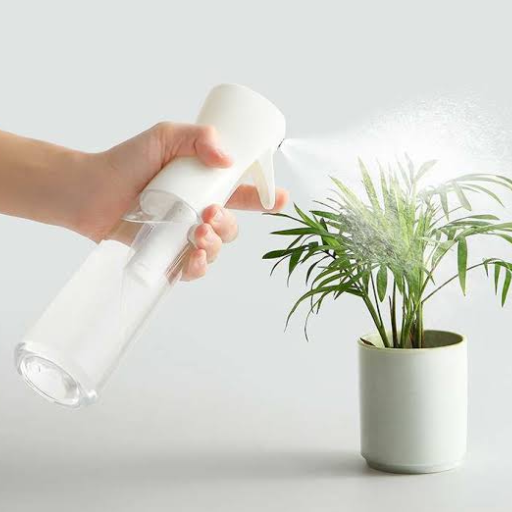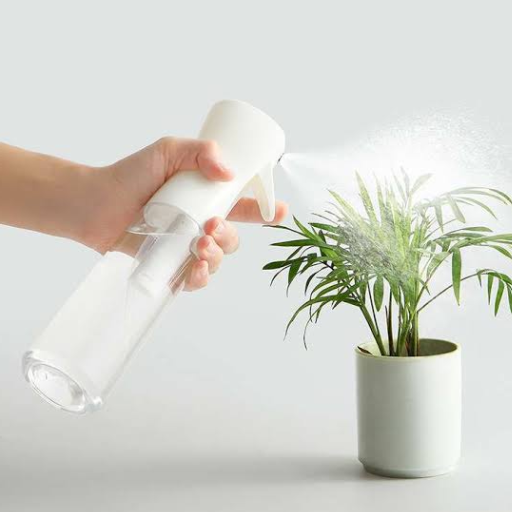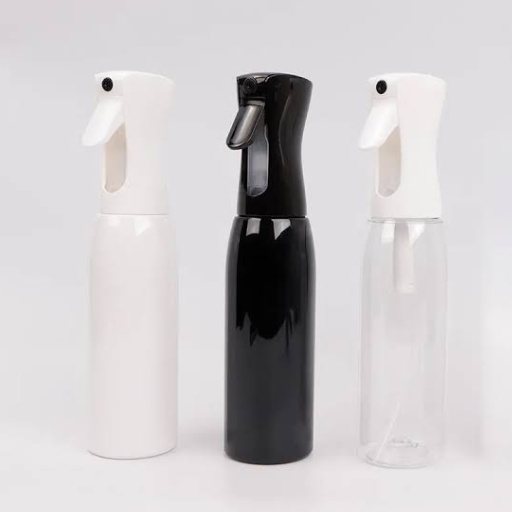
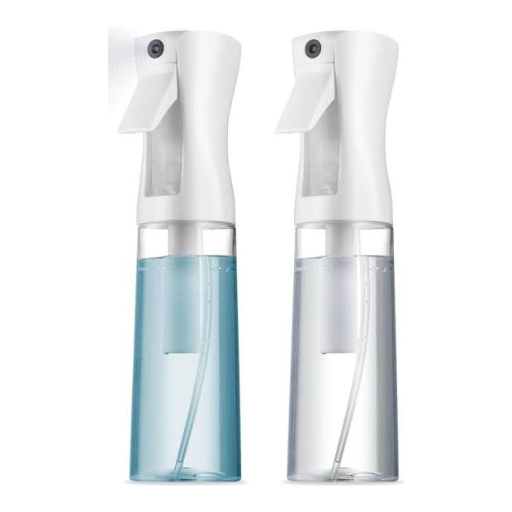
A continuous spray bottle is a refillable dispenser that stores pressure and releases a steady mist for one to four seconds per charge, with no propellant gas. Three different systems get sold under that name, and only one of them can spray upside down.
That’s the short answer. Search for a continuous spray bottle and you’ll find a dozen guides explaining the spring and the valve. Almost none says which of the three technologies you’re buying, or what it costs at volume. Continuous spray bottle manufacturers rarely publish price tiers.
As a result, that gap gets expensive. A brand that specs a dip-tube pump for an upside-down application finds out after the container ships.
We build and source dispensing packaging for beauty, personal care, and household brands, so we see these orders on the factory floor. This guide covers the mechanism, the three technologies, the specs your formula must meet, and the 2026 price bands we see from Chinese suppliers. For wider selection detail, our complete fine mist sprayer guide covers neck finishes and pump families.
Key Takeaways
- “Continuous spray bottle” describes three different systems: a mechanical pre-compression pump, a bag-on-valve can, and a large continuous trigger. They aren’t interchangeable.
- Only bag-on-valve and airless-piston designs spray at 360 degrees. A dip-tube pre-compression pump can’t spray inverted, because the tube draws air.
- Expect roughly 0.60perpieceonceyoupass5,000units,fallingtoabout0.60perpieceonceyoupass5,000units,fallingtoabout0.58 above 20,000, with 1.20to1.20to1.25 the norm at trial quantities.
- Spray duration runs roughly one to four seconds per charge depending on design, and suppliers typically cite a valve threshold around 2.5 to 3.0 bar.
- MOQs cluster at 10,000 pieces, though some suppliers accept 1,000 for a trial order.
What Is a Continuous Spray Bottle?

A continuous spray bottle stores pressure mechanically and releases it as an even mist for a sustained period after a single actuation. “Continuous” describes spray duration per charge, not an endless supply.
That distinction matters. A standard fine mist sprayer delivers one short burst per press, then stops. A continuous system keeps flowing for a second or more after you let go. Users feel it immediately, which is why stylists and skincare brands pay extra.
The category name is where the confusion starts. Suppliers apply “continuous spray” to at least three distinct mechanisms, and the trade press rarely separates them. If you read one section, make it the comparison below.
Sourcing a continuous spray bottle for a launch? Our team can walk you through the technology options against your formula and volume. Request a free wholesale quote and we will come back with specs and pricing.
How a Continuous Spray Bottle Works
The mechanical version runs on stored pressure and a calibrated spring. No gas, no propellant, nothing flammable.
The Spray Cycle, Step by Step
A pre-compression pump moves liquid into a sealed accumulator chamber, and each press adds pressure. A spring-loaded valve stays shut until the chamber hits its release threshold.
Once that threshold is crossed, stored pressure drives liquid up the dip tube and out through the nozzle as atomised mist. When pressure drops back below the threshold, the spring closes the valve and the cycle resets.
Suppliers typically cite a release threshold around 2.5 to 3.0 bar, though we treat that as a design range rather than a fixed standard. Confirm it against your pump maker’s datasheet. The branded version most buyers encounter is Flairosol, developed by AFA Dispensing, the reference design for propellant-free continuous spray.
Why It Keeps Spraying After You Let Go
That spring and accumulator are the whole trick. They hold enough reserve pressure to keep the valve open after your finger leaves the actuator.
In practice, a single charge produces roughly one to four seconds of spray. The range depends on chamber volume, spring rate, and nozzle orifice, so ask your supplier for a measured figure rather than a marketing claim.
This is also why continuous spray bottles need priming. Air has to be displaced before the accumulator can build pressure. Most designs want three to ten strokes on first use, plus a second round after the bottle has sat unused for several days, because pressure bleeds off slowly.
Pre-Compression, Bag-on-Valve, or Continuous Trigger?
A continuous spray bottle comes in three designs: a mechanical pre-compression pump, a bag-on-valve can, and a continuous trigger. Only bag-on-valve and airless-piston versions spray upside down. The table below compares all three on propellant, refillability, spray orientation, format, filling requirement, and observed unit cost.
| Feature | Mechanical pre-compression | Bag-on-valve (BOV) | Continuous trigger |
|---|---|---|---|
| Propellant | None | Compressed air or nitrogen | None |
| User refillable | Yes | No | Yes |
| Sprays upside down | No, dip tube draws air | Yes, true 360 degrees | No |
| Typical format | Plastic or glass bottle, 100 to 500 ml | Pressurised metal or plastic can | Large trigger bottle, 1 to 3 L |
| Filling requirement | Standard liquid fill | Aerosol filling line | Standard liquid fill |
| Observed unit cost | 0.58to0.58to1.25 | Higher, plus filling cost | 0.80to0.80to1.00 |
| Best for | Hair mist, facial mist, skincare | Sunscreen, pharma, true all-angle use | Cleaning, garden, large-area |
Read the third row twice. Much packaging copy, including some of our own older material, implies every continuous spray bottle sprays at any angle. That isn’t true. A dip-tube pump pulls liquid up from the base, so turn it upside down and the tube draws air.
If your product needs to work inverted, you need bag-on-valve or an airless piston design, plus an aerosol filling line.
Marisol found this out the hard way. She runs a small curl-care brand in Lisbon and wanted a bottle stylists could mist from underneath. Her first sample order arrived with standard dip-tube continuous pumps, and every stylist who tried one upside down got a sputter of air within two seconds. The reorder, with an airless piston design, cost her about $0.31 more per unit and pushed her launch back nine weeks.
The Specs That Decide Whether Your Formula Works

A pre-compression spray bottle fails on formula far more often than on hardware. A pump that mists perfectly in a water sample will clog or dribble with the wrong viscosity or solvent load. Specify these things together, never one at a time.
Output, Droplet Size, and Nozzle Orifice
Continuous systems typically deliver around 1 to 1.25 ml per second, a heavier dose than a standard fine mist sprayer’s 0.1 to 0.15 ml per stroke. That’s the point of the format. Users get coverage, not a dot.
Droplet size for pre-compression designs is commonly cited at 30 to 50 microns, against 60 to 80 for a fingertip sprayer. Nozzle orifices run 0.2 to 0.5 mm. Smaller orifices give a finer mist but clog more easily, so match the orifice to your particle load rather than chasing the finest number on the sheet.
Viscosity and Solvent Limits
Thin, water-like and alcohol-based formulas are the natural home for this technology. Suppliers commonly quote a viscosity ceiling around 15 cP and an ethanol tolerance of roughly 60 to 70 percent. Those figures originate from supplier documentation, not a published standard. Yolanda Packaging’s pre-compression explainer is a useful cross-check, though it labels its own numbers illustrative.
Both shift with nozzle choice and pump materials. If your formula is a suspension, a gel, or foam-prone, test a physical sample before you order.
For pump-side detail on materials and neck finishes, our fine mist spray pump specifications guide goes deeper.
Capacity and Neck Finish
Standard stock capacities are 200, 250, 360, and 500 ml, with 100 and 150 ml available for travel and sample formats. Neck finishes cluster around 24/410 and 28/410.
Bottle resin is usually PET for clarity and chemical resistance, with the pump in PP and the spring in stainless steel. If you’re sourcing the vessel separately, our guide to fine mist spray bottles and wholesale sourcing covers bottle-side decisions in detail.
Continuous Spray Bottle Price Bands and MOQ
A continuous spray bottle costs 0.58to0.58to1.25 per piece at volume in 2026. The biggest single break comes at 5,000 units, where a tiered supplier drops from 1.20to1.20to0.60, then to $0.58 above 20,000. No editorial competitor publishes continuous spray bottle wholesale pricing, which is why quotes for the same spec vary by a factor of two.
What You Pay at Volume
Pricing behaves differently depending on supplier type, so the data splits in two. A tiered supplier rewards volume in steps. A factory-direct or trading company quote often starts higher and falls differently.
Tiered supplier, one factory, volume breaks:
| Volume tier | Observed unit price | Note |
|---|---|---|
| 1,000 to 4,999 | $1.20 | Trial quantity |
| 5,000 to 19,999 | $0.60 | First volume break |
| 20,000+ | $0.58 | Best rate from this supplier |
Factory-direct and trading-company quotes:
| Volume tier | Observed unit price | Note |
|---|---|---|
| 10,000 flat | $1.25 | Trading company, no tiers offered |
| 20,000 to 99,999 | $1.10 | Factory-direct, higher entry floor |
| 100,000 to 499,999 | $1.00 | Factory-direct, mid volume |
| 500,000+ | $0.98 | Factory-direct, annual contract |
Two things stand out. First, the step from 4,999 to 5,000 units is worth $0.60 per piece, the single biggest lever most buyers have.
Second, a factory-direct supplier can sit above a trading company at low volume and below it at high volume. Cheap at 1,000 units doesn’t predict cheap at 100,000.
These are prices for a complete bottle plus pump, not a pump alone. Sprayer components on their own run 0.03to0.03to0.06 for standard PP. That gap is why per-unit figures across our guides look inconsistent until you compare like with like.
Where the Cost Sits
Three cost pools drive the quote: the pump assembly, the bottle body, and decoration. The pump is usually largest and least negotiable, because accumulator and spring tolerances are what you’re paying for.
Bottle material is the second lever. PET is the workhorse, glass adds cost and weight, and PCR carries a premium today that regulation may remove later. Decoration is the most flexible line, covered next.
MOQ, Lead Time, and Stock Versus Custom
The continuous spray bottle MOQ most suppliers quote is 10,000 pieces. Some accept 5,000, and a few will take 1,000 as a paid trial order at a premium. If a quote states no MOQ at all, ask directly. One supplier we reviewed cites order sizes from 5,000 to 500,000 without committing to a minimum.
Lead times run 15 to 20 days for stock colours and about 25 days for custom production after payment. Stock items can ship in as little as three days. Custom tooling adds its own timeline, covered next.
Ready to compare quotes against your actual volume? Send us your spec and target quantity and we will tell you which tier you fall into before you commit.
Custom Continuous Spray Bottle: Customization and Quality Control

A custom continuous spray bottle falls into two buckets of change, and only one requires tooling. The other bucket is where most brands actually live. Either way, the order is only as good as the inspection that follows it.
Colour, Decoration, and Branding
Colour, printing, frosting, and overcap design are all achievable without new moulds, and they’re the changes most brands actually need. Screen printing handles a logo and a short line of copy, hot stamping gives a metallic finish, and frosting reads premium on PET.
Turnaround on decorated stock bottles is the 25-day custom window, not the three-day stock window, so plan launches around the decoration.
Custom Tooling and When It Pays Back
A custom bottle shell is a different decision. Tooling is one-time, and it only pays back above a certain volume.
Grant, who runs a sunscreen brand in Queensland, wanted a flattened oval bottle that wouldn’t roll off a beach towel. His tooling quote only made sense above roughly 150,000 units a year, and at his launch volume of 20,000 the amortised tooling cost more per unit than the design was worth. He launched in a stock 250 ml PET bottle with a custom overcap instead.
As a rule of thumb, specify custom decoration at almost any volume, but custom tooling only when you can amortise the mould across at least three production runs.
Quality Control: The Tests That Catch Failures
A continuous spray bottle has more moving parts than a standard sprayer, so it fails in more ways. A sensible QC protocol covers these tests.
Continuity and Output Consistency
Measure spray duration and output across a sample batch, not one unit. The failure mode is a pump that sprays three seconds on the first actuation and one second by the fiftieth. Cycle testing to 50,000 actuations without output loss is a reasonable benchmark to request.
Leak, Drop, and Vacuum Tests
A 1.5 m drop test catches cracked shoulders and popped actuators. A vacuum test at around negative 0.06 MPa for five minutes catches a different fault: seal failures that only appear in transit. Leak testing should be done in the orientation the product will actually ship.
AQL and Third-Party Inspection
Ask for an AQL level in writing. A common standard for major defects is 0.65 percent, with a higher tolerance for minor cosmetic issues. If your supplier can’t state a number, that’s your answer.
Third-party inspection before shipment is worth the fee on any first order: a few hundred dollars against a container of unusable bottles.
Sustainability, Propellant-Free Claims, and the PPWR
The propellant-free story is real, and it’s the strongest environmental argument for a mechanical continuous spray bottle. There’s no butane, no propane, and no pressurised can to dispose of. The bottle refills.
Be precise in how you market it, though. “Propellant-free” describes pre-compression pumps and continuous triggers. Bag-on-valve systems use compressed air or nitrogen, which isn’t a hydrocarbon propellant but is still a gas charge inside a pressurised can. Both claims are defensible, but they aren’t the same claim.
On regulation, the EU Packaging and Packaging Waste Regulation, Regulation (EU) 2025/40, has applied since 12 August 2026. It replaced Directive 94/62/EC and now governs packaging placed on the EU market, including recyclability, minimum recycled content, labelling, and extended producer responsibility registration. The European Commission’s packaging waste pages are the primary source, worth reading directly rather than relying on a supplier summary.
If you were planning around an August 2026 deadline, it has passed. The phase-ins that remain are labelling, recyclability performance grades, and recycled-content thresholds, which arrive in stages. Your supplier should be able to say where a given SKU sits against them today.
Our sustainable packaging guide covers material choices and recyclability in more depth, including how PCR content affects both cost and compliance.
Frequently Asked Questions
How long does a continuous spray bottle spray?
Expect a sustained burst of up to about four seconds, though many stock designs stop nearer 1.2. Chamber size, spring tension, and nozzle diameter all move the number, and marketing copy quotes the best case. Ask for a measured figure from your supplier’s test.
Does a continuous spray bottle need propellant?
Mechanical types don’t need one. A spring and stored pressure do the work, so there’s no gas in the bottle at all. Bag-on-valve is the exception: it relies on compressed air or nitrogen outside the product pouch. That isn’t a hydrocarbon propellant, but it is a gas charge, so don’t call BOV gas-free.
Can a continuous spray bottle spray upside down?
Only if it uses a bag-on-valve or airless-piston design. A standard dip-tube pre-compression pump draws liquid up from the base, so turning it upside down makes the tube pull air instead of product. If you need true 360-degree spray, budget for an aerosol filling line.
Is a continuous spray bottle an aerosol?
Not in the regulatory sense, unless it’s a bag-on-valve can. Mechanical continuous systems are refillable pump dispensers, so they avoid the flammable-propellant and pressurised-vessel rules that apply to aerosols. If you ship to the EU, confirm the classification with your supplier before you print a label.
What is the MOQ for a continuous spray bottle?
Budget for 10,000 pieces as the standard minimum, though 5,000 is negotiable and some factories will run 1,000 as a paid trial. Below 5,000, expect a premium that erases the savings. Add 15 to 20 days for stock colours, or around 25 for custom, to whatever freight quotes.
Conclusion
A continuous spray bottle is a pressure-storing dispenser, not a single product. The three systems sold under that name behave, cost, and fail differently. Choose the technology before the bottle.
Four things to carry into your next quote. Match the technology to your spray orientation, because a dip-tube pump can’t spray inverted. Specify output, orifice, viscosity, and neck finish together, not in sequence. Treat the jump from 1,000 to 5,000 units as your biggest pricing lever. And put an AQL number in writing before production starts, because it’s the cheapest insurance in the process.
Your next step: write down your formula’s viscosity, your target spray orientation, and your annual volume. Those three answers determine which technology you need. Then send us your formula and volume and we’ll match a continuous spray bottle to your spec, send samples for testing, and confirm pricing at your actual tier.