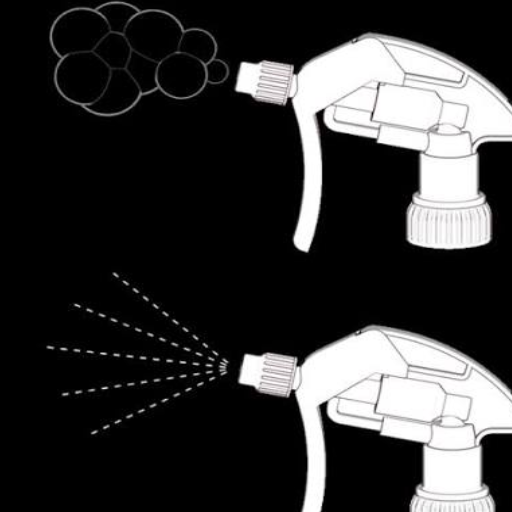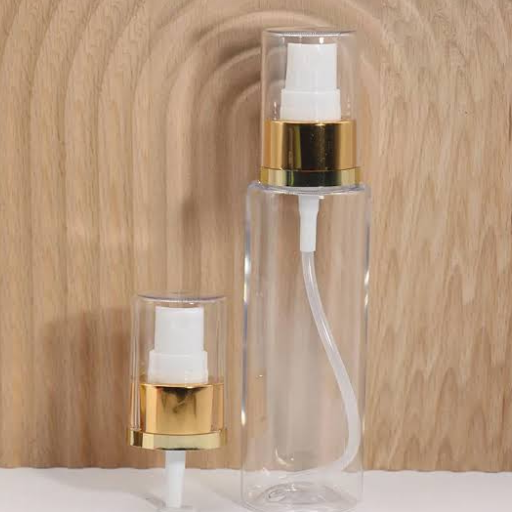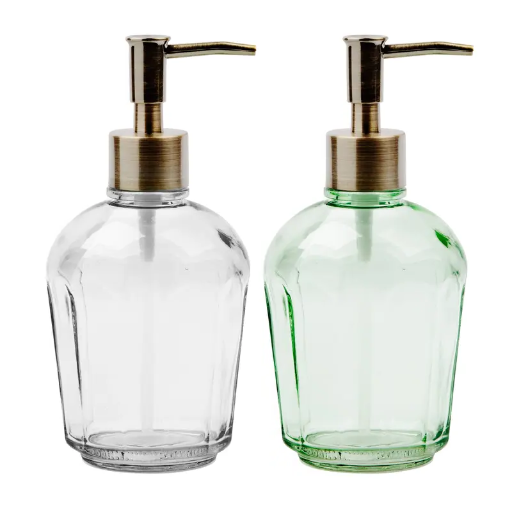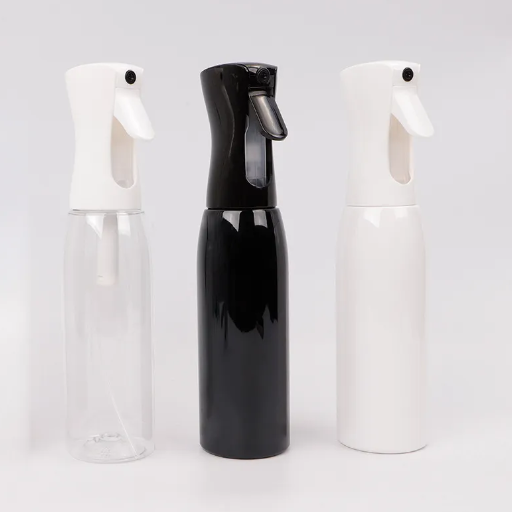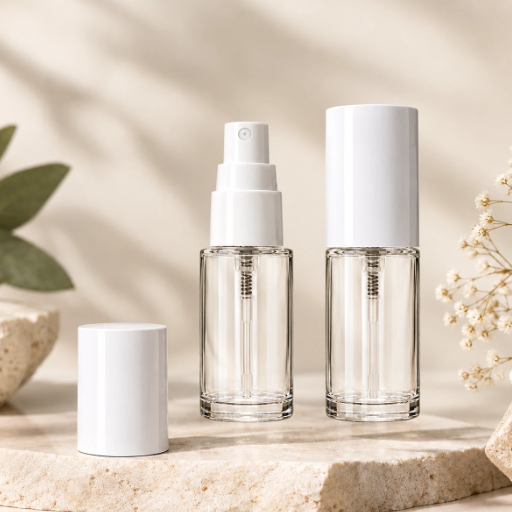
A custom perfume bottle is a fragrance container built to your brand’s specification rather than chosen from a stock catalogue. The glass body, neck finish, pump, collar, cap, decoration and outer box are specified together, and they have to fit together. For a B2B buyer, the decision splits into three build levels, and the level you choose sets your tooling cost, minimum order, lead time and risk before a single quote comes back.
Most pages ranking for custom perfume bottles are catalogues. They show shapes and colors, then ask you to email for a price. That is fine for browsing, less useful when three factories send three formats and you have to work out which quote is cheaper once molds, decoration, freight and duty are added.
This guide follows one bottle from brief to reorder: picking the build level, writing a brief that produces comparable quotes, checking component fit, costing decoration and landed freight, and inspecting what arrives. It is written for fragrance founders, product managers and packaging buyers sourcing custom glass perfume bottles at commercial scale.
Key Takeaways
- Custom perfume bottles come in three build levels: stock shape plus decoration, semi-custom, and a new mold. Only the third gives you an exclusive body, and it carries the highest minimum order and tooling cost.
- Your real MOQ is the highest of the component minimums you actually need, not the lowest number in a quote. A 1,000-piece bottle quote means little if the cap starts at 5,000.
- Neck finish compatibility causes most returns: the bottle, pump ferrule, collar and cap must be specified as one system, and FEA crimp necks are not interchangeable with screw necks.
- Landed cost at 5,000 units can be roughly double the FOB unit price once mold amortization, decoration setup, freight and duty are added. Volume changes that ratio more than negotiation does.
- Ask who owns the mold before you pay for it. Ownership decides your reorder price, your lead time and whether you can move to another factory.
What Are Custom Perfume Bottles?
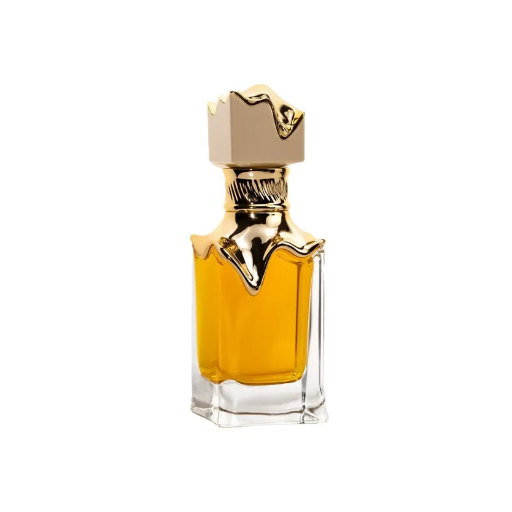
Custom perfume bottles are glass fragrance containers produced to a buyer’s specification for body shape, capacity, neck finish, closure set, surface decoration and secondary packaging. “Custom” can mean a stock bottle with your logo printed on it, or an exclusive mold developed for one brand.
That range is why custom perfume bottles are hard to compare on price: two suppliers can both say “MOQ 10,000” and mean different things. Decide the build level before you request pricing.
| Build level | What you change | What you pay for in tooling | Typical MOQ | Typical lead time | Main risk |
|---|---|---|---|---|---|
| Stock shape + decoration | Your print, foil, coating or frosting on a catalogue bottle | Decoration setup (screen, foil die, spray masking) | Decoration minimums, often below body minimums | Shortest; no mold stage | Your shape is shared with other brands |
| Semi-custom | Stock bottle mold, but a new cap, collar or neck modification | Cap or collar mold, sometimes a neck insert | Middle tier | Mold lead time plus production | Fit problems between modified parts and a stock body |
| New bottle mold | An exclusive glass body drawn to your design | Bottle mold, sample rounds, engineering time | Highest | Longest | Cost, delay, and design changes between render and mold |
Published market ranges, not rules: Lisson Group’s 2026 guide puts stock MOQ at 1,000 to 5,000 units with 7 to 30 day lead times, and custom MOQ at 10,000 to 100,000+ with 30 to 45 day production and molds from USD 1,000 to 5,000+. GPBottles lists 10,000 pieces per shape, 45 to 50 day production and 3 to 4 extra weeks for a new mold. Factories differ because their mold banks and customer mix differ.
The decision rule that saves the most money: your real MOQ is the highest of the component minimums you actually need. If the body starts at 3,000, the cap at 5,000 and the foil at 2,000, your launch quantity is 5,000.
Illustrative scenario. A founder budgets for 3,000 bottles and buys caps separately to save 12%. The caps arrive with a 0.4 mm neck mismatch and a different collar height, so the assembled bottle sits proud of the cap line. The reshoot costs more than the saving. The lesson is to specify and sample the set as a set. If you want to browse formats first, start with our and note the neck finish on each page.
Custom vs Stock vs Personalized Bottles
The word “custom” covers three different businesses. B2B custom manufacturing means a factory makes bottles to your specification, in your quantity, for your brand. Stock buying means you purchase an existing bottle and decorate it. Consumer personalization means an engraving shop puts a name on a retail bottle.
Search demand reflects the split. Engraved perfume bottles draw about 1,900 US searches a month and personalized perfume bottles about 480, both with gift intent. Custom perfume bottles draws about 1,300 with commercial intent, and those buyers are comparing factories.
The practical boundary: consumer engraving is one bottle and a name, with no tooling and no MOQ; stock plus decoration is the fastest and cheapest entry; semi-custom adds a new closure to a stock body and is often the best value when the cap carries the brand; fully custom means a new body mold, which is exclusive, expensive and slow.
Where does stock stop making sense? When the shape is the brand. If your differentiation lives in the cap, label and box, a stock body plus a custom zamac cap delivers most of the perceived value at a fraction of the tooling cost.
There is also an ownership question inside “custom.” decides who controls the design file, who holds the mold, and whose name sits on the regulatory paperwork.
Materials, Shapes, Sizes and Neck Finishes
Glass grades
Most custom perfume bottles are soda-lime glass, the standard container glass used across cosmetics. “High-flint” or “extra-white” describes a low-iron glass that reads clearer and cooler in tone. It’s a clarity grade, not lead crystal, and clarity does not equal strength.
Colored glass is the same base with colorant in the batch. Post-consumer recycled (PCR) glass is available from some suppliers, but recycled content and color consistency are supplier-specific, so ask for the percentage in writing.
Capacity and shape families
The fragrance range is roughly 1 ml to 250 ml: samples at 1 to 10 ml, travel sizes at 10 to 30 ml, mainstream eau de parfum at 30 to 100 ml, large formats at 100 to 250 ml. Our catalogue covers 1 to 250+ ml across round, square, rectangular, mini, roller-ball, heart-shaped and colored bodies. Buyers comparing perfume bottle sizes should read nominal capacity, fill volume, headspace and glass weight together, because all four change the pack.
Shape affects cost. Round bottles are the most efficient to mold and the most forgiving to decorate. Square and rectangular bodies give more label area but concentrate stress at the corners and complicate annealing. Very flat or tall designs can distort in the lehr, which is why factories ask for small changes after seeing your render.
Neck finishes
On custom perfume bottles, the neck finish is the threaded or crimped opening at the top. It is the most important compatibility specification and where most sourcing errors happen.
| Finish | Family | Closure type | Typical capacity | Common use |
|---|---|---|---|---|
| FEA 13 | Crimp | 13 mm crimp pump or valve | 5 to 15 ml | Minis, samples, travel |
| FEA 15 | Crimp | 15 mm crimp pump | 15 to 100 ml | Mainstream fragrance |
| FEA 17 | Crimp | 17 mm crimp pump | 50 to 100 ml | Mid to large formats |
| FEA 18 | Crimp | 18 mm crimp pump | 50 to 200 ml | Larger fragrance, home fragrance |
| FEA 20 | Crimp | 20 mm crimp pump | 100 to 250 ml | Large formats |
| Screw 15/415 | Screw | 15 mm screw pump or cap | 5 to 30 ml | Refillable, roller-ball conversions |
| Screw 18/415 | Screw | 18 mm screw pump or cap | 30 to 100 ml | Refillable formats |
FEA finishes are crimp necks in the EN 14854 dimensional family. A crimp pump is pressed and rolled onto the glass and cannot be removed without destroying the ferrule. Screw finishes use a thread; 15/415 and 18/415 are the common fragrance sizes. The systems are not interchangeable: a 15 mm crimp neck and a 15 mm screw neck are both “15” and entirely different parts.
One warning: 24/410 and 28/400 are lotion, soap and household sizes, not fragrance crimp finishes. A page that lists them as perfume bottle necks is describing another product category. Our covers measurements and tolerances.
Designing and Tooling Custom Perfume Bottles
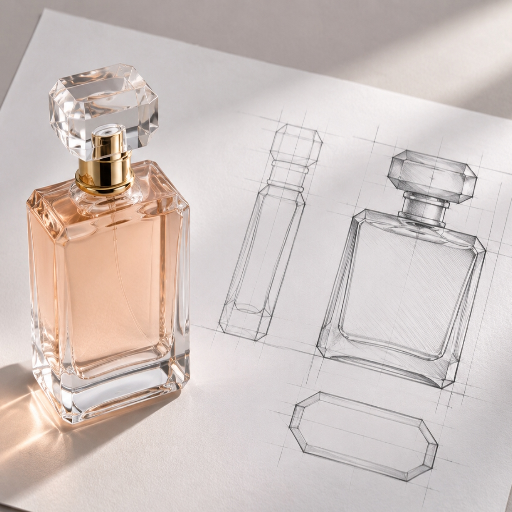
A custom bottle starts as a brief, not a drawing. State capacity, fill level, formula type, neck finish, closure concept, decoration, target unit cost, launch quantity, markets and drop-test standard. Factories quote badly when any of these is missing.
The factory then produces a 2D specification and a 3D render. The render is a sales document; the mold is the manufacturing document. Glass has minimum wall thickness, draft angles, corner radii and a parting line, so a render that ignores them will come back modified. Expect the tooling engineer to change something.
Tooling runs through mold design, mold cutting, a T1 trial, adjustments and a pre-production sample (PPS). T1 is where you see real glass for the first time. Approve the PPS, not the render: it is the sample the factory will match in bulk, signed, dated and kept by both sides.
Published benchmarks are consistent enough to plan with. Lisson cites molds from USD 1,000 to 5,000+ and custom production of 30 to 45 days. GPBottles publishes 45 to 50 days plus 3 to 4 weeks for a new mold. Treat these as market context; your quote depends on mold complexity, cavity count and whether the factory already owns a similar blank.
Here is the part most guides skip. Jarsking notes that a new appearance does not always require a new bottle mold, and describes three development tiers: modify an existing platform, develop a tailored variant, or cut a private mold. Many “custom” bottles are existing molds with a new neck insert, base emboss or decoration. If a factory proposes a new mold immediately, ask what existing platform is closest.
Mold ownership is a contract term, not a detail. If you pay for the mold, the agreement should say you own it, where it is stored, who maintains it, and what happens if you leave. If the factory owns it, the amortization sits inside your unit price and you cannot take the tool with you. Both arrangements are legitimate; not knowing which one you have is not.
Decoration and Branding for Custom Perfume Bottles
Decoration is where brands spend money and where suppliers make margin. The method affects minimum order, unit cost, lead time and how the finish survives alcohol, filling and shipping.
| Method | Typical MOQ | Typical unit adder | Setup | Best use | Main failure mode |
|---|---|---|---|---|---|
| Screen printing | 1,000 to 2,000 | USD 0.03 to 0.30 | USD 80 to 150 per color | Solid logos, text, simple graphics | Scratches, poor adhesion on curved glass |
| Hot foil stamping | 1,000 to 3,000 | USD 0.08 to 0.15 | USD 80 to 300 per die | Metallic accents, fine line work | Foil lifting at edges, die wear |
| Spray coating | 3,000+ | USD 0.15 to 0.45 | Masking and line setup | Full-color bodies, soft-touch | Chipping at shoulder and base |
| Frosting | 3,000+ | Similar to coating | Line setup | Matte, premium surface | Uneven etch, fingerprinting |
| Metallization | 5,000+ | USD 0.30 to 0.60 | Vacuum line setup | Mirror gold, silver, chrome look | Flaking, alcohol attack |
| Embossing or debossing | 10,000+ | Tool-dependent | Custom tooling | Structural branding in glass or cap | Tool cost, low relief visibility |
These are published supplier ranges, not quotes, and they move with volume, colors and curvature. The MOQ column matters as much as the price: a metallized finish at 5,000 pieces can wreck a 3,000-piece plan even when the unit adder looks acceptable.
Compatibility is the hidden cost. Alcohol-based fragrance attacks some coatings and inks, especially at the shoulder where spills collect. If your formula is high in alcohol or your filling line is aggressive, ask for an alcohol soak test on the decorated sample, not just a print proof. A finish that looks perfect in a photo can cloud or lift after two weeks in contact with the product.
Three tests you can run on a PPS before approving bulk:
- Tape adhesion. Press standard adhesive tape onto the decoration, pull at 90 degrees, inspect for lifting. Repeat on a curved area.
- Rub test. Rub the print with a solvent-soaked cloth for a set number of strokes and compare against the approved sample.
- Alcohol soak. Submerge a decorated bottle in the actual formula or a high-alcohol surrogate for 24 to 72 hours and check for color shift, blistering or loss of gloss.
Write the pass criteria into the purchase order. “Decoration must pass tape adhesion and 48-hour alcohol soak per approved PPS” is enforceable. “Good quality printing” is not.
Building the Complete Component Set
A custom perfume bottle is a system, not a container. The set includes the glass body, neck finish, pump or valve, the collar that covers the crimp, the overcap, the dip tube and the outer box. Each part has a tolerance, and the tolerances stack.
Four dimensions cause most failures:
- Neck finish diameter and height. The pump ferrule crimps to a specific finish. A 15 mm pump on a neck with the wrong height will leak or sit loose.
- Crimp versus screw. A crimp pump cannot go on a screw neck, and a screw pump cannot be crimped. No adapter makes this safe for retail.
- Pump dose. FEA 15 pumps commonly deliver around 0.05 to 0.15 ml per stroke, with model-specific variation.
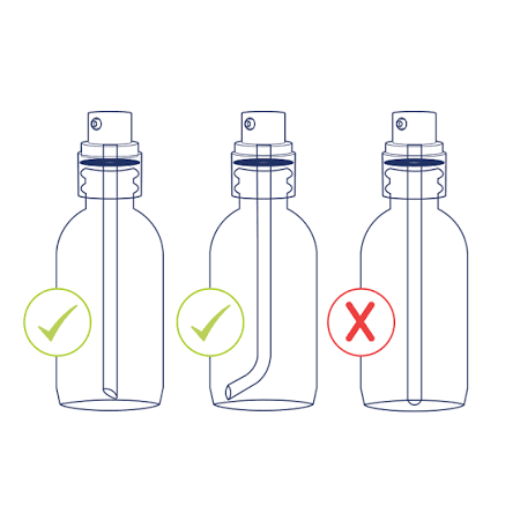
- Dip tube length. The tube must reach the base without coiling, and stop short enough to avoid drawing sediment.
Add the cosmetic fit: the collar must cover the crimp ring cleanly, the cap must seat without rocking, and its inner height must clear the actuator. A cap that fits one supplier’s 15 mm pump may not fit another’s, because actuator heights differ.
Specify the set as one bill of materials and ask one supplier to confirm compatibility across all parts, even if some are made elsewhere. Our explains the method, and covers materials and fits.
Illustrative scenario. A brand approves a 50 ml FEA 15 bottle and a 15 mm crimp pump from two suppliers. Both are within their own tolerances. Assembled, the collar sits 1.2 mm high, leaving a visible glass ring. Nothing is defective, but the pack looks wrong. The fix is a taller collar, which needs a new collar mold and five more weeks. Compatibility is cheaper to design in than to correct later.
MOQ, Sampling and Lead Times
For custom perfume bottles, MOQ is a cost threshold, not a factory mood. Production lines have setup time, scrap rates and minimum run lengths for glass, coating, printing and assembly. Below a certain quantity the supplier cannot recover the setup, so the unit price rises sharply or the order is refused.
Break your MOQ down by component before you negotiate:
- Bottle body: mold-dependent, often the highest number for a new mold.
- Cap: mold and material dependent; metal caps often carry a higher minimum than plastic.
- Pump: sold in standard cartons with a carton minimum.
- Decoration: process-dependent, as the decoration table shows.
- Box: print minimums, often lower than glass.
Then apply the rule again: your order quantity is the maximum of those minimums.
Sampling runs in a predictable sequence: brief and specification review, 2D and 3D approval, mold cutting and T1, correction, decoration trial, PPS approval, bulk production, pre-shipment inspection. Mold cutting plus T1 plus correction is commonly several weeks; GPBottles quotes 3 to 4 weeks for a new mold alone, then 45 to 50 days of production. Freight, clearance and inland delivery sit on top. If your launch date is fixed, work backward from the shelf date and add buffer for one rejection round.
Our published production time is 4 to 6 weeks, quoted per project. We don’t publish a single MOQ because it depends on the component set. Send the full brief and we will quote MOQ and lead time together, which is the only way the two numbers mean anything. Our page explains the documents, and covers tier mechanics.
What Custom Perfume Bottles Cost
Custom perfume bottles are costed in layers, and the layers competitors omit usually decide the project.
| Cost layer | What it covers | When it is charged |
|---|---|---|
| Bottle mold | Tooling for an exclusive body | One time, at mold approval |
| Decoration setup | Screens, dies, masking, line setup | One time per design change |
| Unit product | Glass, pump, collar, cap, print | Per unit |
| Assembly and QC | Crimping, leak test, inspection | Usually inside unit price |
| Packaging | Box, insert, carton | Per unit, often quoted separately |
| Freight and insurance | Sea or air, volumetric | Per shipment |
| Duty and fees | HTS classification, brokerage | At import |
Worked example (illustrative, not a quote). A 50 ml round flint bottle with a FEA 15 crimp neck, a FEA 15 pump and collar, a zamac cap and a one-color screen print, at 5,000 units.
| Line | Assumption | USD per unit |
|---|---|---|
| Bottle, custom flint, FEA 15 | 0.85 | 0.85 |
| Pump and collar, FEA 15 | 0.12 | 0.12 |
| Zamac cap | 0.55 | 0.55 |
| One-color screen print | 0.15 | 0.15 |
| Product subtotal | 1.67 |
| One-time cost | Assumption | USD |
|---|---|---|
| Bottle mold | 3,000 | 3,000 |
| Screen setup | 120 | 120 |
| Design and 3D (if used) | 400 | 400 |
| One-time subtotal | 3,520 |
| Landed total at 5,000 units | Assumption | USD |
|---|---|---|
| Product, 5,000 × 1.67 | 8,350 | |
| One-time costs | 3,520 | |
| Freight, insurance and fees | 10% of product | 835 |
| Duty at 22.5% (7013.37.20 scenario) | on 8,350 | 1,879 |
| Landed total | 14,584 | |
| Landed per unit | 2.92 |
The duty line deserves attention. US HTS treatment of glass fragrance bottles can range from 2.5% under 7010.90.20 to 22.5% under 7013.37.20 depending on classification and value, and the model uses the higher scenario deliberately.
Section 301 and other Chapter 99 additional duties are excluded and must be checked at shipment in the USITC HTS database. Our page covers classification in detail.
Volume effect (illustrative). The mold is fixed, so volume changes unit economics far more than a few percent of negotiation. Luxury perfume bottles wholesale pricing follows the same stack, but heavier glass and metal caps move freight and duty more than the mold does.
| Volume | Bottle | Pump | Cap | Product per unit | Mold per unit | Landed per unit | |
|---|---|---|---|---|---|---|---|
| 5,000 | 0.85 | 0.12 | 0.55 | 0.15 | 1.67 | 0.60 | ~2.92 |
| 20,000 | 0.70 | 0.09 | 0.45 | 0.10 | 1.34 | 0.15 | ~1.95 |
| 50,000 | 0.62 | 0.07 | 0.38 | 0.08 | 1.15 | 0.06 | ~1.59 |
Three caveats. Tooling is one-time only if you own and reuse the mold; if the supplier owns it, amortization is already inside the unit price. Freight is volumetric, so a thick-based bottle costs more to ship than its FOB price suggests. And duty classification can move the rate by a factor of nine.
Where costs hide, in order of frequency: decoration setup repeated for a second color, cap minimums above body minimums, freight on heavy glass, duty misclassification, and rework after a PPS approved without an alcohol test.
Choosing a Manufacturer for Custom Perfume Bottles
The first split is factory versus trader. A trader quotes fast and sources from several factories; a direct manufacturer controls the mold, the line and the QC. Know which one you are buying from, because it decides who answers when something goes wrong. A custom perfume bottle manufacturer should be able to show the mold shop, the decoration line and the QC station that will touch your order.
Five questions separate the two quickly:
- Which parts do you make in-house, and which do you buy in?
- Can I see the mold shop and decoration line, on video or on site? A trader cannot show a line they do not own.
- Who owns the mold after I pay for it, and where is it stored?
- What is your AQL plan and which standard do you inspect to? ISO 2859-1 is the acceptance-sampling standard indexed by AQL, and the level should be in the PO.
- What documents can you supply for my market? In the EU, Regulation 1223/2009 puts the obligations on the responsible person, including the product information file and the cosmetic product safety report. In the US, MoCRA requires facility registration and product listing, with adverse-event reporting inside 15 business days.
Those duties belong to the brand or its responsible person, not the bottle factory. A good supplier helps with documentation, but cannot take over your compliance role.
Defect taxonomy. Group defects so inspection reports are comparable across suppliers.
| Category | Examples | Typical cause |
|---|---|---|
| Dimensional | Neck finish out of tolerance, height variance, base wobble | Mold wear, lehr distortion |
| Cosmetic glass | Bubbles, stones, cords, scratches, mold seam | Batch quality, handling |
| Decoration | Misregistration, fade, lift, off-color | Setup, ink, cure |
| Assembly | Leak, loose collar, cap rock, short dip tube | Crimp pressure, component mix |
| Packaging | Carton crush, label error, count short | Handling, packing spec |
Typical pre-shipment tests: a drop test, a leak or vacuum test on filled or water-filled units, a decoration adhesion test, a cap fit and torque check, and a count and carton check. Lisson cites a 36-inch drop test, which is one published benchmark; others use ISTA 3A or a buyer-defined height. Pick one, write it into the PO, and apply it to every shipment so results are comparable.
Put these in the purchase order, not just the email thread: approved PPS reference, neck finish tolerance, decoration pass criteria, AQL level and inspection stage, drop-test height and orientation, packaging specification, and the mold ownership clause. If it is not in the PO, it is not enforceable.
Wholesale, Reorders and Mold Ownership
The second order is easier than the first and usually more profitable, provided the first was documented. Reorders skip design, mold and sampling, so lead time shortens to production plus decoration plus freight. If you are planning custom perfume bottles wholesale volumes across several SKUs, share the forecast before the first order so mold and decoration setup can be allocated sensibly.
Three things make reorders go wrong. The mold was not maintained and the body dimension drifts. The decoration setup was not stored, so a repeat print needs new screens. Or the supplier changed the pump model, and the collar no longer seats.
Protect against all three with a change-control clause: no change to glass, decoration or components without written approval and a new PPS. Keep the golden sample sealed, with the date and PO number.
Mold ownership belongs in the contract. If you own it, ask where it is stored, what maintenance applies, and the transfer procedure if you move. If the supplier owns it, ask about an exclusivity period, because their mold can be used for another client’s similar bottle.
Our guide covers forecast bands, safety stock and the volume at which a second cavity pays for itself.
Where CustomPackingCo Fits
Fuzhou Longlu Packaging Co., Ltd. is a direct manufacturer in Fuzhou, China, working OEM and ODM for fragrance brands. Our catalogue covers glass perfume bottles from 1 to 250+ ml, caps and collars, crimp and screw sprays, testers and perfume boxes. The site describes a 6,000 m² facility with CNC equipment and automated assembly lines; that is the company’s own description, not an audited claim.
We quote bottle, cap, pump, collar and box as one set, so one team checks the neck finish, collar fit and cap clearance before the order is placed. Production time is 4 to 6 weeks. We don’t publish a single MOQ because it depends on the component set. Certifications aren’t listed on our site, and we won’t claim one we can’t document.
If you have a brief, a capacity, a neck finish and a target quantity, and we will return the component set, MOQ and lead time together.
Frequently Asked Questions
How much do custom perfume bottles cost?
Custom perfume bottles typically land between about USD 1.60 and USD 3.00 per unit at 5,000 to 50,000 pieces once mold amortization, decoration, freight and duty are included. Published stock bottle prices run from about USD 0.35 to USD 1.20 depending on volume and finish. Your number depends on capacity, glass weight, closure material and decoration.
What is the minimum order for custom perfume bottles?
There’s no single number for custom perfume bottles. Published factory ranges put stock bottles at 1,000 to 5,000 units and fully custom molds at 10,000 to 100,000+. Your real minimum is the highest component minimum in your set, so check the cap, pump, decoration and box first.
What is the difference between FEA 15 and 15/415?
On custom perfume bottles, FEA 15 is a 15 mm crimp neck: the pump is crimped on and can’t be removed. 15/415 is a 15 mm screw neck: the closure twists on and can be refilled. They are both “15” and completely different parts.
How long does it take to make a custom perfume bottle?
Plan for 8 to 14 weeks from brief to delivered goods on a new mold: 3 to 4 weeks for mold and trial, 4 to 6 weeks of production, plus decoration and freight. Stock bodies with decoration are much faster. Add two weeks of buffer for one correction round.
Can I use a stock bottle and still call it custom?
Yes, and often you should. A stock body with your own cap, decoration, label and box is a legitimate custom package, and it avoids mold cost and lead time. Call it custom decoration in your own planning, so quotes are compared on the same basis.
Do I need a new mold to get a unique bottle shape?
Not always. Many suppliers can modify an existing platform with a new neck insert, base emboss or shoulder change at a fraction of a new mold cost. Ask what existing platform is closest, and get the modification scope in writing.
Conclusion
Custom perfume bottles reward buyers who specify before they shop. Decide the build level first, because it sets tooling, MOQ and timeline. Write a brief complete enough that three factories quote the same thing.
Treat the neck finish, pump, collar and cap as one system rather than four line items. Cost the project landed, with mold amortization included, and put the PPS, AQL, drop test and mold ownership clause in the purchase order where they can be enforced.
Do that, and your second order of custom perfume bottles becomes simple: same mold, same components, shorter lead time, better unit price. Skip it, and every reorder reopens the same questions.
If you are at the brief stage, or . We will price the set, the MOQ and the lead time in one reply.