
Luxury custom perfume boxes work through three levers: material weight, finishing precision, and closure experience. Nail all three and the box sells the fragrance before the customer ever lifts the bottle.
Amara learned this the hard way. She launched her first fragrance line in 2024 with a beautiful bottle and a printed folding carton she thought was “good enough.” Sales at her first pop-up were flat, and one customer said the box “felt like a magazine insert.” Six months later, Amara switched to a rigid setup box with soft-touch lamination and a debossed logo. Her retail price stayed the same, but perceived value jumped, and her sell-through rate climbed 34%.
Here’s the thing most fragrance brands already suspect: the box is not packaging. It’s the first physical proof of how much your scent is worth. In this guide, you’ll learn exactly which materials, finishes, and closures create that proof, and what each one realistically costs.
Key Takeaways
- Luxury lives in three levers: rigid material weight, precision finishes like foil stamping and embossing, and a satisfying magnetic or drawer closure.
- Rigid board (greyboard) reads premium on first touch; a folding carton rarely does, no matter how good the print.
- True luxury custom perfume boxes typically cost 3.00to3.00to5.00 or more each, versus 1.50to1.50to3.00 for premium and roughly $0.50 for basic folding cartons.
- You don’t need every finish. One hero finish plus soft-touch lamination beats stacking five treatments and looking cheap.
- Luxury and sustainability can coexist with FSC-certified rigid board, recycled greyboard, and mono-material design.
What Makes a Perfume Box Luxurious?

A luxury perfume box is a premium rigid or specialty-paper container built on three levers: material weight, finishing precision, and closure experience. Together they protect the bottle, signal exclusivity, and create a tactile, memorable unboxing moment.
Standard perfume boxes focus on one job: holding the bottle. A luxury custom perfume box does three jobs at once. It protects a fragile glass bottle in transit. It communicates brand position on a crowded shelf. And it choreographs the moment of opening.
Think of it as a system, not a single feature. A heavy greyboard box with a cheap flap feels worse than a light rigid box with a magnetic closure. Luxury is the combination of weight, finish, and motion working together. For a fuller look at the whole packaging system, including bottles, caps, and labels, see our complete guide to custom perfume packaging.
Premium Materials for Luxury Custom Perfume Boxes
Material is the single biggest driver of both cost and perceived quality. Choose wrong here and no finish will save you.
| Material | Feel | Relative Cost | Best For |
|---|---|---|---|
| Folding carton (SBS paperboard) | Thin, 350 to 500gsm | Low (about $0.50/box) | Mass-market and budget lines |
| Rigid board (greyboard) | Heavy, 1,000 to 1,200gsm | Medium (1.50to1.50to3.00) | Premium and luxury |
| Wood veneer / PU leather | Dense, keepsake-quality | High ($5.00+) | Collector and gift sets |
| Specialty wraps | Tactile surface layer | Low to medium | Brand feel and texture |
Rigid Board (Greyboard) vs. Folding Carton
The fastest way to make a perfume box feel premium is to move from folding carton to rigid board. Folding cartons are thin paperboard, typically 350 to 500gsm, folded and glued into shape. Rigid boxes are built from greyboard, usually 1,000 to 1,200gsm and around 2.3mm thick, wrapped in printed paper.
The difference is physical. A rigid box resists when you press it. It has mass in the hand. That mass registers as quality instantly, before the customer reads a single word.
This is why premium and luxury fragrances default to rigid. If your bottle retails above 60,afoldingcartonisactivelyworkingagainstyou.Ifitretailsbelow60,afoldingcartonisactivelyworkingagainstyou.Ifitretailsbelow30, a rigid box may be overkill unless you’re positioning the brand as accessible luxury.
Specialty Wraps: Leather-Touch, Linen, Soft-Touch, and Metallic Papers
The greyboard is the skeleton. The wrap is the skin. Specialty papers transform a plain rigid box into something tactile.
Soft-touch lamination gives a velvety, matte feel that invites the hand to linger. Leather-touch paper mimics the grain of fine leather at a fraction of the cost. Linen and cotton-textured papers add an organic, artisanal signal. Metallic and pearlescent papers catch light and read as celebratory.
Each wrap sends a different message. Soft-touch says modern minimalism. Linen says heritage and craft. Metallic says evening and occasion. Match the wrap to the fragrance’s personality, not just to what looks pretty in isolation.
Wood, PU Leather, and Mixed-Material Options
For the top of the market, boxes that combine rigid board with wood veneer or PU leather deliver true collector-level feel. A wooden lid or a leather-wrapped shell is heavy, durable, and unmistakably expensive.
These options cost more and have longer lead times, but they’re what separates a 90fragrancefroma90fragrancefroma250 one on the shelf. Fuzhou Longlu Packaging Co., Ltd. regularly builds these mixed-material boxes for brands that want the object itself to be a keepsake.
Premium Inserts: Velvet, Satin, EVA Foam, and Molded Pulp
The insert is where protection meets presentation. A bottle rattling inside a beautiful box destroys the entire effect.
Velvet and satin inserts cradle the bottle and whisper luxury. EVA foam, precision-cut to the bottle’s silhouette, holds it perfectly still and reads as engineered quality. Molded pulp is the sustainable choice, a recyclable tray that still positions the bottle precisely.
The rule is simple: the insert should hold the bottle so snugly that you can turn the box upside down without movement. Fit is a feature.
Luxury Finishes That Elevate a Perfume Box

Finishes are where luxury custom perfume boxes become memorable. They add depth, light, and texture that flat printing can’t achieve.
Hot Foil Stamping (Gold, Silver, Holographic)
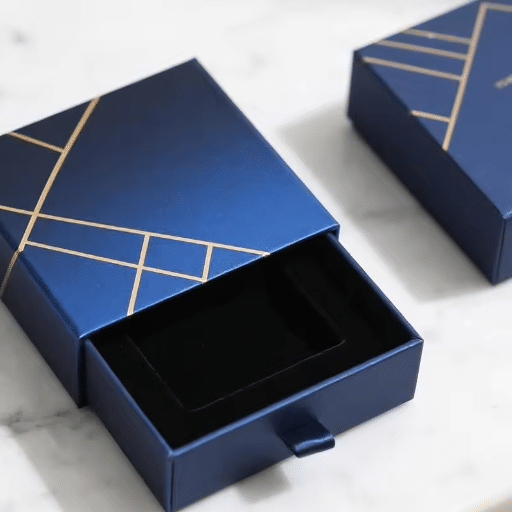
Foil stamping applies a thin metallic or pigmented foil to the box under heat and pressure. It’s the fastest route to an expensive look. Gold foil on deep navy. Silver foil on matte black. Holographic foil for a modern, limited-edition edge.
Foil works best when it’s restrained. A logo, a monogram, a thin border. Too much foil and the box reads as gaudy rather than luxurious. One or two foil elements is the sweet spot.
Embossing, Debossing, and Blind Debossing
Embossing raises a design above the surface. Debossing presses it in. Both create a three-dimensional, tactile effect that makes people run their fingers over the box.
Blind debossing, done without ink or foil, is a quiet signal of refinement. It’s the packaging equivalent of a suit with no visible branding. For a modern, minimal fragrance, a blind debossed logo on soft-touch paper is often the single most effective finish you can choose.
Spot UV and Raised Texture
Spot UV applies a glossy coating to specific areas, creating contrast between shiny and matte. Use it to make a logo or pattern pop against a matte background. Raised UV goes a step further, adding a subtle texture you can feel.
Spot UV is ideal for detail work: a pattern that only appears under light, or a highlight that draws the eye to the brand name.
Soft-Touch and Matte Lamination
Lamination protects the printed wrap and controls the finish. Soft-touch lamination is the workhorse of luxury packaging. It’s what gives premium boxes that velvety, non-reflective feel.
Matte lamination is similar but with less texture. Both are more durable than uncoated paper and resist scuffs and fingerprints, which matters when the box sits on a retail shelf being handled all day.
How to Combine Finishes Without Looking Cheap
The most common mistake we see is over-finishing. A box with foil, embossing, spot UV, and a metallic wrap all at once doesn’t look expensive. It looks busy.
Pick one hero finish. Foil or embossing usually. Then support it with soft-touch lamination as the base. Everything else stays quiet. Restraint is what reads as luxury, because restraint is what wealthy brands can afford.
Daniel made the over-finishing mistake on his second launch. His first fragrance used gold foil and sold well, so he added embossing, spot UV, and a holographic band to the second. Sales dropped, and customers said the box felt “trying too hard.”
When he stripped it back to a single debossed monogram on soft-touch, the reviews flipped to “elegant” overnight.
Luxury Closure Styles and Structures
The closure is the box’s handshake. It’s the first thing a customer touches when they pick up the box, and the mechanism of the reveal.
Magnetic Closure (Flip-Top and Book-Style) Boxes
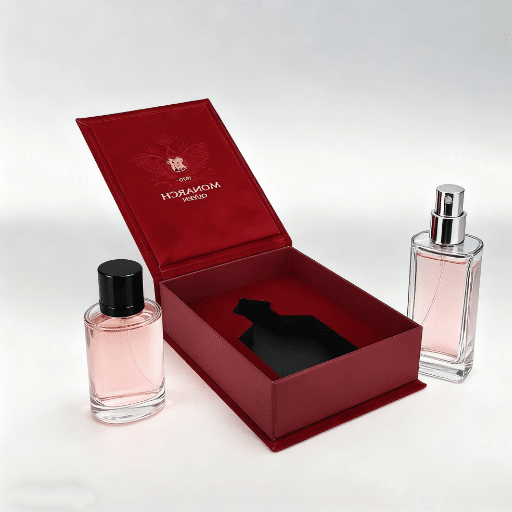
A magnetic closure uses hidden magnets embedded in the rigid board. The lid closes with a satisfying snap, then opens smoothly without tape or tearing. It’s the single most effective upgrade you can make to a perfume box.
Book-style magnetic boxes open like a hardcover book, revealing the bottle and an interior card. They’re ideal for storytelling, gift sets, and anything where the reveal matters. Magnetic closures cost more than a simple lid, but the perceived value they add is almost always worth it.
Drawer and Slide Boxes
A drawer box slides open horizontally, like a small chest. It forces a slower, more deliberate reveal, which builds anticipation. Drawer boxes feel gift-like and are a favorite for premium sample sets and discovery kits.
The tradeoff is cost and complexity. Drawer boxes require more precise construction than a lid-and-base box, so expect a slightly higher per-unit price and longer lead time.
Lift-Off Lid and Base (Two-Piece) Rigid Boxes
The lift-off box is the classic: a separate lid that lifts vertically off a base. It’s elegant, sturdy, and relatively economical among rigid options. The lift-off reveal is instant and satisfying, making it a strong default for standalone fragrances.
Double-Door and Pedestal Display Boxes
For statement pieces, double-door boxes open outward from the center, and pedestal boxes lift the bottle on a raised platform. These are theatrical and best reserved for hero SKUs, limited editions, and retail displays where the box is part of the merchandising.
| Closure Style | Best For | Relative Cost | Reveal Feel |
|---|---|---|---|
| Magnetic (book-style) | Gift sets, storytelling | High | Cinematic, layered |
| Drawer / slide | Sample sets, discovery kits | High | Slow, anticipatory |
| Lift-off lid & base | Standalone fragrances | Medium | Instant, classic |
| Double-door | Hero SKUs, displays | High | Theatrical |
| Folding carton | Budget / mass lines | Low | Functional only |
Designing the Luxury Unboxing Sequence
Luxury isn’t just the box. It’s the choreography of opening it. The best perfume brands script the entire sequence.
The Layered Reveal: Sleeve, Box, Insert, Inner Card
Great unboxing builds in steps. An outer sleeve slides off. A rigid box opens. The bottle rests in a velvet insert. An inner card carries the fragrance story. Each layer adds a beat of anticipation.
This layered reveal is why rigid boxes outperform folding cartons on social media. People film unboxing experiences that have clear, satisfying moments. A box that opens in two slow, deliberate movements gets shared. A box that opens in one rip doesn’t.
Ribbon, Pull Tabs, and Magnetic “Snap” Moments
Small details do heavy lifting. A ribbon pull tab lifts the bottle from its insert. A magnetic lid closes with an audible snap. These micro-moments are what customers remember and describe to friends.
Design for the hands, not just the eyes. The moment the lid snaps shut, or the ribbon slides free, is the moment the box feels worth its price.
Matching the Box to the Bottle and Cap
A luxury box is worthless if the bottle fights it. The insert must fit the exact bottle and cap dimensions, including any over-cap or collar. The box’s proportions should mirror the bottle’s shape, so the two feel like one object.
Maira runs a niche house with unusually tall, thin bottles. Her first supplier used a generic insert, and bottles arrived tilted in their boxes. After switching to precision-cut EVA inserts matched to the exact silhouette, her return rate from damaged bottles dropped to nearly zero.
What Luxury Custom Perfume Boxes Cost (Real Tiers)

Understanding real price ranges is the fastest way to avoid overpaying or underspending.
Premium Tier: 1.50to1.50to3.00 per Unit
At this tier you get a rigid box with decent paper wrap and one or two basic finishes. Think soft-touch lamination with a foil logo. This is the right range for brands retailing between 60and60and120.
True Luxury Tier: 3.00to3.00to5.00+ per Unit
Here you get heavier greyboard, specialty wraps like leather-touch or linen, magnetic or drawer closures, precision inserts, and multiple tasteful finishes. This is the tier for brands above $150, gift sets, and limited editions. For detailed bulk pricing guidance, see our wholesale perfume boxes guide.
MOQ Realities: 50 vs. 500 vs. 1,000+ Units
Minimum order quantities vary widely. Some suppliers start as low as 50 boxes for simple rigid styles. Many manufacturers set MOQs at 500 pieces, and overseas factories often require 1,000 to 5,000 units for the lowest per-unit price. A low MOQ means a higher price per box, so startups should order enough to cover a launch plus reorders without overcommitting.
Hidden Costs: Dies, Plates, and Foil and Emboss Samples
The per-unit price is not the total. Custom dies and printing plates are one-time setup costs. Foil and embossing samples can run 50to50to150 each. Tooling for a unique box shape costs more. Budget for these upfront, and the per-unit price won’t surprise you later.
Luxury and Sustainability Can Coexist
Luxury used to mean excess. Today, the most expensive brands are also the most sustainable, and buyers expect both.
FSC-Certified Rigid Board and Recycled Greyboard
You don’t have to sacrifice quality to go green. FSC-certified rigid board and recycled greyboard are widely available and perform identically to virgin board. The luxury feel comes from construction and finishing, not from whether the board is virgin or recycled.
Mono-Material Design and Recyclability (EU PPWR 2025/40)
The EU’s Packaging and Packaging Waste Regulation (PPWR) 2025/40 pushes brands toward recyclable, single-material packaging. The trick is designing a box that uses one recyclable material with minimal coatings, so it can enter the recycling stream without being downcycled.
The tension is real: foil, lamination, and mixed materials complicate recycling. Work with a manufacturer who can advise on recyclable finishes and de-inkable inks, so your luxury box stays premium and compliant.
How to Avoid Greenwashing in Premium Packaging
Don’t print “eco-friendly” on a box that isn’t. If your box uses FSC board, say so specifically. If it’s recyclable, name the material. Vague claims invite scrutiny, and luxury buyers are increasingly skeptical of empty sustainability messaging. Specificity builds trust.
Frequently Asked Questions
What is the difference between a rigid box and a folding carton?
A rigid box is built from thick greyboard, around 2.3mm, and feels heavy and premium. A folding carton is thin paperboard, usually 350 to 500gsm, folded flat and shipped assembled. Rigid boxes cost more but read as luxury; folding cartons are economical but rarely feel high-end.
How much do luxury custom perfume boxes cost?
Premium rigid boxes typically run 1.50to1.50to3.00 per unit, while true luxury boxes with magnetic closures, specialty wraps, and precision inserts run 3.00to3.00to5.00 or more. Basic folding cartons start around $0.50 each at volume.
What is a magnetic closure perfume box?
A magnetic closure box has hidden magnets embedded in the rigid board, so the lid closes with a snap and opens smoothly without tape. It’s a premium upgrade that adds perceived value and is popular for gift sets and high-end fragrances.
What finishes make perfume packaging feel premium?
Hot foil stamping, embossing and debossing, spot UV, and soft-touch lamination are the core luxury finishes. The key is restraint: one hero finish, such as foil or a blind deboss, supported by soft-touch lamination, reads as more expensive than stacking many treatments.
Can luxury perfume boxes be recycled?
Yes, if designed for it. FSC-certified rigid board and recycled greyboard are recyclable, and mono-material construction with minimal coatings improves recyclability. Foil and lamination complicate recycling, so ask your manufacturer about recyclable finish options.
Conclusion
Luxury custom perfume boxes are a strategic investment, not an afterthought. They protect the bottle, position the brand, and script the moment of opening. Get the material weight, finishing precision, and closure experience right, and the box does real selling work.
Here’s what to remember. Start with rigid board instead of folding carton if your bottle retails above 60.Chooseoneherofinishandsupportitwithsoft−touchlaminationratherthanpilingontreatments.Pickaclosurethatmatchestherevealyouwant,magneticforlayeredstorytellingorlift−offforaclassicinstantreveal.Andexpecttopay60.Chooseoneherofinishandsupportitwithsoft−touchlaminationratherthanpilingontreatments.Pickaclosurethatmatchestherevealyouwant,magneticforlayeredstorytellingorlift−offforaclassicinstantreveal.Andexpecttopay3.00 to $5.00 per box for true luxury, with hidden setup costs on top.
The brands that win aren’t the ones with the most finishes. They’re the ones who understand that restraint, weight, and motion are what make a box feel expensive.
Ready to spec a luxury box for your fragrance? Fuzhou Longlu Packaging Co., Ltd. builds custom rigid perfume boxes with foil stamping, embossing, magnetic closures, and precision inserts. Request a free quote or sample and see the difference the right box makes.